


Questions
6 questionsShowing 1–6 of 6 questions
-
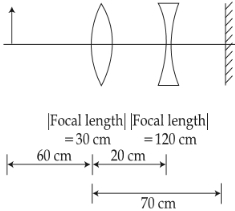
- (A) \(60\,cm\) from the convex lens
- (B) \(60\,cm\) from the concave lens
- (C) \(70\,cm\) from the convex lens
- (D) \(70\,cm\) from the concave lens
Show answer and solution
Correct Answer: (A)
Len's formula is given by\(\frac{1}{f}=\frac{1}{v}-\frac{1}{u}\)
For convex lens,
\(\frac{1}{30}=\frac{1}{v}+\frac{1}{60} \Rightarrow \frac{1}{60}=\frac{1}{v}\)
Similarly for concave lens
\(\frac{1}{-120}=\frac{1}{v}-\frac{1}{40} \Rightarrow \frac{1}{v}=\frac{1}{60}\)
Virtual object \(10\,\mathrm{cm}\) behind plane mirror.
Hencereal image \(10\,\mathrm{cm}\) infront of mirror or, \(60\,\mathrm{cm}\) from convex lens
-
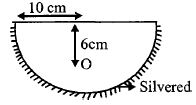
- (A) \(14\, cm\) below flat surface
- (B) \(20\, cm\) below flat surface
- (C) \(16\, cm\) below flat surface
- (D) \(30\, cm\) below flat surface
Show answer and solution
Correct Answer: (B)
Given, radius of herrispherical glass \(\mathrm{R}=10\, \mathrm{cm}\)\(\therefore\) Focal length \(\mathrm{f}=\frac{10}{2}=-5 \,\mathrm{cm}\)
\(\mathrm{u}=(10-6)=-4\, \mathrm{cm}\)
By using mirror formula,
\(\frac{1}{v}+\frac{1}{u}=\frac{1}{f} \Rightarrow \frac{1}{v}+\frac{1}{-4}=\frac{1}{-5}\)
\(\Rightarrow v=20 \,\mathrm{cm}\)
Apparen the height,
\(\mathrm{h}_{\mathrm{a}}=\mathrm{h}_{\mathrm{r}} \frac{\mu_{1}}{\mu_{2}}=30 \times \frac{1}{15}=20\, \mathrm{cm}\) below flat surface.
-
- (A) \(20\) times taller
- (B) \(20\) times nearer
- (C) \(10 \) times taller
- (D) \(10\) times nearer
Show answer and solution
Correct Answer: (B)
A telescope magnifies by making the object appering closer. -
- (A) \(1.7\)
- (B) \(1.8\)
- (C) \(1.5\)
- (D) \(1.6\)
Show answer and solution
Correct Answer: (C)
We know that \(i+e-A=\delta\)\(35^o+79^o-\mathrm{A}=40^o\) \(\therefore \quad \mathrm{A}=74^o\)
But \(\mu = \frac{{\sin \left( {\frac{{{\text{A}} + {\delta _{\text{m}}}}}{2}} \right)}}{{\sin {\text{A}}/2}}\) \( = \frac{{\sin \left( {\frac{{74 + {\delta _{\text{m}}}}}{2}} \right)}}{{\sin \frac{{74}}{2}}}\)
\( = \frac{5}{3}\sin \left( {{{37}^o} + \frac{{{\delta _{\text{m}}}}}{2}} \right)\)
\(\mu_{\max }\) can be \(\frac{5}{3}\). That is \(\mu_{\max }\) is less than \(\frac{5}{3}=1.67\)
But \(\delta_{\mathrm{m}}\) will be less than \(40^o\) so
\(\mu < \frac{5}{3}\sin {57^o}\) \( < \frac{5}{3}\sin {60^o}\) \( \Rightarrow \mu = 1.45\)
- 5. To determine refractive index of glass slab using a travelling microscope, minimum number of readings required are 2016 Medium
- (A) \(2\)
- (B) \(4\)
- (C) \(3\)
- (D) \(5\)
Show answer and solution
Correct Answer: (C)
Reading one \( \Rightarrow \) without slab
Reading two \( \Rightarrow \) with slab
Reading three \( \Rightarrow \) with saw dust
Minimum three readings are required to determine refractive index of glass slab using a travelling microscope -
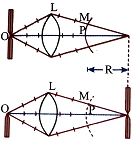
- (A) \(f_1 = 7.8\,cm\,\,\,\,\, f_2 = 12.7\,\,cm\)
- (B) \(f_1 = 12.7\,cm\,\,\,\,\, f_2 = 7.8\,\,cm\)
- (C) \(f_1 = 15.6\,cm\,\,\,\,\, f_2 = 25.4\,\,cm\)
- (D) \(f_1 = 7.8\,cm\,\,\,\,\, f_2 = 25.4\,\,cm\)
Show answer and solution
Correct Answer: (A)
From lens\(u_{1}=-(32.2-22.2) c m=-10 c m\)
\(v_{1}=(71.2-32.2) \mathrm{cm}=39 \mathrm{cm}\)
\(\frac{1}{f_{1}}=\frac{1}{v_{1}}-\frac{1}{u_{1}}=\frac{1}{36}+\frac{1}{10}=\frac{49}{390}\)
or \(f_{1}=\frac{390}{49} \mathrm{cm}=7.8 \mathrm{cm}\)
For mirror \(R=(71.2-45.8) \mathrm{cm}=25.4 \mathrm{cm}\)
or \(f_{2}=\frac{25.4}{2} \mathrm{cm}=12.7 \mathrm{cm}\)
No questions on this page match these filters.