


Questions
8 questionsShowing 1–8 of 8 questions
-
- (A) \(13.3\)
- (B) \(5.0\)
- (C) \(9.4\)
- (D) \(6.7\)
Show answer and solution
Correct Answer: (B)
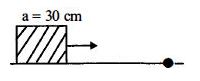
Angular momentum, \(mvr = I\omega \)momrnt of Inertia \((I)\) of cubical block is given by
\(\begin{array}{l}
I = m\left( {\frac{{{R^2}}}{6} + {{\left( {\frac{R}{{\sqrt 2 }}} \right)}^2}} \right)\\
\therefore \,\,\omega = \frac{{m.2\frac{R}{2}}}{{m\left( {\frac{{{R^2}}}{6} + {{\left( {\frac{R}{{\sqrt 2 }}} \right)}^2}} \right)}}\\
\Rightarrow \omega = \frac{{12}}{{8R}} = \frac{3}{{2 \times 0.3}} = \frac{{10}}{2} = 5\,rad/s.
\end{array}\) -
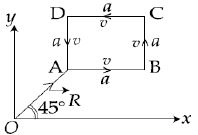
- (A) \(\;\left( a \right)\overrightarrow {\;L} \) \( = mv\left[ {\frac{R}{{\sqrt 2 }} + a} \right]\hat k\) ,when the particle is moving from \(B\) to \(C\)
- (B) \(\vec L\) \( = \frac{{mv}}{{\sqrt 2 }}\;R\;\hat k\) , when the particle is moving from \(D\) to \(A\)
- (C) \(\left( d \right)\overrightarrow {\;L} \) \( = mv\left[ {\frac{R}{{\sqrt 2 }} - a} \right]\hat k\) ,when the particle is moving from \(C\) to \(D\)
- (D) Both (b) and (c)
Show answer and solution
Correct Answer: (D)
\(\overrightarrow{\mathrm{L}}=\overrightarrow{\mathrm{r}} \times \overrightarrow{\mathrm{P}}\) or \(\overrightarrow{\mathrm{L}}=\mathrm{rpsin} \theta \hat{\mathrm{n}}\)\(\overrightarrow{\mathrm{L}}=\mathrm{r}_{\perp}(\mathrm{P}) \hat{\mathrm{n}}\)
For \(D\) to \(A\)
\(\overrightarrow{\mathrm{L}}=\frac{\mathrm{R}}{\sqrt{2}} \mathrm{mV}(-\hat{\mathrm{k}})\)
For \(A\) to \(B\)
\(\overrightarrow{\mathrm{L}}=\frac{\mathrm{R}}{\sqrt{2}} \mathrm{mV}(-\hat{\mathrm{k}})\)
For \(\mathrm{C}\) to \(\mathrm{D}\)
\(\overrightarrow{\mathrm{L}}=\left(\frac{\mathrm{R}}{\sqrt{2}}+\mathrm{a}\right) \mathrm{mV}(\hat{\mathrm{k}})\)
For \(B\) to \(C\)
\(\overrightarrow{\mathrm{L}}=\left(\frac{\mathrm{R}}{\sqrt{2}}+\mathrm{a}\right) \mathrm{mV}(\hat{\mathrm{k}})\)
-
- (A) go straight
- (B) tum left and right alternately
- (C) turn left
- (D) turn right
Show answer and solution
Correct Answer: (C)
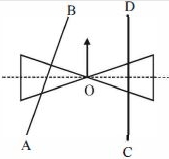
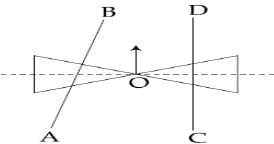
As shown in the diagram, the normal reaction of \(AB\) on roller will shift towards \(O\).This will lead to tending of the system of cones to trun left.
-
- (A) go straight
- (B) tum left and right alternately
- (C) turn left
- (D) turn right
Show answer and solution
Correct Answer: (C)
As shown in the diagram, the normal reaction of \(AB\) on roller will shift towards \(O\).This will lead to tending of the system of cones to trun left.
-
- (A) \(1.85\)
- (B) \(1.5\)
- (C) \(1.37\)
- (D) \(3\)
Show answer and solution
Correct Answer: (C)
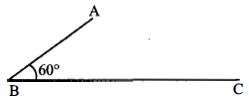
Center of mass\(\begin{array}{l}
{x_{cm}} = \frac{x}{2} = \frac{{\left( {\rho x} \right)\left( {\frac{x}{2}} \right)\frac{1}{2} + \rho y\left( {\frac{y}{2}} \right)}}{{\rho \left( {x + y} \right)}}\\
\Rightarrow \frac{1}{2} + \frac{y}{x} = \frac{{{y^2}}}{{{x^2}}}\\
\therefore \frac{{BC}}{{AB}} = \frac{y}{x} = \frac{{1 + \sqrt 3 }}{2} = 1.37
\end{array}\)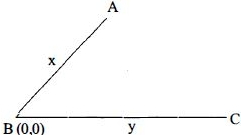
-
- (A) \(1.85\)
- (B) \(1.5\)
- (C) \(1.37\)
- (D) \(3\)
Show answer and solution
Correct Answer: (C)
Center of mass\(\begin{array}{l}
{x_{cm}} = \frac{x}{2} = \frac{{\left( {\rho x} \right)\left( {\frac{x}{2}} \right)\frac{1}{2} + \rho y\left( {\frac{y}{2}} \right)}}{{\rho \left( {x + y} \right)}}\\
\Rightarrow \frac{1}{2} + \frac{y}{x} = \frac{{{y^2}}}{{{x^2}}}\\
\therefore \frac{{BC}}{{AB}} = \frac{y}{x} = \frac{{1 + \sqrt 3 }}{2} = 1.37
\end{array}\)
No questions on this page match these filters.