


Questions
4 questionsShowing 1–4 of 4 questions
-
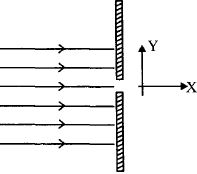
- (A) \(\left| {{P_y}} \right|d > h\)
- (B) \(\left| {{P_y}} \right|d < h\)
- (C) \(\left| {{P_y}} \right|d \simeq h\)
- (D) \(\left| {{P_y}} \right|d > > h\)
Show answer and solution
Correct Answer: (A)
From Bragg's equation\(d \sin \theta=\lambda\)
\(\sin \theta=\frac{\lambda}{d}<1\)
\(\therefore \lambda < d\)
\(\frac{h}{{\left| {{p_y}} \right|}} < d\) \(\left[ {\because \lambda = \frac{h}{{\left| {{p_y}} \right|}}} \right]\)
\(\therefore \quad h<\left|p_{y}\right| d\)
-
- (A) \(30\)
- (B) \(100\)
- (C) \(300\)
- (D) \(1\)
Show answer and solution
Correct Answer: (A)
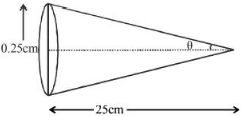
\(\sin \,\theta \, = \,\frac{{0.25}}{{25}}\, = \,\frac{1}{{100}}\)Resolving power \( = \,\frac{{1.22\,\lambda }}{{2\,\mu \,\sin \,\theta }}\, = \,30\,\mu m\)
-
- (A) \(\frac{\beta }{6}\)
- (B) \(\frac{\beta }{3}\)
- (C) \(\frac{\beta }{4}\)
- (D) \(\frac{\beta }{2}\)
Show answer and solution
Correct Answer: (C)
\(2 I_{0}=4 I_{0} \cos ^{2}\left(\frac{\Delta \phi}{2}\right) \quad\) here, \(\Delta \phi=\frac{\pi}{2}\)But, \(\Delta \phi=\frac{2 \pi}{\lambda} \Delta x\)
so, \(\Delta x=\frac{\lambda}{4}\)
\(\frac{d y}{D}=\frac{\lambda}{4}\) ..... \((i)\)
\({\frac{{\lambda D}}{d} = \beta }\) ..... \((ii)\)
Multiplying equation \((i)\) and \((ii)\) we get,
\(y=\frac{\beta}{4}\)
-
- (A) reflected light is completely polarized witih intensity less than \(\frac{I_0}{2}\)
- (B) transmitted light is completely polarized with intensity less than \(\frac{I_0}{2}\)
- (C) transmitted light is partially polarized with intensity \(\frac{I_0}{2}\)
- (D) reflected light is partially polarized with intensity \(\frac{I_0}{2}\)
Show answer and solution
Correct Answer: (A)
When unpolarised light is incident at Brewster 's angle then reflected light is completely polarized and the intensity of the reflected light is less than half of the incident light.
No questions on this page match these filters.