


Questions
3 questionsShowing 1–3 of 3 questions
-
- (A) \(0.4\, A\) and \(0.2\, A\)
- (B) \(0.2\, A\) and \(0.4\, A\)
- (C) \(0.1\, A\) and \(0.2\, A\)
- (D) \(0.2\, A\) and \(0.1\, A\)
Show answer and solution
Correct Answer: (A)
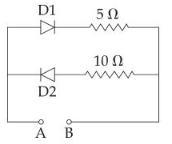
When positive terminal connected to \(A\) then diode \(D_1\) is forward biased, current \(I \, = \frac{2}{5} \, = 0.4\, A\)When positive terminal connected to \(B\) then diode \(D_2\) is forward biased, current, \(I\, = \frac{2}{10}\, = 0.2\,A\)
- 2. In an unbiased \(n-p\) junction electrons diffuse from \(n-\) region to \(p-\) region because 2015 Easy
- (A) holes in \(p-\) region attract them
- (B) electrons travel across the junction due to potential difference
- (C) only electrons move from \(n\) to \(p\) region and not the vice-versa
- (D) electron concentration in \(n-\) region is more compared to that in \(p-\) region
Show answer and solution
Correct Answer: (D)
Electrons in an unbiased \(p-n\) junction, diffuse from \(n -\) region \(i.e.\) higher electron concentration to \(p-\) region \(i.e.\) low electron concentration region. - 3. The value of the resistor, \(R_S\), needed in the \(dc\) voltage regulator circuit shown here, equals
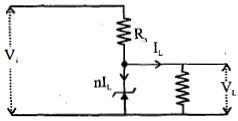 2015 Medium
- (A) \(\frac{{\left( {{V_i} - {V_L}} \right)}}{{\left( {n + 1} \right){I_L}}}\)
- (B) \(\frac{{\left( {{V_i} + {V_L}} \right)}}{{\left( {n + 1} \right){I_L}}}\)
- (C) \(\frac{{\left( {{V_i} - {V_L}} \right)}}{{n{I_L}}}\)
- (D) \(\frac{{\left( {{V_i} + {V_L}} \right)}}{{n{I_L}}}\)
Show answer and solution
Correct Answer: (A)
Voltage on resistor \(R_s\,=\,V_i\,-\,V_L\)or, \(({{I}_{L}}\,+\,n{{I}_{L}}){{R}_{s}}\,=\,{{V}_{i}}\,-\,{{V}_{L}}\)
\(\therefore \,\,{{R}_{s}}\,=\,\frac{\,{{V}_{i}}\,-\,{{V}_{L}}}{(n+\,1){{I}_{L}}}\)
No questions on this page match these filters.