


All JEE Mains 2015 Physics questions
27 chaptersShowing 51–75 of 75 questions
-
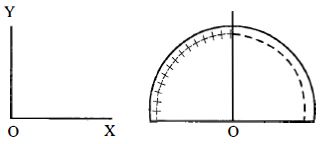
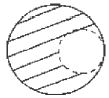
- (A) \(\frac{\sigma }{{4a{ \in _0}}}\)
- (B) \(\frac{\sigma }{{8a{ \in _0}}}\)
- (C) \(\frac{\sigma }{{a{ \in _0}}}\)
- (D) \(\frac{\sigma }{{2a{ \in _0}}}\)
Show answer and solution
Correct Answer: (A)
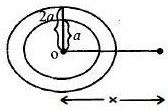
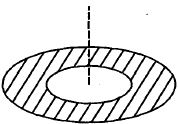
Eleatric field due to complete disc \((R=2 a)\) at a distance \(x\) and on its axis\(E_{1}=\frac{\sigma}{2 \varepsilon_{0}}\left[1-\frac{x}{\sqrt{R^{2}+x^{2}}}\right]\)
\(E_{1}=\frac{\sigma}{2 \varepsilon_{0}}\left[1-\frac{h}{\sqrt{4 a^{2}+h^{2}}}\right]\)
\( = \frac{\sigma }{{2{\varepsilon _0}}}\left[ {1 - \frac{h}{{2a}}} \right]\)
\(\left[ \begin{gathered}
{\text{ here }}x = h{\text{ }} \hfill \\
{\text{and }},R = 2a \hfill \\
\end{gathered} \right]\)Similarly, electric field due to disc \((R=a)\)
\(E_{2}=\frac{\sigma}{2 \varepsilon_{0}}\left(1-\frac{h}{a}\right)\)
Electric field due to given disc \(E=E_{1}-E_{2}\)
\(\frac{\sigma}{2 \varepsilon_{0}}\left[1-\frac{h}{2 a}\right]-\frac{\sigma}{2 \varepsilon_{0}}\left[1-\frac{h}{a}\right]-\frac{\sigma h}{4 \varepsilon_{0} a}\)
Hence, \(c=\frac{\sigma}{4 a \varepsilon_{0}}\)
-
- (A) \(\left( {50 \times {{10}^3}\,N/C} \right)\hat j\)
- (B) \(\left( {50 \times {{10}^3}\,N/C} \right)\hat i\)
- (C) \(\left( {25 \times {{10}^3}\,N/C} \right)\hat j\)
- (D) \(\left( {25 \times {{10}^3}\,N/C} \right)\hat i\)
Show answer and solution
Correct Answer: (D)
Given: Length of wire \(L=20 \,\mathrm{cm}\) charge \(Q=10^{3} \varepsilon_{0}\)We know, electric field at the centre of the semicircular arc
\({E=\frac{2 K \lambda}{r}}\)
\({\text{ or, }}\quad E = \frac{{2K\left( {\frac{{2Q}}{{\pi r}}} \right)}}{r}\left[ {As\,\lambda = \frac{{2Q}}{{\pi r}}} \right]\)
\(=\frac{4 K Q}{\pi r^{2}}=\frac{4 K Q \pi^{2}}{\pi L^{2}}=\frac{4 \pi K Q}{L^{2}}=25 \times 10^{3} \,N / C \hat{i}\)
-
- (A) \(\begin{array}{l}
{\sigma _1}\, \ne \,0,\,\,{Q_1}\, = \,0\\
{\sigma _2}\, = \,0,\,\,{Q_2}\, = \,0
\end{array}\) - (B) \(\begin{array}{l}
{\sigma _1}\, \ne \,0,\,\,{Q_1}\, = \,0\\
{\sigma _2}\, \ne \,0,\,\,{Q_2}\, = \,0
\end{array}\) - (C) \(\begin{array}{l}
{\sigma _1}\, = \,0,\,\,{Q_1}\, = \,0\\
{\sigma _2}\, = \,0,\,\,{Q_2}\, = \,0
\end{array}\) - (D) \(\begin{array}{l}
{\sigma _1}\, \ne \,0,\,\,{Q_1}\, \ne \,0\\
{\sigma _2}\, \ne \,0,\,\,{Q_2}\, \ne \,0
\end{array}\)
Show answer and solution
Correct Answer: (C)
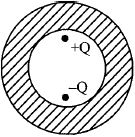
Inside the cavity net charge is zero.\(\therefore \quad Q_{1}=0\) and \(\sigma_{1}=0\)
There is no effect of point charges \(+Q\)
\(Q\) and induced charge on inner surface on the outer surface.
\(\therefore \quad Q_{2}=0\) and \(\sigma_{2}=0\)
- (A) \(\begin{array}{l}
-
- (A) \(8516\)
- (B) \(8258\)
- (C) \(8424\)
- (D) \(8000\)
Show answer and solution
Correct Answer: (A)
Reflected frequency of sound reaching bat\( = \left[ {\frac{{V - \left( {{V_0}} \right)}}{{V - {V_s}}}} \right]f = \left[ {\frac{{V + {V_0}}}{{V - {V_s}}}} \right]f = \frac{{V + 10}}{{V - 10}}f\)
\( = \left( {\frac{{320 + 10}}{{320 - 10}}} \right) \times 8000 = 8516Hz\)
-
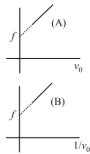
- (A) graph \(A\) with slope \( = \,\frac{{{f_0}}}{{\left( {v + {v_s}} \right)}}\)
- (B) graph \(B\) with slope \( = \,\frac{{{f_0}}}{{\left( {v - {v_s}} \right)}}\)
- (C) graph \(A\) with slope \( = \,\frac{{{f_0}}}{{\left( {v - {v_s}} \right)}}\)
- (D) graph \(B\) with slope \( = \,\frac{{{f_0}}}{{\left( {v + {v_s}} \right)}}\)
Show answer and solution
Correct Answer: (C)
According to Doppler's effect,Apparent, frequency \(f=\left(\frac{V+V_{0}}{V-V_{S}}\right) f_{0}\)
Now, \(f=\left(\frac{f_{0}}{V-V_{S}}\right) V_{0}+\frac{V f_{0}}{V-V_{s}}\)
So, slope \(=\frac{f_{0}}{V-V_{S}}\)
Hence, option \((c)\) is the correct answer.
-
- (A) \(12\)
- (B) \(18\)
- (C) \(24\)
- (D) \(6\)
Show answer and solution
Correct Answer: (A)
\(f_{1}=f\left[\frac{v}{v-v_{s}}\right]=f \times \frac{320}{300} \mathrm{Hz}\)\(f_{2}=f\left[\frac{v}{v+v_{s}}\right]=f \times \frac{320}{340} \mathrm{Hz}\)
\(\left(\frac{f_{2}}{f_{1}}-1\right) \times 100=\left(\frac{300}{340}-1\right) \times 100 \simeq 12 \%\)
-
- (A) \(52\)
- (B) \(65\)
- (C) \(39\)
- (D) \(26\)
Show answer and solution
Correct Answer: (C)
Required equivalent length\(=\frac{\rho_{\text {wood }}}{\rho_{\text {liquid }}} \times\) height of block
\(=\frac{650}{900} \times 54 \times 10^{-2}\)
\(\Rightarrow l=0.39 \mathrm{m}=39 \mathrm{cm}\)
-
- (A) \(\frac{1}{2}\)
- (B) \(\frac{1}{{30}}\ln \,3\)
- (C) \(2\)
- (D) \(\frac{1}{{15}}\ln \,3\)
Show answer and solution
Correct Answer: (D)
As we know, \(E=E_{0} e^{-\frac{b t}{m}}\)\(15=45 e^{-\frac{b 15}{m}}\)
[As no. of oscillations \(=15 \text { so } t=15 \mathrm{sec}]\)
\(\frac{1}{3}=e^{-\frac{b 15}{m}}\)
Taking log on both sides
\(\frac{b}{m}=\frac{1}{15} \ell \mathrm{n} 3\)
-
- (A) \(\sin \,t\, + \,\frac{1}{2}\,\cos \,2t\)
- (B) \(\cos \,t\, - \,\frac{1}{2}\,\sin \,2t\)
- (C) \(\sin \,t\, - \,\frac{1}{2}\,\sin \,2t\)
- (D) \(\sin \,t\, + \,\frac{1}{2}\,\sin \,2t\)
Show answer and solution
Correct Answer: (C)
As we know,\(F=m a \Rightarrow a \propto F\)
or, \(a \propto \sin t\)
\(\Rightarrow \frac{d v}{d t} \propto \sin t\)
\(\Rightarrow \int_{0}^{0} d V \propto \int_{0}^{t} \sin t d t\)
\(V \propto-\cos t+1\)
\(\int_{0}^{x} d x=\int_{0}^{t}(-\cos t+1) d t\)
\(x=\sin t-\frac{1}{2} \sin 2 t\) -
- (A) \(\left[ {{{\left( {\frac{{{T_M}}}{T}} \right)}^2} - 1} \right]\frac{{Mg}}{A}\;\;\;\;\;\;\)
- (B) \(\;\left[ {1 - {{\left( {\frac{{{T_M}}}{T}} \right)}^2}} \right]\frac{A}{{{M_g}}}\)
- (C) \(\;\left[ {1 - {{\left( {\frac{T}{{{T_M}}}} \right)}^2}} \right]\frac{A}{{{M_g}}}\)
- (D) \(\;\left[ {{{\left( {\frac{{{T_M}}}{T}} \right)}^2} - 1} \right]\frac{A}{{{M_g}}}\)
Show answer and solution
Correct Answer: (D)
As we know, time period, \(T=2 \pi \sqrt{\frac{\ell}{g}}\)\( When\, additional \,mass \mathrm\,{M}\) is added then
\(\mathrm{T}_{\mathrm{M}}=2 \pi \sqrt{\frac{\ell+\Delta \ell}{\mathrm{g}}}\)
\(T_{\frac{M}{T}}=\sqrt{\frac{\ell+\Delta \ell}{\ell}}\) or \(\left(\frac{T_{M}}{T}\right)^{2}=\frac{\ell+\Delta \ell}{\ell}\)
or, \(\left(\frac{T_{M}}{T}\right)^{2}=1+\frac{M g}{A y}\left[\because \Delta \ell=\frac{M g \ell}{A y}\right]\)
\(\therefore \frac{1}{y}=\left[\left(\frac{T_{M}}{T}\right)^{2}-1\right] \frac{A}{M g}\)
-
- (A) \(\frac{{3\gamma - 5}}{6}\;\;\;\;\;\;\;\;\;\;\;\;\;\;\;\;\)
- (B) \(\;\frac{{\gamma + 1}}{2}\)
- (C) \(\;\frac{{\gamma - 1}}{2}\)
- (D) \(\;\frac{{3\gamma + 5}}{6}\)
Show answer and solution
Correct Answer: (B)
\(\tau = \frac{1}{{\sqrt 2 \pi {d^2}\left( {\frac{N}{V}} \right)\sqrt {\frac{{3RT}}{M}} }}\)\(\tau \propto \frac{V}{{\sqrt T }}\)
\(As,\,T{V^{\gamma - 1}} = K\)
\(So,\,\tau \propto {V^{\gamma + 1/2}}\)
\(Therefore,\,q = \frac{{\gamma + 1}}{2}\)
-
- (A) \(\frac {1}{2}\)
- (B) \(2\)
- (C) \(\frac {1}{4}\)
- (D) \(1\)
Show answer and solution
Correct Answer: (D)
Pressure, \(P=\frac{1}{3} \frac{m N}{V} V_{r m s}^{2}\)or, \(\quad P=\frac{(m N) T}{V}\)
If the gas mass and temperature are constant then
\(P \propto\left(V_{\max }\right)^{2} \propto T\)
So, force \(\propto\left(V_{\text {rns }}\right)^{2} \propto T\)
i.e., Value of \(q=1\)
-
- (A) \(410\)
- (B) \(25\)
- (C) \(1850\)
- (D) \(925\)
Show answer and solution
Correct Answer: (D)
Using equipartition of energy, we have\(\frac{6}{2} K T=m C T\)
\(C=\frac{3 \times 1.38 \times 10^{-23} \times 6.02 \times 10^{23}}{27 \times 10^{-3}}\)
\(\therefore \mathrm{C}=925 \mathrm{J} / \mathrm{kgK}\)
-
- (A) \(ln \) \(2\),\(ln \) \(2\)
- (B) \(ln\) \(2\),\(2ln\) \(2\)
- (C) \(2\) \(ln\) \(2\),\(8ln\) \(2\)
- (D) \(ln\) \(2\),\(4ln\) \(2\)
Show answer and solution
Correct Answer: (A)
The entropy change of the body in the two cases is same as entropy is a state function. -
- (A) \(T \propto {e^{ - 3R}}\;\;\;\;\;\;\;\;\;\;\;\;\)
- (B) \(\;T \propto \frac{1}{R}\)
- (C) \(\;T \propto \frac{1}{{{R^3}}}\)
- (D) \(\;T \propto {e^{ - R}}\)
Show answer and solution
Correct Answer: (B)
\(As,\,P = \frac{1}{3}\left( {\frac{U}{V}} \right)\)\(But\frac{U}{V} = K{T^4}\)
\(So,P = \frac{1}{3}K{T^4}\)
\(or\,\frac{{uRT}}{V} = \frac{1}{3}K{T^4}\,\,\,\left[ {As\,PV = u\,RT} \right]\)
\(\frac{4}{3}\pi {R^3}{T^3} = constant\)
\(Therfore,T \propto \frac{1}{R}\)
-
- (A) \(560\)
- (B) \(550\)
- (C) \(540\)
- (D) \(530\)
Show answer and solution
Correct Answer: (B)
\(As\,{p_t} = mC\Delta T\)\(So,\,p \times 10 \times 60 = m\,C\,100\,\,\,...\left( i \right)\)
\(and\,p \times 55 \times 60 = mL\,\,\,\,\,\,\,\,\,...\left( {ii} \right)\)
Dividing equation \((i)\) by \((ii)\) we get
\(\frac{{10}}{{55}} = \frac{{C \times 100}}{L}\)
\(\therefore L = 550\,cal/g.\)
-
- (A) \(\frac {T}{R}\)
- (B) \(\frac {4T}{R}\)
- (C) \(\frac {T}{4R}\)
- (D) \(\frac {2T}{R}\)
Show answer and solution
Correct Answer: (D)
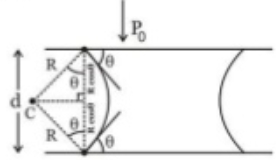
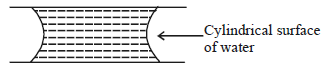
\(d=2 R \cos \theta\)Pressure difference across a double curvature film \(\Delta P=2 T\left(\frac{1}{R_{1}}+\frac{1}{R_{2}}\right)\)
\(\because \quad R_{1}=R\) and \(R_{2}=\infty\)
\(\Delta P=2 T\left(\frac{1}{R}+\frac{1}{\infty}\right)\)
\(\Delta P=\frac{2T}{R}\)
-
- (A) \(1100\)
- (B) \(11,000\)
- (C) \(550\)
- (D) \(5500\)
Show answer and solution
Correct Answer: (D)
Given: Diameter of water tap \( = \frac{2}{{\sqrt \pi }}\,cm\)\(\therefore \,\,Radius,\,r = \frac{1}{{\sqrt \pi }} \times {10^{ - 2}}\,m\)
\(\frac{{dm}}{{dt}} = \rho AV\)
\(\frac{{15}}{{5 \times 60}} = {10^3} \times \pi {\left( {\frac{1}{{\sqrt \pi }}} \right)^2} \times {10^{ - 4}}V\)
\( \Rightarrow V = 0.05\,m/s\)
Reynold's number, \({R_e} = \frac{{\rho Vr}}{n}\)
\( = \frac{{{{10}^3} \times 0.5 \times \frac{2}{{\sqrt \pi }}{{10}^{ - 2}}}}{{{{10}^{ - 3}}}} \cong 5500\)
-
- (A) \(\frac{{m{v^2}}}{{2\left( {L - nr} \right)}}\)
- (B) \(\frac{{m{v^2}}}{{L - 2nr}}\)
- (C) \(\frac{{m{v^2}}}{{L - nr}}\)
- (D) zero
Show answer and solution
Correct Answer: (B)
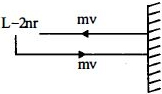
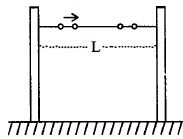
Space between the supports rm for motion of beads is \(L - 2nr\)Average force experinced by each support \(F = \frac{{2mv}}{{\frac{{2\left( {L - 2nr} \right)}}{V}}} =\frac{{m{V^2}}}{{L - 2nr}}\)
-
- (A) \(T\, \propto \,r\)
- (B) \(T\, \propto \,\sqrt r\)
- (C) \(T\, \propto \,r^2\)
- (D) \(T^2\, \propto \,r^3\)
Show answer and solution
Correct Answer: (A)
\(F = \frac{{2GM}}{{Lr}}m\,\,or,\,\,\frac{{m{v^2}}}{r} = \frac{{2GM}}{{Lr}}m\)\(mr{\left( {\frac{{2\pi }}{T}} \right)^2} = \frac{{2GMm}}{{Lr}}\left[ {v = r\omega \,and\,\omega = \frac{{2\pi }}{T}} \right]\)
\( \Rightarrow \,\,T \propto r\)
-
- (A) \(\frac{{ - GM}}{R}\)
- (B) \(\;\frac{{ - 2GM}}{{3R}}\)
- (C) \(\;\frac{{ - 2GM}}{R}\)
- (D) \(\;\frac{{ - GM}}{{2R}}\)
Show answer and solution
Correct Answer: (A)
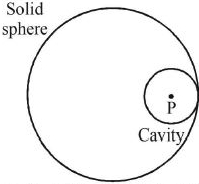
Due to complete solid sphere, potential at point \(p\)\({V_{sphere}} = \frac{{ - GM}}{{2{R^3}}}\left[ {3{R^2} - {{\left( {\frac{R}{2}} \right)}^2}} \right]\)
\( = \frac{{ - GM}}{{2{R^3}}}\left( {\frac{{11{R^2}}}{4}} \right) = - 11\frac{{GM}}{{8R}}\)
Due to cavity part potential at point \(P\)
\({V_{cavity}} = - \frac{3}{2}\frac{{\frac{{GM}}{8}}}{{\frac{R}{2}}} = - \frac{{3GM}}{{8R}}\)
So potential at the center of carvity
\( = {V_{sphere}} - {V_{cavity}} = - \frac{{11GM}}{{8R}} - \left( { - \frac{3}{8}\frac{{GM}}{R}} \right)\)
\( = \frac{{ - GM}}{R}\)
-
- (A) \(0.05\)
- (B) \(0.02\)
- (C) \(0.03\)
- (D) \(0.04\)
Show answer and solution
Correct Answer: (D)
\(f =\mu (M + m) g\)\(\begin{gathered}
a = \frac{f}{{M + m}} = \frac{{\mu \left( {M + m} \right)g}}{{(M + m)}} = \mu g \hfill \\
= 0.05 \times 10 = 0.5\,m{s^{ - 2}} \hfill \\
{V_0} = \frac{{Initial\,momentum\,}}{{\left( {M + m} \right)}} = \frac{{0.05V}}{{10.05}} \hfill \\
m = 50g\,\,\,\,\,\,\,\,\,\,\,\,M = 10\,kg \hfill \\
\end{gathered} \)\({\left( {\frac{{0.05v}}{{10.05}}} \right)^2} = 2 \times 0.5 \times 2\)
Solving we get \(v = 201\sqrt 2 \) object falling from height \(H.\)
\(\begin{gathered}
\frac{V}{{10}} = \sqrt {2gh} \hfill \\
\frac{{201\sqrt 2 }}{{10}} = \sqrt {2 \times 10 \times H} \hfill \\
\end{gathered} \)\(H = 40\; m = 0.04\; km\)
\(\begin{gathered}
{v^2} - {u^2} = 2as \hfill \\
0 - {u^2} = 2as \hfill \\
{u^2} = 2as \hfill \\
\end{gathered} \)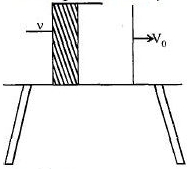
-
- (A) \(\frac{1}{2}\alpha {r^3}\)
- (B) \(\frac{5}{6}\alpha {r^3}\)
- (C) \(\frac{4}{3}\alpha {r^3}\)
- (D) \(\alpha {r^3}\)
Show answer and solution
Correct Answer: (B)
As we Known, \(dU = F.dr\)\(\begin{gathered}
U = \int\limits_0^r {\alpha {r^2}} dr = \frac{{a{r^3}}}{3}\,\,\,\,\,\,\,\,\,\,\,\,\,\,...\left( i \right) \hfill \\
As,\,\,\frac{{m{v^2}}}{r} = \alpha {r^2} \hfill \\
\Rightarrow \,\frac{1}{2}m{v^2} = \frac{{\alpha \,{r^3}}}{2} \hfill \\
or,\,\,\left( {KE} \right) = \frac{1}{2}\,\alpha {r^3}\,\,\,\,\,\,\,\,\,\,\,\,\,\,...\left( {ii} \right) \hfill \\
\end{gathered} \)Total energy = Potential energy + kinetic energy
Now, from eqn \((i)\) and \((ii)\)
Total energy \(= K.E. + P.E.\)
\( = \frac{{\alpha {r^3}}}{3} + \frac{{\alpha {r^3}}}{2} = \frac{5}{6}\alpha {r^3}\)
-
- (A) \(50\)
- (B) \(56\)
- (C) \(62 \)
- (D) \(44\)
Show answer and solution
Correct Answer: (B)
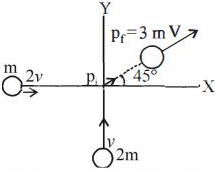
Initial momentum of the system\({p_i} = \sqrt {\left[ {m{{\left( {2V} \right)}^2} \times m{{\left( {2V} \right)}^2}} \right]} \)
\( = \sqrt 2 m \times 2V\)
Final momentum of the system\( = 3mV\)
By the law of conservation of momentum
\(2\sqrt 2 mv \times 3mV\)
\( \Rightarrow \frac{{2\sqrt 2 v}}{3} = {V_{combined}}\)
Loss in energy
\(\Delta E = \frac{1}{2}{m_1}V_1^2 + \frac{1}{2}{m_2}V_2^2 - \frac{1}{2}\left( {{m_1} + {m_2}} \right)V_{combined}^2\)
\(\Delta E = 3m{v^2} - \frac{4}{3}m{v^2} = \frac{5}{3}m{v^2} = 55.55\% \)
Percentage loss in energy during the collision \(=56\%\)
-
- (A) \(\left| {\vec A} \right|\,\Delta \theta \)
- (B) \(\left| {\vec B} \right|\,\Delta \theta - \left| {\vec A} \right|\,\)
- (C) \(\left| {\vec A} \right|\,\left( {1 - \frac{{\Delta {\theta ^2}}}{2}} \right)\)
- (D) \(0\)
Show answer and solution
Correct Answer: (A)
\(\begin{array}{l}
Arc\,length\, = \,radius \times angle\\
So,\,\left| {\vec B - \vec A} \right| = \left| {\vec A} \right|\Delta \theta
\end{array}\)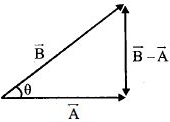
No questions on this page match these filters.