


JEE Mains · Physics · STD 12 - 3. current electricity
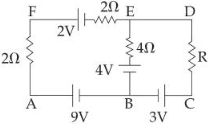
In the electric network shown, when no current flows through the \(4\, \Omega \) resistor in the arm \(EB\), the potential difference between the points \(A\) and \(D\) will be ............... \(V\)
- A \(6\)
- B \(3\)
- C \(5\)
- D \(4\)
Answer & Solution
Correct Answer
(C) \(5\)
Step-by-step Solution
Detailed explanation
As no current flows through arm \(E B\) then \(\mathrm{V}_{\mathrm{D}}=0\, \mathrm{V}\) \(\mathrm{V}_{\mathrm{E}}=0\, \mathrm{V}\) \(\mathrm{v}_{\mathrm{B}}=-4 \,\mathrm{V}\) \(\mathrm{V}_{\mathrm{A}}=5 \,\mathrm{V}\) So, potential difference between the points \(A\) and \(D\)…
See the Complete Solution
Get step-by-step explanations for this and 2.5 Lakh+ more JEE, NEET & CET questions.
- Unlock all solutions
- Practice the full chapter
- Track accuracy across PYQs
4.8 rated on Google Play · 14,000+ reviews
More questions from Physics
- A copper wire of length \(1.0\, m\) and a steel wire of length \(0.5\, m\) having equal cross-sectional areas are joined end to end. The composite wire is stretched by a certain load which stretches the copper wire by \(1\, mm\). If the Young's modulii of copper and steel are respectively \(1.0\times10^{11}\, Nm^{-2}\) and \(2.0\times10^{11}\, Nm^{- 2}\), the total extension of the composite wire is ........ \(mm\)JEE Mains 2013 Medium
- Given below are two statements : Statement \(I:\) If the Brewster's angle for the light propagating from air to glass is \(\theta_{ B }\), then Brewster's angle for the light propagating from glass to air is \(\frac{\pi}{2}-\theta_B\). Statement \(II:\) The Brewster's angle for the light propagating from glass to air is \(\tan ^{-1}\left(\mu_{ g }\right)\) where \(\mu_{ g }\) is the refractive index of glass. In the light of the above statements, choose the correct answer from the options given below :JEE Mains 2023 Medium
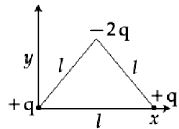
- Determine the electric dipole moment of the system of three charges, placed on the vertices of an equilateral triangle, as shown in the figure
 JEE Mains 2019 Hard
 - A mass of \(50\, {kg}\) is placed at the centre of a uniform spherical shell of mass \(100\, {kg}\) and radius \(50 \,{m}\). If the gravitational potential at a point, \(25\, {m}\) from the centre is \({V} \,{kg} / {m} .\) The value of \({V}\) isJEE Mains 2021 Medium
- Two moles a monoatomic gas is mixed with six moles of a diatomic gas. The molar specific heat of the mixture at constant volume is _______.JEE Mains 2024 Hard
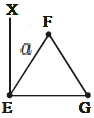
- An massless equilateral triangle \(EFG\) of side \('a'\) (As shown in figure) has three particles of mass \(m\) situated at its vertices. The moment of intertia of the system about the line \(EX\) perpendicular to \(EG\) in the plane of \(EFG\) is \(\frac{ N }{20}\, ma ^{2}\) where \(N\) is an integer. The value of \(N\) is
 JEE Mains 2020 Medium
More PYQs from JEE Mains
- The current in a coil of self inductance \(2.0 \,H\) is increasing according to \(I =2 \sin \left( t ^{2}\right) A\). The amount of energy spent during the period when current changes from \(0\) to \(2\, A\) is......\(J.\)JEE Mains 2022 Medium
- The value of \(\alpha\) for which \(4 \alpha \int\limits_{-1}^{2} \mathrm{e}^{-\alpha \mathrm{|x|} } \mathrm{d} \mathrm{x}=5,\) isJEE Mains 2020 Hard
- Two vertical poles \(AB =15 m\) and \(CD =10 m\) are standing apart on a horizontal ground with points \(A\) and \(C\) on the ground. If \(P\) is the point of intersection of \(BC\) and \(AD ,\) then the height of \(P\) (in \(m\) ) above the line \(AC\) isJEE Mains 2020 Medium
- If \(0<\theta, \phi<\frac{\pi}{2}, x =\sum_{ n =0}^{\infty} \cos ^{2 n } \theta, y =\sum_{ n =0}^{\infty} \sin ^{2 n } \phi\) and \(z =\sum_{ n =0}^{\infty} \cos ^{2 n } \theta \cdot \sin ^{2 n } \phi\) thenJEE Mains 2021 Hard
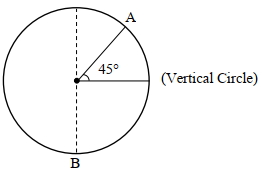
- A body of \(\mathrm{m} \mathrm{kg}\) slides from rest along the curve of vertical circle from point \(A\) to \(B\) in friction less path. The velocity of the body at \(B\) is _______. (given, \(\mathrm{R}=14 \mathrm{~m}, \mathrm{~g}=10 \mathrm{~m} / \mathrm{s}^2\) and \(\sqrt{2}=1.4\) )
 JEE Mains 2024 Hard
 - Let \(\lambda^{*}\) be the largest value of \(\lambda\) for which the function \(f _{\lambda}( x )=4 \lambda x ^{3}-36 \lambda x ^{2}+36 x +48\) is increasing for all \(x \in R\). Then \(f _{\lambda} *(1)+ f _{\lambda} *(-1)\) is equal toJEE Mains 2022 Hard