


Questions
4 questionsShowing 1–4 of 4 questions
-
- (A) \(30\)
- (B) \(15\)
- (C) \(60\)
- (D) \(1\)
Show answer and solution
Correct Answer: (A)
Magnifying power of telescope,\(M P=\frac{\tan \beta( \text { angle subtended by image at eye piece) } }{\tan \alpha \text { (angle subtended by object on objective) }}\)
Also, \(M P =\frac{f_{o}}{f_{e}}=\frac{150}{5}=30\)
\(\tan \alpha =\frac{50}{1000}=\frac{1}{20}\, \mathrm{rad}\)
\(\therefore \quad \tan \beta=\theta=M P \times \tan \alpha\)
\(=30 \times \frac{1}{20}=\frac{3}{2}=1.5\)
or, closest value of \(\beta \approx 60^o\)
-
- (A) \(3f\)
- (B) \(\frac{3}{2}f\)
- (C) \(f\)
- (D) \(2f\)
Show answer and solution
Correct Answer: (D)
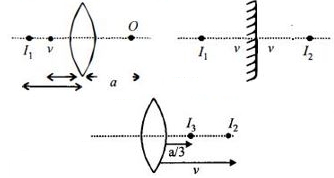
When object is keept at a distance \('a'\) from thin covex lensBy lens formula: \(\frac{1}{v}-\frac{1}{u}=\frac{1}{f}\)
\(\frac{1}{V}-\frac{1}{(-a)}=\frac{1}{f}\)
or, \(\frac{1}{v}=\frac{1}{f}-\frac{1}{a}\) ...... \((i)\)
Mirror forms image at equal distance from mirror
Now, again from lens formula
\(\frac{3}{a}-\frac{1}{V}=\frac{1}{f}\)
\({\frac{3}{a} - \frac{1}{f} + \frac{1}{a} = \frac{1}{f}}\) [From eqn. \((i)\)]
Hence, \(a=2f\)
-
- (A) \(\theta < Si{n^{ - 1}}\left[ {\mu sin\left( {A - si{n^{ - 1}}\left( {\frac{1}{\mu }} \right)} \right)} \right]\)
- (B) \(\;\theta > co{s^{ - 1}}\left[ {\mu sin\left( {A + si{n^{ - 1}}\left( {\frac{1}{\mu }} \right)} \right)} \right]\)
- (C) \(\;\theta < co{s^{ - 1}}\left[ {\mu sin\left( {A + si{n^{ - 1}}\left( {\frac{1}{\mu }} \right)} \right)} \right]\)
- (D) \(\theta > Si{n^{ - 1}}\left[ {\mu sin\left( {A - si{n^{ - 1}}\left( {\frac{1}{\mu }} \right)} \right)} \right]\)
Show answer and solution
Correct Answer: (D)
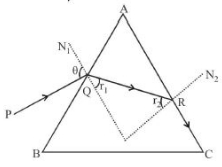
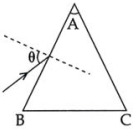
When \({{\text{r}}_2} = {\text{C}},\) \(\angle {{\text{N}}_2}{\text{Rc}} = {90^o}\)Where \(C=\) critical angle
As \(\sin C=\frac{1}{v}=\sin r_{2}\)
Applying snell's law at \('R'\)
\(\mu \,\,\sin {r_2} = 1\,\,\sin {90^o}\) ..... \((i)\)
Applying snell's law at \('Q'\)
\(1 \times \sin \theta=\mu \sin r_{1}\) ...... \((ii)\)
But \(r_{1}=A-r_{2}\)
So, \(\sin \theta=\mu \sin \left(A-r_{2}\right)\)
\(\sin \theta=\mu \sin A \cos r_{2}-\cos A\) ...... \((iii)\) [using \((i)\) ]
From \(( 1 )\)
\(\cos r_{2}=\sqrt{1-\sin ^{2} r_{2}}=\sqrt{1-\frac{1}{\mu^{2}}}\) ..... \((iv)\)
By eq. \((iii)\) and \((iv)\)
\(\sin \theta=\mu \sin A \sqrt{1-\frac{1}{\mu^{2}}}-\cos A\)
on further solving we can show for raynot to transmitted through face \(AC\)
\(\theta=\sin ^{-1}\left[u \sin \left(A-\sin ^{-1}\left(\frac{1}{\mu}\right)\right]\right.\)
So, for transmission through face \(\mathrm{AC}\)
\(\theta > {\sin ^{ - 1}}\) \(\left[ {u\sin \left( {A - {{\sin }^{ - 1}}\left( {\frac{1}{\mu }} \right)} \right]} \right.\)
-
- (A) \(60\)
- (B) \(-24\)
- (C) \(-60\)
- (D) \(24\)
Show answer and solution
Correct Answer: (C)
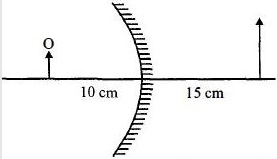
convex mirror is used as a shaving mirror.From question \(: v=15\, \mathrm{cm}, u=-10\,\mathrm{cm}\)
Radius of curvature, \(R=2\,\,f=?\)
Using mirror formula, \(\frac{1}{v}+\frac{1}{u}=\frac{1}{f}\)
\(\frac{1}{15}+\frac{1}{(-10)}=\frac{1}{f} \Rightarrow f=-30\, \mathrm{cm}\)
Therefore radius of curvature,
\(R=2\, \,f=-\,60\, \mathrm{cm}\)
No questions on this page match these filters.