


Questions
6 questionsShowing 1–6 of 6 questions
-
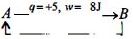
- (A) \(10\, J\) of the work will be done by the gas
- (B) \(6\, J\) of the work will be done by the gas
- (C) \(10\, J\) of the work will be done by the surrounding on gas
- (D) \(6\, J\) of the work will be done by the surrounding on gas.
Show answer and solution
Correct Answer: (D)
\(\Delta {U_{AB}} = q + w = + 5 + ( - 8) = - 3\)\(q = - 3,\,\Delta {U_{BA}} = + 3\)
\(\Delta {U_{BA}} = q + w\)
\( \Rightarrow 3 = - 3 + w \Rightarrow w = + 6\)
(work done on the system)
-
- (A) enthalpy increases but entropy decreases
- (B) enthalpy remains constant but entropy increases
- (C) enthalpy decreases but entropy increases.
- (D) Both enthalpy and entropy remain constant.
Show answer and solution
Correct Answer: (B)
\(\Delta H = n{c_p}\Delta T = 0\) means \(\Delta H\) constant.\(\Delta S = nR\,\ln {\kern 1pt} \left( {\frac{{{v_f}}}{{{v_i}}}} \right) \geqslant 0\) \(\Delta S\) increases.
- 3. For a reaction, \(A(g) \to A(l)\); \(\Delta H = - 3RT\). The correct statement for the reaction is 2017 Hard
- (A) \(\Delta H = \Delta U \ne O\)
- (B) \(\Delta H = \Delta U = O\)
- (C) \(\left| {\Delta H} \right| < \left| {\Delta U} \right|\)
- (D) \(\left| {\Delta H} \right| > \left| {\Delta U} \right|\)
Show answer and solution
Correct Answer: (D)
\(A(g) \to A(1)\)\(\Delta H = \Delta U + \Delta {n_g}RT\)
Given, \(\Delta H = - 3RT\)
Here
\(\Delta {n_g} = {n_p} - {n_r} = 0 - 1 = - 1\)
\(\Delta H = \Delta U - RT\)
\( \Rightarrow - 3RT = \Delta U - RT\)
\( \Rightarrow - 3RT + RT = \Delta U\)
\( \Rightarrow - 2RT = \Delta U\)
\(|\Delta H|\, > \,|\Delta U|\)
-
- (A) \(+ 74.8\)
- (B) \(+ 144.0\)
- (C) \(- 74.8\)
- (D) \(- 144.0\)
Show answer and solution
Correct Answer: (C)
\(C(graphite) +\mathrm{O}_{2}(\mathrm{g}) \rightarrow \mathrm{CO}_{2}(\mathrm{g})\) \(\Delta_{r} H^{\circ}=-393.55\,\mathrm{kJ}\, \mathrm{mol}^{-1}\)\(\mathrm{H}_{2}(\mathrm{g})+\frac{1}{2} \mathrm{O}_{2}(\mathrm{g}) \rightarrow \mathrm{H}_{2} \mathrm{O}(\mathrm{l}) ; \)\(\quad \Delta_{r} H^{\circ}=-285.8\, \mathrm{kJ}\, \mathrm{mol}^{-1}\)
\(\mathrm{CO}_{2}(\mathrm{g})+2 \mathrm{H}_{2} \mathrm{O}(\mathrm{l}) \rightarrow \mathrm{CH}_{4}(\mathrm{g})+2 \mathrm{O}_{2}(\mathrm{g}) ;\)\( \Delta_{r} H^{\circ}=+890.3\,\mathrm{kJ}\,\mathrm{mol}^{-1}\)
\(C(graphite) +2 \mathrm{H}_{2}(\mathrm{g}) \rightarrow \mathrm{CH}_{4}(\mathrm{g}) ; \)\(\quad \Delta_{r} H^{\circ}=?\)
Now, Eq. \((4)= \) Eq. \((1)+2 \times\) Eq. \((2)+\) Eq. \(( 3)\)
\(\Delta_{r} H^{\circ}=-393.55+2(-285.8)+890.3\)
\(=-74.8\,\mathrm{kJ} \,\mathrm{mol}^{-1}\)
-
- (A) \(5.44\)
- (B) \(5.81\)
- (C) \(6.56\)
- (D) \(6\)
Show answer and solution
Correct Answer: (C)
In order to calculate the enthalpy change for \(H_2O\) at \(5\,^oC\) to ice at \(-\,5\,^oC\) , we need to calculated the enthalpy change of all the transformation involved in the process.\((a)\) Energy change of \(1\,mol\), \(H_2O\,(l)\), at \(5\,^oC\)
\(\to \,1\,mol\), \(H_2O\,(l)\) , \(0\,^oC\)
\((b)\) Energy change of \(1\,mol\), \(H_2O\,(l)\), at \(0\,^oC\)
\(\to \,1\,mol\), \(H_2O\,(s)\) (ice) , \(0\,^oC\)
\((c)\) Energy change of \(1\,mol\), Ice \((s)\), at \(0\,^oC\)
\(\to \,1\,mol\), Ice \((s)\) , \(-5\,^oC\)
Total \(\Delta H\)
\( = \,{C_P}\,[{H_2}O\,(l)]\,\,\Delta T\,\, + \,\Delta H\) freezing \( + \,\,{C_P}\,[{H_2}O\,(s)]\,\,\Delta T\)
\( = \,(75.3\,\,J\,\,mo{l^{ - 1}}\,{K^{ - 1}})\,( - 5)\,K\, + ( - \,6\, \times \,{10^3}\,\,J\,mo{l^{ - 1}}\,{K^{ - 1}})\) \(+ \,(36.8\,\,J\,mo{l^{ - 1}}\,{K^{ - 1}})\,( - 5)\,K\)
\(\Delta H\,\, = \,\, - \,6.56\,\,kJ\,mo{l^{ - 1}}\) (exothermic process)
So, \(\Delta H\,\, = \,\,6.56\,\,kJ\,mo{l^{ - 1}}\)
-
- (A) lsochoric work
- (B) Isobaric work
- (C) Adiabatic work
- (D) Isothermal work
Show answer and solution
Correct Answer: (C)
\(\Delta U = Q +\Delta W\)In adiabatic process no exchange of heat occurs between system and surrounding so \(Q =0\).
Thus, \(\Delta U\) is equal to adiabatic work.
No questions on this page match these filters.