


JEE Mains · Chemistry · STD 12 - Haloalkanes and Haloarenes
- JEE Mains 2017
- Hard
- MCQ
The major product of the following reaction is \(\,\begin{array}{*{20}{c}}
{C{H_3} - CH - C{H_2} - CH - C{H_2} - C{H_3}}\\
{\,\,\,\,\,\,\,\,\,\,\,\,\,\,\,\,\,\,\,\,\,\,\,\,\,\,\,\,\,\,|\,\,\,\,\,\,\,\,\,\,\,\,\,\,\,\,\,\,\,\,\,\,\,\,\,\,\,\,\,\,\,\,\,\,\,|\,\,\,\,\,\,\,\,\,\,\,\,\,\,\,\,\,\,\,\,\,\,\,\,\,\,\,\,\,\,\,\,\,\,\,\,\,\,\,\,\,\,\,\,\,\,\,\,\,\,\,\,}\\
{\,\,\,\,\,\,\,\,\,Br\,\,\,\,\,\,\,\,\,\,\,\,\,\,\,\,\,\,\,\,\,\,\,\,\,\,\,\,\,\,\,Br\,\,\,\,\,\,\,\,\,\,\,\,\,\,\,\,\,\,\,\,\,\,\,\,\,\,\,\,\,\,}
\end{array}\) \(\xrightarrow[{heat}]{{KOH,\,C{H_3}OH}}\)
Pick an option to check your answer.
Answer & Solution
Correct Answer
(D) \(CH_3CH = CH - CH = CHCH_3\)
Step-by-step Solution
Detailed explanation
\(\,\begin{array}{*{20}{c}}
{C{H_3} - CH - C{H_2} - CH - C{H_2} - C{H_3}}\\
{\,\,\,\,\,\,\,\,\,\,\,\,\,\,\,\,\,\,\,\,\,\,\,\,\,\,\,\,\,\,|\,\,\,\,\,\,\,\,\,\,\,\,\,\,\,\,\,\,\,\,\,\,\,\,\,\,\,\,\,\,\,\,\,\,\,|\,\,\,\,\,\,\,\,\,\,\,\,\,\,\,\,\,\,\,\,\,\,\,\,\,\,\,\,\,\,\,\,\,\,\,\,\,\,\,\,\,\,\,\,\,\,\,\,\,\,\,\,}\\
{\,\,\,\,\,\,\,\,\,Br\,\,\,\,\,\,\,\,\,\,\,\,\,\,\,\,\,\,\,\,\,\,\,\,\,\,\,\,\,\,\,Br\,\,\,\,\,\,\,\,\,\,\,\,\,\,\,\,\,\,\,\,\,\,\,\,\,\,\,\,\,\,}
\end{array}\) \(\xrightarrow[{{E_2}}]{{KOH,\,C{H_3}OH\,\Delta }}\) \(\mathop {C{H_3} - CH = CH - CH = CH - C{H_3}}\limits_{{\text{(Saytzeff product)}}} \)
More questions from Chemistry
- Arrange the following orbitals in decreasing order of energy ? \((A)\) \(n =3,1=0, m =0\) \((B)\) \(n =4, l =0, m =0\) \((C)\) \(n =3, l =1, m =0\) \((D)\) \(n =3, l =2, m =1\) The correct option for the order is :JEE Mains 2023 Medium
- \(Pt ( s ) H _2( g )(1 bar )\left| H ^{+}( aq )(1 M )\right|\left| M ^{3+}( aq ), M ^{+}( aq )\right| Pt ( s )\) The \(E _{\text {ceil }}\) for the given cell is \(0.1115\,V\) at \(298\,K\) when \(\frac{\left[ M ^{+}( aq )\right]}{\left[ M ^{3+}( aq )\right]}=10^{ a }\) The value of a is Given : \(E _{ M ^{3+} / M ^{+}}=0.2\,V\) \(\frac{2.303 RT }{ F }=0.059\,V\)JEE Mains 2023 Hard
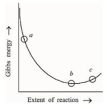
- Consider the graph of \(G i b b s\) free energy \(G\) vs Extent of reaction. The number of statement/s from the following which are true with respect to points \((a), (b)\) and \((c)\) is \(.................\) \(A.\)Reaction is spontaneous at \((a)\) and \((b)\) \(B.\)Reaction is at equilibrium at point \((b)\) and nonspontaneous at point \((c)\) \(C.\)Reaction is spontaneous at \((a)\) and nonspontaneous at \((c)\) \(D.\)Reaction is non-spontaneous at \((a)\) and \((b)\)
 JEE Mains 2023 Medium
- \(80\) mole percent of \(MgCl _2\) is dissociated in aqueous solution. The vapour pressure of \(1.0\) molal aqueous solution of \(MgCl _2\) at \(38^{\circ} C\) is \(.........\,mm\,Hg\). (Nearest integer)Given : Vapour pressure of water at \(38^{\circ} C\) is \(50\,mm\,Hg\)JEE Mains 2023 Medium
- \(1.22\, \mathrm{~g}\) of an organic acid is separately dissolved in \(100 \,\mathrm{~g}\) of benzene \(\left(\mathrm{K}_{\mathrm{b}}=2.6\, \mathrm{~K}\, \mathrm{~kg} \,\mathrm{~mol}^{-1}\right)\) and \(100\, \mathrm{~g}\) of acetone \(\left(\mathrm{K}_{b}=1.7\, \mathrm{~K} \,\mathrm{~kg} \,\mathrm{~mol}^{-1}\right) .\) The acid is known to dimerize in benzene but remain as a monomer in acetone. The boiling point of the solution in acetone increases by \(0.17^{\circ} \mathrm{C}\). The increase in boiling point of solution in benzene in \({ }^{\circ} \mathrm{C}\) is \(\mathrm{x} \times 10^{-2}\). The value of \(\mathrm{x}\) is ..... .(Nearest integer) \([\) Atomic mass : \(\mathrm{C}=12.0, \mathrm{H}=1.0, \mathrm{O}=16.0]\)JEE Mains 2021 Hard
- An organic compound (P) on treatment with aqueous ammonia under hot condition forms compound (Q) which on heating with \( \text{Br}_2 \) and \( \text{KOH} \) forms compound (R) having molecular formula \( \text{C}_6\text{H}_7\text{N} \). Names of P, Q and R respectively are:JEE Mains 2026 Hard
More PYQs from JEE Mains
- Using a battery, a 100 pF capacitor is charged to 60 V and then the battery is removed. After that, a second uncharged capacitor is connected to the first capacitor in parallel. If the final voltage across the second capacitor is 20 V, its capacitance is : (in pF)JEE Mains 2025 Medium
- Given below are two statements : Statement \(I :\) In 'Lassaigne's Test, when both nitrogen and sulphur are present in an organic compound, sodium thiocyanate is formed. Statement \(II :\) If both nitrogen and sulphur are present in an organic compound, then the excess of sodium used in sodium fusion will decompose the sodium thiocyanate formed to give \(NaCN\) and \(Na _{2} S\). In the light of the above statements, choose the most appropriate answer from the options given below...JEE Mains 2022 Medium
- Assume a cell with the following reaction \(\mathrm{Cu}_{(\mathrm{s})}+2 \mathrm{Ag}^{+}\left(1 \times 10^{-3} \,\mathrm{M}\right) \rightarrow \mathrm{Cu}^{2+}(0.250\, \mathrm{M})+2 \mathrm{Ag}_{(\mathrm{s})}\) \(\mathrm{E}_{\mathrm{Cell}}^{\ominus}=2.97\, \mathrm{~V}\) \(\mathrm{E}_{\text {cell }}\) for the above reaction is \(....\,V.\) (Nearest integer) [Given : \(\log 2.5=0.3979, T=298\, \mathrm{~K}]\)JEE Mains 2021 Hard
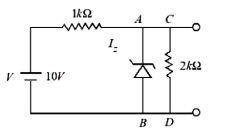
- In the given circuit, the breakdown voltage of the Zener diode is \(3.0 \mathrm{~V}\). What is the value of \(\mathrm{I}_z\) ?
 JEE Mains 2024 Hard
- A charge particle of \(2\,\mu\,C\) accelerated by a potential difference of \(100\,V\) enters a region of uniform magnetic field of magnitude \(4\,m\,T\) at right angle to the direction of field. The charge particle completes semicircle of radius \(3\,cm\) inside magnetic field. The mass of the charge particle is \(........\times 10^{-18}\,kg\).JEE Mains 2023 Medium
- Water of mass \(m\) gram is slowly heated to increase the temperature from \(T_1\) to \(T_2\) The change in entropy of the water, given specific heat of water is \(1 \mathrm{Jkg}^{-1} \mathrm{~K}^{-1}\), is :JEE Mains 2025 Medium