


JEE Mains · Chemistry · STD 12 - Haloalkanes and Haloarenes
- JEE Mains 2017
- Hard
- MCQ
The increasing order of the reactivity of the following halides for the \(S_N1\) reaction is \((I)\,\begin{array}{*{20}{c}}
{C{H_3}CHC{H_2}C{H_3}} \\
{|\,\,\,\,\,\,\,\,\,\,\,} \\
{Cl\,\,\,\,\,\,\,\,\,}
\end{array}\) \((II)\,CH_3CH_2CH_2Cl\) \((III)\,H_3CO-C_6H_4-CH_2Cl\)
Pick an option to check your answer.
Answer & Solution
Correct Answer
(B) \((II) < (I) < (III)\)
Step-by-step Solution
Detailed explanation
Secondary, tertiary and benzylic halides appear to react by a mechanism that involves the formation of a carbocation and proceeds through \(\mathrm{S}_{\mathrm{N}} 1\) mechanism which takes place in two steps. The first step is the slow step \(-\) it is the rate-determining step. In this step, a molecule of alkyI halide ionizes and becomes an alkyl cation. Therefore, greater the stability of carbocation greater will be its tendency to react via \(S_{N} 1\) mechanism.
\(\mathrm{R}-\mathrm{X} \rightleftharpoons \mathrm{R}^{+}+\mathrm{X}^{-}\)
In the second step, the intermediate alkyl cation reacts rapidly with water to produce alcohol.
\(\mathrm{R}^{+}+\mathrm{H}_{2} \mathrm{O} \rightleftharpoons \mathrm{ROH}\)
Hence, the order of reactivity of halides for the \(\mathrm{S}_{\mathrm{N}} 1\) mechanism is \(\mathrm{II}<\mathrm{I}<\mathrm{III}\).
More questions from Chemistry
- x mg of pure HCl was used to make an aqueous solution. 25.0 mL of \(0.1 M Ba ( OH )_2\) solution is used when the HCl solution was titrated against it. The numerical value of x is _________ \(\times 10^{-1}\). (Nearest integer)
Given : Molar mass of HCl and \(Ba ( OH )_2\) are 36.5 and \(171.0 g mol ^{-1}\) respectively.JEE Mains 2026 Medium - The half-life period of a first order reaction is \(15\,minutes\). The amount of substance left after one hour will beJEE Mains 2014 Hard
- Match the List - I with List - II
Choose the correct answer from the options given below :List-I
(Chloro derivative)List-II
(Example)A. Vinyl Chloride I. \(CH _2= CH - CH _2 Cl\) B. Benzyl chloride II. \(CH _3= CH ( Cl ) CH _3\) C. Alkyl chloride III. \(CH _2= CHCl\) D. Allyl chloride IV. 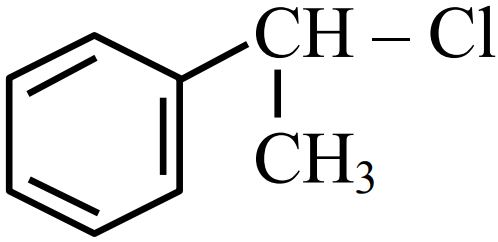 JEE Mains 2026 Medium
- Which among the following react with Hinsberg's reagent?
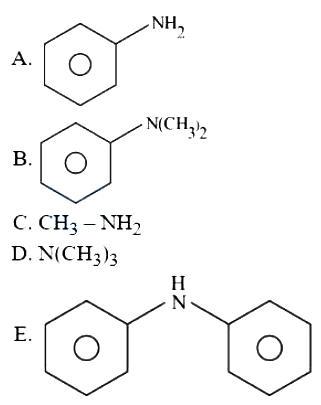
Choose the correct answer from the options given below:JEE Mains 2025 Easy - \(40\, \mathrm{~g}\) of glucose (Molar mass \(=180\) ) is mixed with \(200\, \mathrm{~mL}\) of water. The freezing point of solution is \(.....\,\mathrm{K}\). (Nearest integer) [Given : \(\mathrm{K}_{\mathrm{f}}=1.86 \,\mathrm{~K} \,\mathrm{~kg} \,\mathrm{~mol}^{-1} ;\) Density of water \(=\) \(1.00 \,\mathrm{~g}\, \mathrm{~cm}^{-3} ;\) Freezing point of water \(\left.=273.15\, \mathrm{~K}\right]\)JEE Mains 2021 Medium
- Consider all the structural isomers with molecular formula \(C _5 H _{11} Br\) are separately treated with KOH (aq) to give respective substitution products, without any rearrangement. The number of products which can exhibit optical isomerism from these is_________ .JEE Mains 2026 Hard
More PYQs from JEE Mains
- Given below are two statements: Statement \(I:\) For a planet, if the ratio of mass of the planet to its radius increases, the escape velocity from the planet also increases. Statement \(II:\) Escape velocity is independent of the radius of the planet. In the light of above statements, choose the most appropriate answer from the options given below on :JEE Mains 2023 Medium
- The range of the projectile projected at an angle of \(15^{\circ}\) with horizontal is \(50\,m\). If the projectile is projected with same velocity at an angle of \(45^{\circ}\) with horizontal, then its range will be \(........\,m\)JEE Mains 2023 Medium
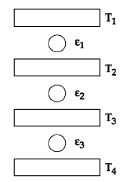
- Three Carnot engines operate in series between a heat source at a temperature \(T_1\) and a heat sink at temperature \(T_4\) (see figure). There are two other reservoirs at temperature \(T_2\) and \(T_3\), as shown, with \(T_1 > T_2 > T_3 > T_4\). The three engines are equally efficient if
 JEE Mains 2019 Hard
- Two light waves of wavelengths \(800\) and \(600\,nm\) are used in Young's double slit experiment to obtain interference fringes on a screen placed \(7\,m\) away from plane of slits. If the two slits are separated by \(0.35\,mm\), then shortest distance from the central bright maximum to the point where the bright fringes of the two wavelength coincide will be \(.............mm\).JEE Mains 2023 Medium
- Solid fuel used in rocket is a mixture of \(Fe _2 O _3\) and \(Al\) (in ratio \(1: 2\) ). The heat evolved \(( kJ )\) per gram of the mixture is \(............\). (Neatest integer) Given : \(\Delta H _{ f }^{\ominus}\left( Al _2 O _3\right)=-1700\,kJ\,mol ^{-1}\) \(\Delta H _{ f }^\theta\left( Fe _2 O _3\right)=-840\,kJ\,mol ^{-1}\) Molar mass of \(Fe , Al\) and \(O\) are \(56,27\) and \(16\,g\,mol ^{-1}\) respectively.JEE Mains 2023 Medium