


JEE Mains · Physics · STD 12 - Electric charges and fields
- JEE Mains 2024
- Hard
- Numerical
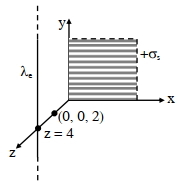
An infinite plane sheet of charge having uniform surface charge density \(+\sigma_5 \mathrm{C} / \mathrm{m}^2\) is placed on \(\mathrm{x}-\mathrm{y}\) plane. Another infinitely long line charge having uniform linear charge density \(+\lambda_e \mathrm{C} / \mathrm{m}\) is placed at \(z=4 \mathrm{~m}\) plane and parallel to \(y\)-axis. If the magnitude values \(\left|\sigma_s\right|=2\left|\lambda_{\mathrm{e}}\right|\) then at point \((0,0,2)\), the ratio of magnitudes of electric field values due to sheet charge to that of line charge is \(\pi \sqrt{\mathrm{n}}: 1\). The value of \(n\) is _______.
Pick an option to check your answer.
Answer & Solution
Correct Answer
(A) \(16\)
Step-by-step Solution
Detailed explanation
Explanation:
Let us calculate the ratio of the electric fields step-by-step based on the Electric Charges and Fields chapter of the NCERT Class 12 Physics textbook:
Step 1: Electric field due to an infinite plane sheet of charge (\(E_s\))
The magnitude of the electric field produced by an infinite plane sheet of charge with uniform surface charge density \(\sigma_s\) at any given point is independent of its distance from the sheet and is expressed as:
\(E_s = \frac{\sigma_s}{2\varepsilon_0}\)
Step 2: Electric field due to an infinitely long straight line charge (\(E_l\))
The magnitude of the electric field produced by an infinitely long line charge with uniform linear charge density \(\lambda_e\) at a perpendicular distance \(r\) from the line is given by:
\(E_l = \frac{\lambda_e}{2\pi\varepsilon_0 r}\)
Step 3: Determine the perpendicular distance (\(r\)) from the line charge to the point
- The infinite sheet lies on the flat \(x-y\) plane where \(z = 0\).
- The line charge is parallel to the \(y\)-axis on the \(z = 4\text{ m}\) plane, meaning it effectively passes through the cross-section coordinates \(x = 0, z = 4\text{ m}\).
- The target test point is located at \((0,0,2)\), where \(z = 2\text{ m}\).
Thus, the absolute perpendicular distance \(r\) from the line charge to the test point is:
\(r = |4 - 2| = 2\text{ m}\)
Step 4: Calculate the ratio of the magnitudes of the electric fields
Taking the ratio of the sheet's field strength (\(E_s\)) to the line's field strength (\(E_l\)):
\(\frac{E_s}{E_l} = \frac{\left(\frac{\sigma_s}{2\varepsilon_0}\right)}{\left(\frac{\lambda_e}{2\pi\varepsilon_0 r}\right)} = \frac{\sigma_s \cdot \pi r}{\lambda_e}\)
Substituting the given relationship \(|\sigma_s| = 2|\lambda_e|\) and the calculated distance \(r = 2\text{ m}\) into the equation:
\(\frac{E_s}{E_l} = \frac{(2\lambda_e) \cdot \pi \cdot 2}{\lambda_e} = 4\pi = \frac{4\pi}{1}\)
Step 5: Compute the final value of \(n\)
We are given that this field magnitude ratio is equal to \(\pi\sqrt{n} : 1\):
\(\pi\sqrt{n} = 4\pi\)
\(\sqrt{n} = 4\)
Squaring both sides of the relation yields:
\(n = 16\)
Hence, Option A is the correct choice.
Let us calculate the ratio of the electric fields step-by-step based on the Electric Charges and Fields chapter of the NCERT Class 12 Physics textbook:
Step 1: Electric field due to an infinite plane sheet of charge (\(E_s\))
The magnitude of the electric field produced by an infinite plane sheet of charge with uniform surface charge density \(\sigma_s\) at any given point is independent of its distance from the sheet and is expressed as:
\(E_s = \frac{\sigma_s}{2\varepsilon_0}\)
Step 2: Electric field due to an infinitely long straight line charge (\(E_l\))
The magnitude of the electric field produced by an infinitely long line charge with uniform linear charge density \(\lambda_e\) at a perpendicular distance \(r\) from the line is given by:
\(E_l = \frac{\lambda_e}{2\pi\varepsilon_0 r}\)
Step 3: Determine the perpendicular distance (\(r\)) from the line charge to the point
- The infinite sheet lies on the flat \(x-y\) plane where \(z = 0\).
- The line charge is parallel to the \(y\)-axis on the \(z = 4\text{ m}\) plane, meaning it effectively passes through the cross-section coordinates \(x = 0, z = 4\text{ m}\).
- The target test point is located at \((0,0,2)\), where \(z = 2\text{ m}\).
Thus, the absolute perpendicular distance \(r\) from the line charge to the test point is:
\(r = |4 - 2| = 2\text{ m}\)
Step 4: Calculate the ratio of the magnitudes of the electric fields
Taking the ratio of the sheet's field strength (\(E_s\)) to the line's field strength (\(E_l\)):
\(\frac{E_s}{E_l} = \frac{\left(\frac{\sigma_s}{2\varepsilon_0}\right)}{\left(\frac{\lambda_e}{2\pi\varepsilon_0 r}\right)} = \frac{\sigma_s \cdot \pi r}{\lambda_e}\)
Substituting the given relationship \(|\sigma_s| = 2|\lambda_e|\) and the calculated distance \(r = 2\text{ m}\) into the equation:
\(\frac{E_s}{E_l} = \frac{(2\lambda_e) \cdot \pi \cdot 2}{\lambda_e} = 4\pi = \frac{4\pi}{1}\)
Step 5: Compute the final value of \(n\)
We are given that this field magnitude ratio is equal to \(\pi\sqrt{n} : 1\):
\(\pi\sqrt{n} = 4\pi\)
\(\sqrt{n} = 4\)
Squaring both sides of the relation yields:
\(n = 16\)
Hence, Option A is the correct choice.
More questions from Physics
- This question has Statement \(- 1\) and Statements \(- 2\). Of the four choices given after the Statements, choose the one that best describes the two Statements Statement \(-1\) : Out of radio waves and microwaves, the radio waves under go more diffraction Statement \(-2\) : Radio waves have greater frequency compared to microwavesJEE Mains 2013 Easy
- Two stars of masses \(3\times10^{31}\, kg\) each, and at distance \(2\times10^{11}\, m\) rotate in a plane about their common centre of mass \(O. A\) meteorite passes through \(O\) moving perpendicular to the star’s rotation plane. In order to escape from the gravitational field of this double star, the minimum speed that meteorite should have at \(O\) is : (Take Gravitational constant \(G = 6.67\times10^{-11}\, Nm^2\, kg^{-2}\))JEE Mains 2019 Medium
- The induced \(emf\) can be produced in a coil by \(A.\) moving the coil with uniform speed inside magnetic field \(B.\) moving the coil with non-uniform speed inside uniform magnetic field \(C.\) rotating the coil inside the uniform magnetic field \(D.\) changing the area of the coil inside the uniform magnetic field Choose the correct answer from the options given below:JEE Mains 2023 Medium
- A moving coil galvanometer allows a full scale current of \(10^{-4}\, A\). A series resistance of \(2\, M\,\Omega \) is required to convert the above galvanometer into a voltmeter of range \(0 -5\, V\). Therefore the value of shunt resistance required to convert the above galvanometer into a ammeter of range \(0-10\, mA\) is....\(\Omega \)JEE Mains 2019 Medium
- A Carnot's engine working between \(400\, K\) and \(800\, K\) has a work output of \(1200\, J\) per cycle. The amount of heat energy supplied to the engine from the source in each cycle is ........... \(J\)JEE Mains 2021 Medium
- If time \((t)\), velocity \((u)\), and angular momentum \((I)\) are taken as the fundamental units. Then the dimension of mass \(({m})\) in terms of \({t}, {u}\) and \({I}\) isJEE Mains 2021 Medium
More PYQs from JEE Mains
- Given below are two statements: one is labelled as Assertion \(A\) and the other is labelled as Reason \(R\). Assertion \(A :\) The escape velocities of planet \(A\) and \(B\) are same. But \(A\) and \(B\) are of unequal mass. Reason \(R :\) The product of their mass and radius must be same, \(M _{1} R _{1}= M _{2} R _{2}\) In the light of the above statements, choose the most appropriate answer from the options given belowJEE Mains 2021 Medium
- A particle of mass \(1\, {kg}\) is hanging from a spring of force constant \(100\, {Nm}^{-1 .}\) The mass is pulled slightly downward and released so that it executes free simple harmonic motion with time period \({T}\). The time when the kinetic energy and potential energy of the system will become equal, is \(\frac{{T}}{{x}}\). The value of \({x}\) is ..... .JEE Mains 2021 Hard
- The planet Mars has two moons, if one of them has a period \(7\, hours,\, 30\, minutes\) and an orbital radius of \(9.0 \times 10^{3}\, {km} .\) Find the mass of Mars. \(\left\{\operatorname{Given} \frac{4 \pi^{2}}{G}=6 \times 10^{11} {N}^{-1} {m}^{-2} {kg}^{2}\right\}\)JEE Mains 2021 Medium
- A vessel contains \(0.15\) m\(^3\) of a gas at pressure \(8\) bar and temperature \(140°\)C with \(c_p = 3R\) and \(c_v = 2R\). It is expanded adiabatically till pressure falls to \(1\) bar. The work done during this process is _______ kJ. (\(R\) is gas constant)JEE Mains 2026 Hard