


JEE Mains · Physics · STD 11 - 13. oscillations
A particle performs simple harmonic motion with amplitude \(A\). Its speed is trebled at the instant that it is at a distance \(\frac{{2A}}{3}\) from equilibrium position. The new amplitude of the motion is
- A \(A\)\(\sqrt 3 \;\;\;\;\;\;\;\;\;\;\;\;\;\;\;\;\;\;\;\;\;\;\)
- B \(\;\frac{{7A}}{3}\)
- C \(\;\frac{A}{3}\sqrt {41} \)
- D \(3A\)
Answer & Solution
Correct Answer
(B) \(\;\frac{{7A}}{3}\)
Step-by-step Solution
Detailed explanation
Let new amplitude is \(A'\) initial velocity \(v^{2}=\omega^{2}\left(A^{2}-\left(\frac{2 A}{3}\right)^{2}\right)\) \(...(1)\) Where \(A\) is initial amplitude \(\&\, \omega\) is angular frequency. Final velocity…
See the Complete Solution
Get step-by-step explanations for this and 2.5 Lakh+ more JEE, NEET & CET questions.
- Unlock all solutions
- Practice the full chapter
- Track accuracy across PYQs
4.8 rated on Google Play · 14,000+ reviews
More questions from Physics
- In a Young's double slit experiment, the intensity at a point is \(\left(\frac{1}{4}\right)^{\text {th }}\) of the maximum intensity, the minimum distance of the point from the central maximum is _______ \(\mu \mathrm{m}\). (Given : \(\lambda=600 \mathrm{~nm}, d=1.0 \mathrm{~mm}, \mathrm{D}=1.0 \mathrm{~m}\) )JEE Mains 2024 Hard
- A uniform sphere of mass \(500\; g\) rolls without slipping on a plane horizontal surface with its centre moving at a speed of \(5.00\; \mathrm{cm} / \mathrm{s}\). Its kinetic energy isJEE Mains 2020 Medium
- Ten charges are placed on the circumference of a circle of radius \(R\) with constant angular separation between successive charges. Alternate charges \(1,3,5,7,9\) have charge \((+q)\) each, while \(2,4,6,8,10\) have charge \((-q)\) each. The potential \(V\) and the electric field \(E\) at the centre of the circle are respectively (Take \(V =0\) at infinity \()\)JEE Mains 2020 Hard
- \(n-\) \(moles\) of an ideal gas with constant volume heat capacity \(C_v\) undergo an isobaric expansion by certain volume. The ratio of the work done in the process, to the heat supplied isJEE Mains 2019 Medium
- An \(X-\)ray tube is operated at \(1.24\) million volt. The shortest wavelength of the produced photon will be ..... \(nm\)JEE Mains 2021 Medium
- An asteroid is moving directly towards the centre of the earth. When at a distance of \(10 \mathrm{R}\) (\(R\) is the radius of the earth) from the earths centre, it has a speed of \(12 \;\mathrm{km} / \mathrm{s}\). Neglecting the effect of earths atmosphere, what will be the speed of the asteroid when it hits the surface of the earth (escape velocity from the earth is \(11.2 \;\mathrm{km} / \mathrm{s}\) ) \(?\) Give your answer to the nearest integer in \(km/s\)JEE Mains 2020 Hard
More PYQs from JEE Mains
- The mean and variance of a data of 10 observations are 10 and 2, respectively. If an observation \( \alpha \) in this data is replaced by \( \beta \), then the mean and variance become 10.1 and 1.99, respectively. Then \( \alpha+\beta \) equals.JEE Mains 2026 Medium
- \(5\,g\) and radius \(1\,cm\) is fixed to a thin stick \(AB\) of negligible mass as shown in the figure. The system is initially at rest. The constant torque, that will make the system rotate about \(AB\) at \(25\) rotations per second in \(5\,s\) is close to
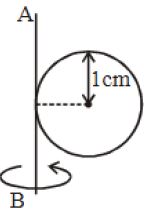 JEE Mains 2019 Medium
 - If the system of linear equations \(x_1 + 2x_2 + 3x_3 = 6\) ; \(x_1 + 3x_2 + 5x_3 = 9\) ; \(2x_1 + 5x_2 + ax_3 = b\) is consistent and has infinite number of solutions, thenJEE Mains 2013 Hard
- \(x * y=x^{2}+y^{3}\) and \((x * 1) * 1=x *(1 * 1)\). Then a value of \(2 \sin ^{-1}\left(\frac{x^{4}+x^{2}-2}{x^{4}+x^{2}+2}\right)\) isJEE Mains 2022 Hard
- A body of mass \(1 kg\) begins to move under the action of a time dependent force \(\vec{F}=\left(t \hat{i}+3 t^2 \hat{ j }\right) N\). where \(\hat{i}\) and \(\hat{j}\) are the unit vectors along \(x\) and \(y\) axis. The 10.Power developed by above force, at the time \(t=2 s\). will be \(..............W\).JEE Mains 2023 Medium
- Let \(y=y(x)\) be the solution of the differential equation \(e^{x} \sqrt{1-y^{2}} d x+\left(\frac{y}{x}\right) d y=0, y(1)=-1\) Then the value of \((y(3))^{2}\) is equal to:JEE Mains 2021 Hard