


JEE Mains · Physics · STD 11 - 9.1 fluid mechanics
An air bubble of volume \(1\,cm ^3\) rises from the bottom of a lake \(40\,m\) deep to the surface at a temperature of \(12^{\circ}\,C\). The atmospheric pressure is \(1 \times 10^5 Pa\), the density of water is \(1000\,kg / m ^3\) and \(g =10\,m / s ^2\). There is no difference of the temperature of water at the depth of \(40\,m\) and on the surface. The volume of air bubble when it reaches the surface will be \(..........\,cm^{3}\)
- A \(5\mathrm{~cm}^3\)
- B \(2\mathrm{~cm}^3\)
- C \(4\mathrm{~cm}^3\)
- D \(3\mathrm{~cm}^3\)
Answer & Solution
Correct Answer
(A) \(5\mathrm{~cm}^3\)
Step-by-step Solution
Detailed explanation
\(P = P _0+\rho gh =10^5\,Pa +10^3 \times 10 \times 40=5 \times 10^5\,Pa\) At \(T\) is constant \(PV = P _0 V _0\) \(\Rightarrow 5 \times 10^5\,Pa \times 1\,cm ^3=10^5 Pa \times V _0 \Rightarrow V _0=5\,cm ^3\)
See the Complete Solution
Get step-by-step explanations for this and 2.5 Lakh+ more JEE, NEET & CET questions.
- Unlock all solutions
- Practice the full chapter
- Track accuracy across PYQs
4.8 rated on Google Play · 14,000+ reviews
More questions from Physics
- The frequency \((v)\) of an oscillating liquid drop may depend upon radius \((r)\) of the drop, density \((\rho)\) of liquid and the surface tension \((s)\) of the liquid as : \(v=r^{ a } \rho^{ b } s ^{ c }\). The values of \(a , b\) and \(c\) respectively areJEE Mains 2023 Medium
- One \(kg\) of water, at \(20\,^oC\), is heated in an electric kettle whose heating element has a mean (temperature averaged) resistance of \(20\, \Omega \). The rms voltage in the mains is \(200\, V\). Ignoring heat loss from the kettle, time taken for water to evaporate fully, is close to.......... \(\min\) [Specific heat of water \(= 4200\, J/kg\, ^oC\)), Latent heat of water \(= 2260\, k\,J/kg\)]JEE Mains 2019 Hard
- Amplitude of a mass-spring system, which is executing simple harmonic motion decreases with time. If mass \(=500\, g\), Decay constant \(=20 \,g / s\) then ...... \(s\) time is required for the amplitude of the system to drop to half of its initial value ? \((\ln 2=0.693)\)JEE Mains 2021 Hard
- In a Young's double slit experiment, the distance between the two identical slits is \(6.1\) times larger than the slit width. Then the number of intensity maxima observed with in the central maximum of the single slit diffraction pattern isJEE Mains 2014 Medium
- Potential energy as a function of \(r\) is given by \(U=\frac{ A }{ r ^{10}}-\frac{ B }{ r ^{5}}\), where \(r\) is the interatomic distance, \(A \) and \(B\) are positive constants. The equilibrium distance between the two atoms will beJEE Mains 2022 Medium
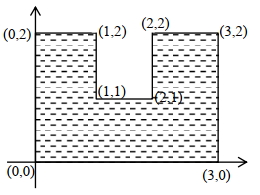
- A uniform thin metal plate of mass \(10 \mathrm{~kg}\) with dimensions is shown. The ratio of \(x\) and \(y\) coordinates of center of mass of plate in \(\frac{n}{9}\). The value of \(n\) is _______.
 JEE Mains 2024 Hard
More PYQs from JEE Mains
- The set of all real values of \(\lambda\) for which the function \(f(x)=\left(1-\cos ^{2} x\right) \cdot(\lambda+\sin x)\) \(x \in\left(-\frac{\pi}{2}, \frac{\pi}{2}\right),\) has exactly one maxima and exactly one minima, isJEE Mains 2020 Hard
- Two coaxial discs, having moments of inertia \(I_1\) and \(\frac{I_1}{2}\) are a rotating with respectively angular velocities \(\omega_1\) and \(\frac{\omega_1}{2}\), about their common axes. They are brought in contact with each other and thereafter they rotate with a common angular velocity. If \(E_f\) and \(E_i\) are the final and initial total energies, then \((E_f -E_i)\) isJEE Mains 2019 Hard
- Let \({a_1},{a_2},\;.\;.\;.\;.,{a_{49}}\) be in \(A.P.\) such that \(\mathop \sum \limits_{k = 0}^{12} {a_{4k + 1}} = 416\) and \({a_9} + {a_{43}} = 66\). If \(a_1^2 + a_2^2 + \ldots + a_{17}^2 = 140m,\) then \(m = \;\;..\;.\;.\;.\;\)JEE Mains 2018 Hard
- Let \(B\) and \(C\) be the two points on the line \(y+x=0\) such that \(B\) and \(C\) are symmetric with respect to the origin. Suppose \(A\) is a point on \(y -2 x =2\) such that \(\triangle ABC\) is an equilateral triangle. Then, the area of the \(\triangle ABC\) isJEE Mains 2023 Hard
- Let \(E\) and \(F\) be two independent events. The probability that both \(E\) and \(F\) happen is \(\frac{1}{12}\) and the probability that neither \(E\) nor \(F\) happens is \(\frac{1}{2}\) , then a value of \(\frac{{P(E)}}{{P\left( F \right)}}\) isJEE Mains 2017 Hard
- Earth has mass 8 times and radius 2 times that of a planet. If the escape velocity from the earth is \(11.2 \mathrm{~km} / \mathrm{s}\), the escape velocity in \(\mathrm{km} / \mathrm{s}\) from the planet will be :JEE Mains 2025 Easy