


JEE Mains · Physics · STD 12 - Ray optics and optical instruments
- JEE Mains 2022
- Medium
- Numerical
In an experiment with a convex lens. The plot of the image distance (\(v'\)) against the object distance \(\left(\mu^{\prime}\right)\) measured from the focus gives a curve \(v^{\prime} \mu^{\prime}=225\). If all the distances are measured in \(cm\). The magnitude of the focal length of the lens is \(cm\).
Pick an option to check your answer.
Answer & Solution
Correct Answer
(B) \(15\)
Step-by-step Solution
Detailed explanation
\(vu = f ^{2}\) (by Newton's formula)
\(f ^{\prime}=225\)
\(f =15\,cm\)
More questions from Physics
- The ratio of surface tensions of mercury and water is given to be \(7.5\) while the ratio of their densities is \(13.6\). Their contact angles, with glass, are close to \(135^o\) and \(0^o\), respectively. It is observed that mercury gets depressed by an amount \(h\) in a capillary tube of radius \(r_1\), while water rises by the same amount \(h\) in a capillary tube of radius \(r_2\). The ratio, \((r_1/r_2)\), is then close toJEE Mains 2019 Medium
- A light wave described by \(E =60 \sin \left(3 \times 10^{15}\right) t + \sin \left(12 \times 10^{15}\right)\) t] (in SI units) falls on a metal surface of work function 2.8 eV . The maximum kinetic energy of ejected photoelectron is (approximately) _________ eV .JEE Mains 2026 Medium
- A spherical body of mass \(2\,kg\) starting from rest acquires a kinetic energy of \(10000\,J\) at the end of \(5^{\text {th }}\) second. The force acted on the body is \(.....N\)JEE Mains 2023 Medium
- A circular loop of radius \(r\) is carrying current I A. The ratio of magnetic field at the centre of circular loop and at a distance \(r\) from the center of the loop on its axis is:JEE Mains 2023 Medium
- Which of the following are correct expression for torque acting on a body?
A. \(\vec{\tau}=\vec{r}\times\vec{L}\)
B. \(\vec{\tau}=\frac{\mathrm{d}}{\mathrm{dt}}(\overrightarrow{\mathrm{r}} \times \overrightarrow{\mathrm{p}})\)
C. \(\vec{\tau}=\overrightarrow{\mathrm{r}} \times \frac{\mathrm{d} \mathrm{p}}{\mathrm{dt}}\)
D. \(\vec{\tau}=\mathrm{I} \vec{\alpha}\)
E. \(\vec{\tau}=\overrightarrow{\mathrm{r}} \times \overrightarrow{\mathrm{F}}\)
( \(\overrightarrow{\mathrm{r}}=\) position vector; \(\overrightarrow{\mathrm{p}}=\) linear momentum;
\(\overrightarrow{\mathrm{L}}=\) angular momentum; \(\vec{\alpha}=\) angular acceleration;
\(I=\) moment of inertia; \(\vec{F}=\) force; \(t=\) time)
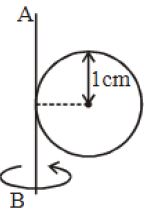
Choose the correct answer from the options given below :JEE Mains 2025 Easy - \(5\,g\) and radius \(1\,cm\) is fixed to a thin stick \(AB\) of negligible mass as shown in the figure. The system is initially at rest. The constant torque, that will make the system rotate about \(AB\) at \(25\) rotations per second in \(5\,s\) is close to
 JEE Mains 2019 Medium