


JEE Mains · Chemistry · STD 11 - 6.1. Equilibrium - 1 (chemical Equilibrium)
The reaction \(A(g) \rightleftharpoons B(g) + C(g)\) was initiated with the amount '\(a\)' of \(A(g)\). At equilibrium it is found that the amount of \(A(g)\) remaining is \((a - x)\) at a total pressure of \(p\).
The equilibrium constant \(K_p\) of the reaction can be calculated from the expression :
- A \(\dfrac{x^2}{a^2 + x^2} \times p\)
- B \(\dfrac{x^2}{a^2 - x^2} \times p\)
- C \(\dfrac{a + x^2}{x^2} \times p\)
- D \(\dfrac{a^2 - x^2}{x^2} \times p\)
Answer & Solution
Correct Answer
(B) \(\dfrac{x^2}{a^2 - x^2} \times p\)
Step-by-step Solution
Detailed explanation
The reaction is \(A(g) \rightleftharpoons B(g) + C(g)\) Initial moles: \(a\) for \(A\), \(0\) for \(B\), \(0\) for \(C\) Moles at equilibrium: \((a - x)\) for \(A\), \(x\) for \(B\), \(x\) for \(C\) Total moles at equilibrium \(= (a - x) + x + x = a + x\) Partial pressures at…
See the Complete Solution
Get step-by-step explanations for this and 2.5 Lakh+ more JEE, NEET & CET questions.
- Unlock all solutions
- Practice the full chapter
- Track accuracy across PYQs
4.8 rated on Google Play · 14,000+ reviews
More questions from Chemistry
- Consider the oxides of group \(14\) elements \(\mathrm{SiO}_2, \mathrm{GeO}_2, \mathrm{SnO}_2, \mathrm{PbO}_2, \mathrm{CO}\) and \(\mathrm{GeO}\). The amphoteric oxides are _______.JEE Mains 2024 Hard
- Consider a weak base 'B' of \( pK_b = 5.699 \). 'x' mL of 0.02 M HCl and 'y' mL of 0.02 M weak base 'B' are mixed to make 100 mL of a buffer of pH 9 at \( 25^{\circ}C \).
The values of 'x' and 'y' respectively are:
(Given: \( \log 2=0.3010, \log 3=0.4771, \log 5=0.699 \))JEE Mains 2026 Easy - Given below are two statements :- Statement \(I:\)- In redox titration, the indicators used are sensitive to change in \(pH\) of the solution. Statement \(II:\)- In acid-base titration, the indicators used are sensitive to change in oxidation potential. In the light of the above statements, choose the most appropriate answer from the options given belowJEE Mains 2023 Medium
- The correct order of the following compounds showing increasing tendency towards nucleophilic substitution reaction is :-
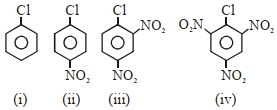 JEE Mains 2021 Easy
 - The group 14 elements A and B have the first ionisation enthalpy values of \(708\) and \(715 \mathrm{~kJ} \mathrm{~mol}^{-1}\) respectively. The above values are lowest among their group members. The nature of their ions \(\mathrm{A}^{2+}\) \(\mathrm{B}^{4+}\) respectively is _______.JEE Mains 2025 Hard
- A sugar ' \(X\) ' dehydrates very slowly under acidic condition to give furfural which on further reaction with resorcinol gives the coloured product after sometime. Sugar ' \(X\) ' isJEE Mains 2022 Medium
More PYQs from JEE Mains
- Let the three sides of a triangle are on the lines \(4 x-7 y+10=0, x+y=5\) and \(7 x+4 y=15\). Then the distance of its orthocentre from the orthocentre of the triangle formed by the lines \(x=0, y=0\) and \(x+y=1\) isJEE Mains 2025 Medium
- The total number of compounds from below when treated with hot \(\text{KMnO} _4\) giving benzoic acid is _______.
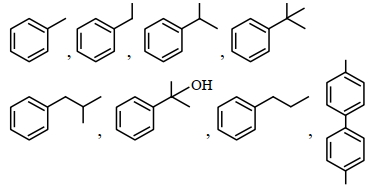 JEE Mains 2025 Medium
 - Consider the three planes \(P_{1}: 3 x+15 y+21 z=9\) ; \(P _{2}: x -3 y - z =5,\) and ; \(P_{3}: 2 x+10 y+14 z=5\). Then, which one of the following is true ?JEE Mains 2021 Medium
- Two coils require \(20\) minutes and \(60\) minutes respectively to produce same amount of heat energy when connected separately to the same source. If they are connected in parallel arrangement to the same source; the time required to produce same amount of heat by the combination of coils, will be________ \(min\)JEE Mains 2022 Hard
- A polysaccharide ' \(X\) ' on boiling with dil \(H _{2} SO _{4}\) at \(393 \,K\) under \(2-3 \,atm\) pressure yields ' \(Y\) '. ' \(Y\) ' on treatment with bromine water gives gluconic acid. ' \(X\) ' contains \(\beta\)-glycosidic linkages only. Compound ' \(X\) ' is ..... .JEE Mains 2022 Medium
- An electron of mass m with an initial velocity \(\overrightarrow{ V }= V_0 \hat i \,(V_0 > 0)\) enters an electric field \(\vec E = -\vec E_0 \hat i \,(E_0 =\) constant \(> 0)\) at \(t = 0.\) If \(\lambda_0\) is its de-Broglie wavelength initially,then its de-Broglie wavelenght at time \(t\) isJEE Mains 2022 Hard