


JEE Mains · Chemistry · STD 11 - 5. Thermodynamics and thermochemistry
Consider the reaction \(X \rightleftharpoons Y\) at \(300\) K. If \(\Delta H^{\theta}\) and \(K\) are \(28.40\) kJ mol\(^{-1}\) and \(1.8 \times 10^{-7}\) at the same temperature, then the magnitude of \(\Delta S^{\theta}\) for the reaction in J K\(^{-1}\) mol\(^{-1}\) is _______. (Nearest integer) (Given: \(R = 8.3\) J K\(^{-1}\) mol\(^{-1}\), \(\ln 10 = 2.3\), \(\log 3 = 0.48\), \(\log 2 = 0.30\))
- A 30
- B 32
- C 34
- D 36
Answer & Solution
Correct Answer
(C) 34
Step-by-step Solution
Detailed explanation
The standard Gibbs free energy change is given by: \(\Delta G^{\theta} = -RT \ln K = -2.3 RT \log K\) First, calculate \(\log K\): \(\log K = \log(1.8 \times 10^{-7}) = \log(18 \times 10^{-8})\) \(\log K = \log 18 - 8 = \log(2 \times 3^2) - 8\) \(\log K = \log 2 + 2 \log 3 - 8\)…
See the Complete Solution
Get step-by-step explanations for this and 2.5 Lakh+ more JEE, NEET & CET questions.
- Unlock all solutions
- Practice the full chapter
- Track accuracy across PYQs
4.8 rated on Google Play · 14,000+ reviews
More questions from Chemistry
- \(20\, mL\) of \(0.1\, M\, H_2SO_4\) is added to \(30\, mL\) of \(0.2\, M\, NH_4OH\) solution. The \(pH\) of the resultant mixture is [\(pk_b\) of \(NH_4OH = 4.7\)]JEE Mains 2019 Hard
- Which of the following oxoacids of sulphur contains \("S"\) in two different oxidation states?JEE Mains 2022 Medium
- Which element is not present in Nessler's reagent?JEE Mains 2023 Hard
- First and second ionization enthalpies of lithium are \(520\) kJ mol\(^{-1}\) and \(7297\) kJ mol\(^{-1}\) respectively. Energy required to convert \(3.5\) mg lithium (g) into \(\text{Li}^{2+}\)(g) \([\text{Li(g)} \rightarrow \text{Li}^{2+}\text{(g)}]\) is _______ kJ mol\(^{-1}\). (nearest integer) [Molar mass of Li \(= 7\) g mol\(^{-1}\)]JEE Mains 2026 Medium
- Which of the following is a Lewis acid?JEE Mains 2018 Hard
- The ' Spin only ' Magnetic moment for \(\left[\mathrm{Ni}\left(\mathrm{NH}_3\right)_6\right]^{2+}\) is _______ \(\times 10^{-1} \mathrm{BM}\). \((\) given \(=\) Atomic number of \(\mathrm{Ni}: 28)\)JEE Mains 2024 Hard
More PYQs from JEE Mains
- Given below are two statements: one is labelled as Assertion A and the other is labelled as Reason R
Assertion A: A diode under reverse-biased condition provides very small current which is nearly independent of voltage until a critical limit at which the current increases drastically.
Reason R: Below the critical voltage limit, only majority charge carriers flow which increases drastically above critical voltage.
Choose the correct answer from the options given belowJEE Mains 2026 Medium - Match \(List-I\) with \(List-II\)
Choose the correct answer from the options given below.\(List-I\) \(List-II\) \(A\) \(Ni ( CO )_{4}\) \(I\) \(sp ^{3}\) \(B\) \({\left[ Ni ( CN )_{4}\right]^{2-} }\) \(II\) \(S p^{3} d^{2}\) \(C\) \({\left[ Co ( CN )_{6}\right]^{3-} }\) \(III\) \({d^{2}}\) \(D\) \({\left[ CoF _{6}\right]^{3-} }\) \(IV\) \({s p^{3}}{d s p^{2}}\) JEE Mains 2022 Medium - Let \(P\) be the point of intersection of the line \(\frac{x+3}{3}=\frac{y+2}{1}=\frac{1-z}{2}\) and the plane \(x + y + z =2\) If the distance of the point \(P\) from the plane \(3 x-4 y+12 z=32\) is \(q\), then \(q\) and \(2 q\) are the roots of the equationJEE Mains 2023 Hard
- The hottest region of Bunsen flame shown in the figure below is :
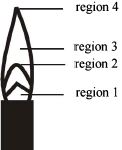 JEE Mains 2016 Hard
 - A series LCR circuit with \(R = 20\ \Omega\), \(L = 1.6\text{ H}\) and \(C = 40\ \mu\text{F}\) is connected to a variable frequency a.c. source. The inductive reactance at resonant frequency is _______ \(\Omega\).JEE Mains 2026 Easy
- A hyperbola has its centre at the origin, passes through the point \((4, 2)\) and has transverse axis of length \(4\) along the \(x -\) axis. Then the eccentricity of the hyperbola isJEE Mains 2019 Hard