


JEE Mains · Chemistry · STD 11 - Thermodynamics and thermochemistry
- JEE Mains 2026
- Medium
- MCQ
Given below are two statements:
Statement I: For an ideal gas, heat capacity at constant volume is always greater than the heat capacity at constant pressure.
Statement II: In a constant volume process, no work is produced and all the heat withdrawn goes into the chaotic motion and is reflected by a temperature increase of the ideal gas.
In the light of the above statements, choose the correct answer from the options given below
Pick an option to check your answer.
Answer & Solution
Correct Answer
(D) Statement I is false but Statement II is true
Step-by-step Solution
Detailed explanation
For an ideal gas, the relationship between heat capacity at constant pressure (\(C_p\)) and heat capacity at constant volume (\(C_v\)) is given by Mayer's relation:
\(C_p - C_v = R\)
Since the universal gas constant \(R\) is a positive value, \(C_p > C_v\). Thus, Statement I is false.
In a constant volume (isochoric) process, the change in volume \(\Delta V = 0\).
Work done, \(W = P\Delta V = 0\).
According to the first law of thermodynamics:
\(\Delta U = q + W\)
Since \(W = 0\), we get \(\Delta U = q_v\).
This means that in a constant volume process, no work is produced and all the heat absorbed by the system (withdrawn from the surroundings) goes entirely into increasing the internal energy (chaotic motion of the molecules). This increase in internal energy is reflected by an increase in the temperature of the ideal gas. Thus, Statement II is true.
Therefore, Statement I is false but Statement II is true.
Answer: Statement I is false but Statement II is true
More questions from Chemistry
- Arrange the following compounds in increasing order of rate of aromatic electrophilic substitution reaction
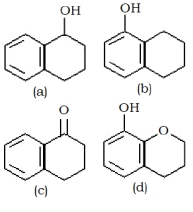 JEE Mains 2023 Hard
- A central atom in a molecule has two lone pairs of electrons and forms three single bonds. The shape of this molecule isJEE Mains 2021 Medium
- Consider the following molecules :
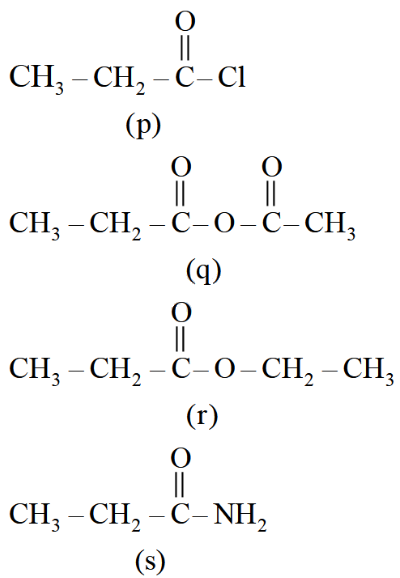
The correct order of rate of hydrolysis is _______.JEE Mains 2025 Medium - The correct increasing order of spin-only magnetic moment values of the complex ions
\([MnBr_{4}]^{2-}\) (A), \([Cu(H_{2}O)_{6}]^{2+}\) (B), \([Ni(CN)_{4}]^{2-}\) (C) and \([Ni(H_{2}O)_{6}]^{2+}\) (D) is:JEE Mains 2026 Medium - Number of geometrical isomers possible for the given structure is _______.
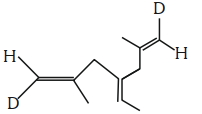 JEE Mains 2024 Hard
- Consider the following data:
\(\Delta_{f}H^{\Theta}(methane,g) = -X~kJ~mol^{-1}\)
Enthalpy of sublimation of graphite = \(Y~kJ~mol^{-1}\)
Dissociation enthalpy of \(H_{2} = Z~kJ~mol^{-1}\)
The bond enthalpy of C-H bond is given by:JEE Mains 2026 Medium
More PYQs from JEE Mains
- Given below are two statements : Statement-I: When a capillary tube is dipped into a liquid, the liquid neither rises nor falls in the capillary. The contact angle may be \(0^{\circ}\). Statement-II: The contact angle between a solid and a liquid is a property of the material of the solid and liquid as well : In the light of above statement, choose the correct answer from the options given below.JEE Mains 2024 Hard
- A steel wire of length 2 m and Young's modulus \(2.0 \times 10^{11} \mathrm{Nm}^{-2}\) is stretched by a force. If Poisson ratio and transverse strain for the wire are 0.2 and \(10^{-3}\) respectively, then the elastic potential energy density of the wire is _______ \(\times 10^5\) (in SI units)JEE Mains 2025 Medium
- A plane electromagnetic wave of frequency \(100\, MHz\) is travelling in vacuum along the \(x -\) direction. At a particular point in space and time, \(\overrightarrow{ B }=2.0 \times 10^{-8} \hat{ k } T\). (where, \(\hat{ k }\) is unit vector along \(z-\)direction) What is \(\overrightarrow{ E }\) at this point ?JEE Mains 2021 Medium
- The metal ions that have the calculated spin only magnetic moment value of 4.9 B.M. are _______.
A. \(\mathrm{Cr}^{2+}\)
B. \(\mathrm{Fe}^{2+}\)
C. \(\mathrm{Fe}^{3+}\)
D. \(\mathrm{Co}^{2+}\)
E. \(\mathrm{Mn}^{3+}\)
Choose the correct answer from the options given below.JEE Mains 2025 Medium - Let the moment of inertia of a hollow cylinder of length \(30\, cm\) (inner radius \(10\, cm\) and outer radius \(20\, cm\)), about its axis be \(I\). The radius of a thin cylinder of the same mass such that its moment of inertia about its axis is also \(I\), is ......... \(cm\).JEE Mains 2019 Hard