


JEE Mains · Chemistry · STD 11 - Thermodynamics and thermochemistry
- JEE Mains 2026
- Hard
- MCQ
Consider the following thermochemical data:
(i) \( 2Al(s) + 6HCl(aq) \rightarrow Al_2Cl_6(aq) + 3H_2(g) \) ; \( \Delta H_1 = -1200\text{ kJ/mol} \)
(ii) \( H_2(g) + Cl_2(g) \rightarrow 2HCl(g) \) ; \( \Delta H_2 = -164\text{ kJ/mol} \)
(iii) \( HCl(g) + aq \rightarrow HCl(aq) \) ; \( \Delta H_3 = -83\text{ kJ/mol} \)
(iv) \( Al_2Cl_6(s) + aq \rightarrow Al_2Cl_6(aq) \) ; \( \Delta H_4 = -663\text{ kJ/mol} \)
The enthalpy of formation of anhydrous solid \( Al_2Cl_6 \) is:
Pick an option to check your answer.
Answer & Solution
Correct Answer
(D) \(-1527\) kJ mol\(^{-1}\)
Step-by-step Solution
Detailed explanation
Explanation:
Let us calculate the enthalpy of formation of anhydrous solid \( Al_2Cl_6 \) using Hess's Law of Constant Heat Summation:
1. Identify the Target Reaction:
The standard reaction for the enthalpy of formation of anhydrous solid \( Al_2Cl_6 \) from its constituent elements is:
\( 2Al(s) + 3Cl_2(g) \rightarrow Al_2Cl_6(s) \) ; \( \Delta H_f = ? \)
2. Algebraic Manipulation of Given Equations:
To obtain the target equation, we perform the following mathematical operations on the given equations:
We need \( 2Al(s) \) on the reactant side: Keep Equation (i) as it is.
We need \( 3Cl_2(g) \) on the reactant side: Multiply Equation (ii) by 3.
To cancel out the \( 6HCl(g) \) produced, we need them in aqueous form: Multiply Equation (iii) by 6.
We need anhydrous \( Al_2Cl_6(s) \) on the product side: Reverse Equation (iv) (multiply by -1).
Therefore, the net operation is: Equation (i) + 3 \times Equation (ii) + 6 \times Equation (iii) - Equation (iv)
3. Verification by Adding the Modified Equations:
\( 2Al(s) + 6HCl(aq) \rightarrow Al_2Cl_6(aq) + 3H_2(g) \)
\( 3H_2(g) + 3Cl_2(g) \rightarrow 6HCl(g) \)
\( 6HCl(g) + aq \rightarrow 6HCl(aq) \)
\( Al_2Cl_6(aq) \rightarrow Al_2Cl_6(s) + aq \)
Summing these equations and canceling common species on both sides yields our target equation:
\( 2Al(s) + 3Cl_2(g) \rightarrow Al_2Cl_6(s) \)
4. Calculating the Final Enthalpy (\( \Delta H_f \)):
Applying the same algebraic operations to the respective enthalpy values:
\( \Delta H_f = \Delta H_1 + 3\Delta H_2 + 6\Delta H_3 - \Delta H_4 \)
\( \Delta H_f = -1200 + 3(-164) + 6(-83) - (-663) \)
\( \Delta H_f = -1200 - 492 - 498 + 663 \)
\( \Delta H_f = -2190 + 663 = -1527\text{ kJ/mol} \)
Hence, Option D is the correct choice.
More questions from Chemistry
- The correct order of the following complexes in terms of their crystal field stabilization energies is _______.JEE Mains 2025 Hard
- The molecules having square pyramidal geometry are which?JEE Mains 2025 Easy
- Accumulation of which of the following molecules in the muscles occurs as a result of vigorous exercise ?JEE Mains 2015 Hard
- The freezing point of benzene decreases by \(0.45^o C\) when \(0.2\,g\) of acetic acid is added to \(20\, g\) of benzene. If acetic acid associates to form a dimer in benzene, percentage association of acetic acid in benzene will be .......... \(\%\) \((K_f \) for benzene \(= 5.12 \,K\, kg\, mol^{-1})\)JEE Mains 2017 Easy
- If 1 mM solution of ethylamine produces \(\mathrm{pH}=9\), then the ionization constant \(\left(\mathrm{K}_{\mathrm{b}}\right)\) of ethylamine is \(10^{-x}\). The value of \(x\) is ______ (nearest integer).
[The degree of ionization of ethylamine can be neglected with respect to unity.]JEE Mains 2025 Medium - The average molar mass of chlorine is \(35.5\, g\) \(mol ^{-1}\). The ratio of \(35\, Cl\) to \(37 \,Cl\) in naturally occurring chlorine is close to :JEE Mains 2020 Hard
More PYQs from JEE Mains
- Following statements are given : \((1)\) The average kinetic energy of a gas molecule decreases when the temperature is reduced. \((2)\) The average kinetic energy of a gas molecule increases with increase in pressure at constant temperature. \((3)\) The average kinetic energy of a gas molecule decreases with increases in volume. \((4)\) Pressure of a gas increases with increase in temperature at constant pressure. \((5)\) The volume of gas decreases with increase in temperature. Choose the correct answer from the options given below:JEE Mains 2022 Medium
- Given below are two statements. Statement \(I:\) On heating with \(KHSO _{4}\), glycerol is dehydrated and acrolein is formed. Statement \(II:\) Acrolein has fruity odour and can be used to test glycerol's presence.Choose the correct option.JEE Mains 2022 Medium
- In free space, an electromagnetic wave of \(3 \; GHz\) of \(3 \; GHz\) frequency strikes over the edge of an object of size \(\frac{\lambda}{100}\), where \(\lambda\) is the wavelength of the wave in free space. The phenomenon, which happens there will be .....JEE Mains 2022 Hard
- A velocity selector consists of electric field \(\overrightarrow{ E }= E \hat{ k }\) and magnetic field \(\overrightarrow{ B }= B \hat{ j }\) with \(B =12 mT\). The value \(E\) required for an electron of energy \(728 eV\) moving along the positive \(x\)-axis to pass undeflected is: (Given, , ass of electron \(=9.1 \times 10^{-31} kg\) )JEE Mains 2022 Hard
- n-Butane on monochlorination under photochemical condition gives an optically active compound "P". "P" on further chlorination gives dichloro compounds. The number of dichloro compounds obtained (ignore stereoisomers) is:JEE Mains 2026 Hard
- Two blocks of masses \(3 \,{kg}\) and \(5\, {kg}\) are connected by a metal wire going over a smooth pulley. The breaking stress of the metal is \(\frac{24}{\pi} \times 10^{2}\, {Nm}^{-2}\). What is the minimum radius of the wire? (Take \(\left.g=10\, {ms}^{-2}\right)\) (in \(cm\))
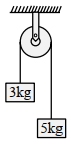 JEE Mains 2021 Hard