


JEE Mains · Chemistry · STD 11 - Equilibrium - 1 (chemical Equilibrium)
- JEE Mains 2026
- Easy
- Numerical
For the following gas phase equilibrium reaction at constant temperature,
\(NH_3(g) \rightleftharpoons \frac{1}{2} N_2(g)+\frac{3}{2} H_2(g)\)
If the total pressure is \(\sqrt{3} \) atm and the pressure equilibrium constant \(\left( K _{ p }\right)\) is 9 atm , then the degree of dissociation is given as \(\left(x \times 10^{-2}\right)^{-1 / 2}\).
The value of \(x\) is __________ (Nearest integer)
Pick an option to check your answer.
Answer & Solution
Correct Answer
(B) 125
Step-by-step Solution
Detailed explanation
\(NH _{3(g)} \rightleftharpoons \frac{1}{2} N_{2(g)}+\frac{3}{2} H _{2(g)}\)
\(t=0\)\(\quad\)1mole\(\quad\quad\)—\(\quad\quad\)—
\(t = t _{ eq }\)\(\quad\)\(1-\alpha\)\(\quad\)\(\alpha / 2\)\(\quad\)\(3 \alpha / 2\)
\(k _{ p }=\frac{\left(\frac{\alpha}{2}\right)^{1 / 2}\left(\frac{3 \alpha}{2}\right)^{3 / 2}}{(1-\alpha)}\left[\frac{ P _{ T }}{1+\alpha}\right]^1\)\(\quad\)\(\left[\because P _{ T }=\sqrt{3} atm\right]\)
\(9=\frac{\left(\frac{\alpha}{2}\right)^{1 / 2}\left(\frac{3 \alpha}{2}\right)^{3 / 2}}{(1-\alpha)} \times \frac{(3)^{1 / 2}}{1+\alpha}\)
\(9=\frac{9\left(\frac{\alpha}{2}\right)^2}{1-\alpha^2}\)
\(1-\alpha^2=\frac{\alpha^2}{4}\)
\(\frac{5 \alpha^2}{4}=1\)
\(\alpha^2=0.8\)
\(\alpha=(0.8)^{1 / 2}\)
\(\alpha=\left[\frac{1}{0.8}\right]^{-1 / 2}\)
\(\begin{array}{l}\alpha=\left[125 \times 10^{-2}\right]^{-1 / 2} \\ x=125\end{array}\)
More questions from Chemistry
- Match the LIST-I with LIST-II
Choose the correct answer from the options given belowList-I
ReagentsList-II
Name of Reaction involving carbonyl compoundA. \(NH _2- NH _2, KOH\) I. Tollen's Test B. \(Ag \left( NH _3\right)_2 OH\) II. Clemmensen Reduction C. Aq. \(CuSO _4\), Sodium Potassium tartarate, KOH III. Wolff-Kishner Reduction D. \(Zn - Hg , HCl\) Iv. Fehling's Test JEE Mains 2026 Medium - The reaction of \(H _{2} O _{2}\) with potassium permanganate in acidic medium leads to the formation of mainly.JEE Mains 2022 Medium
- One Faraday of electricity liberates \(\mathrm{x} \times 10^{-1}\) gram atom of copper from copper sulphate, \(\mathrm{x}\) is _______.JEE Mains 2024 Hard
- \(2 \mathrm{SO}_{2}(\mathrm{~g})+\mathrm{O}_{2}(\mathrm{~g}) \rightarrow 2 \mathrm{SO}_{3}(\mathrm{~g})\) The above reaction is carried out in a vessel starting with partial pressure \(\mathrm{P}_{\mathrm{SO}_{2}}=250\, \mathrm{~m}\) \(bar,\) \(\mathrm{P}_{0_{2}}=750 \,\mathrm{~m}\) \(bar\) and \(\mathrm{P}_{\mathrm{SO}_{3}}=0 \,\mathrm{bar}\). When the reaction is complete, the total pressure in the reaction vessel is \(.....\mathrm{m}\) \(bar.\) (Round off to the Nearest Integer).JEE Mains 2021 Medium
- Consider the dissociation equilibrium of the following weak acid \(HA \rightleftharpoons H ^{+}( aq )+ A ^{-}( aq )\) If the pKa of the acid is 4 , then the pH of 10 mM HA solution is __________ . (Nearest integer)
[Given : The degree of dissociation can be neglected with respect to unity]JEE Mains 2026 Medium - An electrochemical cell is constructed using half cells in the direction of spontaneous change
\(Fe(OH)_2(s) + 2e^- \rightarrow Fe(s) + 2OH^-(aq) \quad E^\theta = -0.88\) V
and \(AgBr(s) + e^- \rightarrow Ag(s) + Br^-(aq) \quad E^\theta = +0.07\) V
Which of the following option is correct?JEE Mains 2026 Medium
More PYQs from JEE Mains
- \(1.2\, mL\) of acetic acid is dissolved in water to make \(2.0\, L\) of solution. The depression in freezing point observed for this strength of acid is \(0.0198^{\circ} C\). The percentage of dissociation of the acid is \(....\) (Nearest integer) [Given : Density of acetic acid is \(1.02\, g\, mL ^{-1}\) Molar mass of acetic acid is \(60 \,g\, mol ^{-1}\) \(\left.K _{ f }\left( H _{2} O \right)=1.85\, K\, kg\, mol ^{-1}\right]\)JEE Mains 2022 Hard
- Among \(10^{-9} \mathrm{~g}\) (each) of the following elements, which one will have the highest number of atoms? Element : \(\mathrm{Pb}, \mathrm{Po}, \mathrm{Pr}\) and PtJEE Mains 2025 Medium
- Given below are two statements:
Statement (I) : for \(\mathrm{ClF}_3\), all three possible structures may be drawn as follows.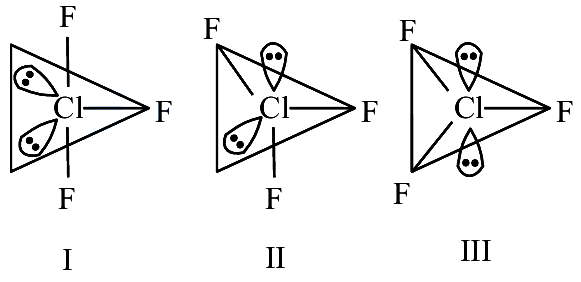
Statement (II) : Structure III is most stable, as the orbitals having the lone pairs are axial, where the \(\ell \mathrm{p}-\mathrm{bp}\) repulsion is minimum.
In the light of the above statements, choose the most appropriate answer from the options given below:JEE Mains 2025 Easy - The ratio of the shortest wavelength of two spectral series of hydrogen spectrum is found to be about \(9\). The spectral series areJEE Mains 2019 Medium
- Given below are two statements :- Statement \(I:\)- In redox titration, the indicators used are sensitive to change in \(pH\) of the solution. Statement \(II:\)- In acid-base titration, the indicators used are sensitive to change in oxidation potential. In the light of the above statements, choose the most appropriate answer from the options given belowJEE Mains 2023 Medium
- A circular coil having \(200\) turns, \(2.5 \times 10^{-4} \mathrm{~m}^2\) area and carrying \(100 \mu \mathrm{A}\) current is placed in a uniform magnetic field of \(1 \mathrm{~T}\). Initially the magnetic dipole moment \((\vec{M})\) was directed along \(\vec{B}\). Amount of work, required to rotate the coil through \(90^{\circ}\) from its initial orientation such that \(\overrightarrow{\mathrm{M}}\) becomes perpendicular to \(\vec{B}\) is _______ \(\mu \mathrm{J}\).JEE Mains 2024 Hard