


JEE Mains · Chemistry · STD 11 - Thermodynamics and thermochemistry
- JEE Mains 2026
- Medium
- Numerical
Consider the reaction
\(2\text{H}_2\text{S}(g) + 3\text{O}_2(g) \rightarrow 2\text{H}_2\text{O}(l) + 2\text{SO}_2(g)\)
The magnitude of enthalpy change for the reaction in kJ mol\(^{-1}\) is ________. (Nearest integer)
Given: \(\Delta_fH^{\ominus}(\text{H}_2\text{S}) = -20.1\) kJ mol\(^{-1}\)
\(\Delta_fH^{\ominus}(\text{H}_2\text{O}) = -286.0\) kJ mol\(^{-1}\)
\(\Delta_fH^{\ominus}(\text{SO}_2) = -297.0\) kJ mol\(^{-1}\)
Pick an option to check your answer.
Answer & Solution
Correct Answer
(B) 1126
Step-by-step Solution
Detailed explanation
The standard enthalpy of reaction is given by:
\(\Delta_r H^{\ominus} = \sum \Delta_f H^{\ominus}(\text{products}) - \sum \Delta_f H^{\ominus}(\text{reactants})\)
For the given reaction:
\(2\text{H}_2\text{S}(g) + 3\text{O}_2(g) \rightarrow 2\text{H}_2\text{O}(l) + 2\text{SO}_2(g)\)
\(\Delta_r H^{\ominus} = [2 \Delta_f H^{\ominus}(\text{H}_2\text{O}, l) + 2 \Delta_f H^{\ominus}(\text{SO}_2, g)] - [2 \Delta_f H^{\ominus}(\text{H}_2\text{S}, g) + 3 \Delta_f H^{\ominus}(\text{O}_2, g)]\)
Substituting the given values:
\(\Delta_r H^{\ominus} = [2(-286.0) + 2(-297.0)] - [2(-20.1) + 3(0)]\)
\(\Delta_r H^{\ominus} = [-572.0 - 594.0] - [-40.2]\)
\(\Delta_r H^{\ominus} = -1166.0 + 40.2 = -1125.8 \text{ kJ mol}^{-1}\)
The magnitude of the enthalpy change is \(1125.8 \text{ kJ mol}^{-1}\).
Rounding to the nearest integer, we get \(1126\).
Answer: \(1126\)
More questions from Chemistry
- A process will be spontaneous at all temperatures ifJEE Mains 2019 Hard
- The correct order of spin only magnetic moments for the following complex ions isJEE Mains 2023 Medium
- Thyroxine, the hormone has given below structure
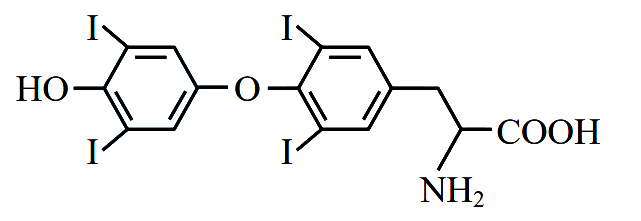
The percentage of iodine in thyroxine is ____ \(\%\). (nearest integer)
(Given molar mass in \(\mathrm{g} \mathrm{mol}^{-1} \mathrm{C}: 12. \mathrm{H}: 1, \mathrm{O}: 16\), \(\mathrm{N}: 14, \mathrm{I}: 127)\)JEE Mains 2025 Medium - Which of the following species is not paramagnetic ?JEE Mains 2017 Hard
- The electronegativity of aluminium is similar toJEE Mains 2019 Easy
- The number of \(P-OH\) bonds and the oxidation state of phosphorus atom in pyrophosphoric acid \((H_4P_ 2O_7)\) respectively areJEE Mains 2017 Hard
More PYQs from JEE Mains
- Given below are two statements: Statement \((I)\) : In the Lanthanoids, the formation of \(\mathrm{Ce}^{+4}\) is favoured by its noble gas configuration. Statement \((II)\) : \(\mathrm{Ce}^{+4}\) is a strong oxidant reverting to the common \(+3\) state. In the light of the above statements, choose the most appropriate answer from the options given below:JEE Mains 2024 Hard
- Consider a rectangular sheet of solid material of length \(\ell=9 \mathrm{~cm}\) and width \(\mathrm{d}=4 \mathrm{~cm}\). The coefficient of linear expansion is \(\alpha=3.1 \times 10^{-5} \mathrm{~K}^{-1}\) at room temperature and one atmospheric pressure. The mass of sheet \(\mathrm{m}=0.1 \mathrm{~kg}\) and the specific heat capacity \(\mathrm{C}_{\mathrm{v}}=900 \mathrm{~J} \mathrm{~kg}^{-1} \mathrm{~K}^{-1}\). If the amount of heat supplied to the material is \(8.1 \times 10^2 \mathrm{~J}\) then change in area of the rectangular sheet is :-JEE Mains 2025 Easy
- The stopping potential for electrons emitted from a photosensitive surface illuminated by light of wavelength \(491\, nm\) is \(0.710\, V\). When the incident wavelength is changed to a new value, the stopping potential is \(1.43\, V\). The new wavelength is ....... \(nm.\)JEE Mains 2021 Medium
- Given below are two statements :
Statement I : Wet cotton clothes made of cellulose based carbohydrate takes comparatively longer time to get dried than wet nylon polymer based clothes.
Statement II : Intermolecular hydrogen bonding with water molecule is more in nylon-based clothes than in the case of cotton clothes.
In the light of above statements, choose the Correct answer from the options given belowJEE Mains 2025 Medium - Identify the incorrect statementJEE Mains 2013 Hard