


JEE Mains · Chemistry · STD 11 - Thermodynamics and thermochemistry
- JEE Mains 2026
- Hard
- Numerical
If \(3.365\) g of ethanol \((l)\) is burnt completely in a bomb calorimeter at \(298.15\) K, the heat produced is \(99.472\) kJ. The \(|\Delta H_f°|\) of ethanol at \(298.15\) K is ______ \(\times 10^2\) kJ mol\(^{-1}\). (Nearest integer)
Given: Standard enthalpy for combustion of graphite \(=-393.5\) kJ mol\(^{-1}\)
Standard enthalpy of formation of water \((l)=-285.8\) kJ mol\(^{-1}\)
Molar mass in g mol\(^{-1}\) of C, H, O are \(12\), \(1\) and \(16\) respectively
Pick an option to check your answer.
Answer & Solution
Correct Answer
(A) 3
Step-by-step Solution
Detailed explanation
Molar mass of ethanol (\(C_2H_5OH\)) \(= 2(12) + 6(1) + 16 = 46\) g mol\(^{-1}\)
Number of moles of ethanol burnt, \(n = \dfrac{3.365}{46} = 0.07315\) mol
Since the combustion occurs in a bomb calorimeter (constant volume), the heat produced corresponds to the change in internal energy (\(\Delta U_c^\circ\)).
\(\Delta U_c^\circ = -\dfrac{99.472}{0.07315} = -1359.8\) kJ mol\(^{-1}\)
The balanced chemical equation for the combustion of ethanol is:
\(C_2H_5OH(l) + 3O_2(g) \rightarrow 2CO_2(g) + 3H_2O(l)\)
Change in the number of gaseous moles, \(\Delta n_g = 2 - 3 = -1\)
Now, calculating the standard enthalpy of combustion (\(\Delta H_c^\circ\)):
\(\Delta H_c^\circ = \Delta U_c^\circ + \Delta n_g RT\)
\(\Delta H_c^\circ = -1359.8 + (-1) \times (8.314 \times 10^{-3} \text{ kJ K}^{-1} \text{ mol}^{-1}) \times 298.15 \text{ K}\)
\(\Delta H_c^\circ = -1359.8 - 2.48 = -1362.28\) kJ mol\(^{-1}\)
The standard enthalpy of combustion can also be written in terms of enthalpies of formation:
\(\Delta H_c^\circ = \sum \Delta H_f^\circ(\text{products}) - \sum \Delta H_f^\circ(\text{reactants})\)
\(\Delta H_c^\circ = [2\Delta H_f^\circ(CO_2, g) + 3\Delta H_f^\circ(H_2O, l)] - [\Delta H_f^\circ(C_2H_5OH, l) + 3\Delta H_f^\circ(O_2, g)]\)
Substituting the given values (note that \(\Delta H_f^\circ\) of \(O_2(g)\) is \(0\)):
\(-1362.28 = [2(-393.5) + 3(-285.8)] - \Delta H_f^\circ(C_2H_5OH, l)\)
\(-1362.28 = [-787.0 - 857.4] - \Delta H_f^\circ(C_2H_5OH, l)\)
\(-1362.28 = -1644.4 - \Delta H_f^\circ(C_2H_5OH, l)\)
\(\Delta H_f^\circ(C_2H_5OH, l) = -1644.4 + 1362.28 = -282.12\) kJ mol\(^{-1}\)
The magnitude is \(|\Delta H_f^\circ| = 282.12\) kJ mol\(^{-1} = 2.8212 \times 10^2\) kJ mol\(^{-1}\)
Rounding to the nearest integer, we get \(3\).
Answer: \(3\)
More questions from Chemistry
- The nature of charge on resulting colloidal particles when \(FeCl _{3}\) is added to excess of hot water is :JEE Mains 2021 Easy
- Match List-I with List-II
Sr. No. List-I No. List-II (A) Solution of chloroform and acetone (I) Minimum boiling azeotrope (B) Solution of ethanol and water (II) Dimerizes (C) Solution of benzene and toluene (III) Maximum boiling azeotrope (D) Solution of acetic acid in benzene (IV) ΔVmix = 0
Choose the correct answer from the options given below :JEE Mains 2025 Hard - Glycosidic linkage is actually anJEE Mains 2013 Hard
- Number of ambidentate ligands in a representative metal complex \(\left[ M ( en )( SCN )_4\right]\) is \(\text { [en }=\text { ethylenediamine }]\)JEE Mains 2023 Medium
- For a sparingly soluble salt \(\mathrm{AB}_2\), the equilibrium concentrations of \(\mathrm{A}^{2+}\) ions and \(\mathrm{B}^{-}\)ions are \(1.2 \times 10^{-4} \mathrm{M}\) and \(0.24 \times 10^{-3} \mathrm{M}\), respectively. The solubility product of \(\mathrm{AB}_2\) is _______.JEE Mains 2024 Medium
-
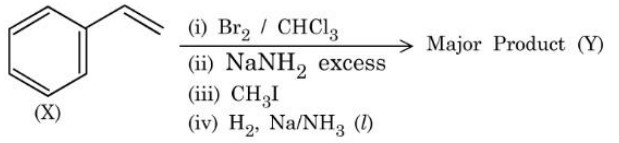
Compound (X) [styrene] is subjected to the sequence of reactions as shown above: (i) \(Br_2/CHCl_3\) (ii) \(NaNH_2\) excess (iii) \(CH_3I\) (iv) \(H_2\), \(Na/NH_3\) \((l)\), giving Major Product (Y). Molar mass of the major product (Y) formed is ______ g mol\(^{-1}\).
(Given molar mass in g mol\(^{-1}\) C:\(12\), H: \(1\), O: \(16\))JEE Mains 2026 Hard
More PYQs from JEE Mains
- A coil is placed in a time varying magnetic field. If the number of turns in the coil were to be halved and the radius of wire doubled, the electrical power dissipated due to the current induced in the coil would be: (Assume the coil to be short circuited.)JEE Mains 2022 Medium
- The correct statements among \(I\) to \(III\) regarding group \(13\) element oxides are, \(I\). Boron trioxide is acidic \(II\). Oxides of aluminium and gallium are amphoteric \(III\). Oxides of indium and thallium are basicJEE Mains 2019 Medium
- First ionisation enthalpy values of first four group 15 elements are given below. Choose the correct value for the element that is a main component of apatite family :JEE Mains 2025 Medium
- The decreasing order of hydride affinity for following carbocations is: Choose the correct answer from the options given below:
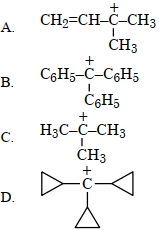 JEE Mains 2023 Medium
- In Carius method of estimation of halogens, \(250 \,mg\) of an organic compound gave \(141 \,mg\) of \(AgBr.\) The percentage of bromine in the compound is : (at. mass \(Ag =108; Br = 80\))JEE Mains 2015 Hard
- The radiation pressure exerted by a 450 W light source on a perfectly reflecting surface placed at 2 m away from it, is :JEE Mains 2025 Medium