


JEE Mains · Chemistry · STD 11 - Classification of elements and periodicity in properties
- JEE Mains 2026
- Easy
- MCQ
In a period, the first ionisation enthalpy of the element at extreme left and the negative electron gain enthalpy of the extreme right element, except noble gases, are respectively.
Pick an option to check your answer.
Answer & Solution
Correct Answer
(C) lowest and highest
Step-by-step Solution
Detailed explanation
In a period, as we move from left to right, the atomic size decreases and the effective nuclear charge increases.
Due to the large atomic size and low effective nuclear charge, the element at the extreme left (alkali metal) has the lowest first ionisation enthalpy in the period.
As we move to the extreme right (excluding noble gases), the elements (halogens) have the smallest atomic size and highest effective nuclear charge in the period. They require only one electron to complete their octet. Thus, they have the highest negative electron gain enthalpy.
Therefore, the first ionisation enthalpy of the extreme left element is the lowest, and the negative electron gain enthalpy of the extreme right element is the highest.
Answer: lowest and highest
More questions from Chemistry
- The reaction \(X \to Y\) is an exothermic reaction . Activation energy of the reaction for \(X\) into \(Y\) is \(150\,kJ\,mol^{-1}\) . Enthalpy of reaction is \(135\,kJ\,mol^{-1}\) . The activation energy for the reverse reaction, \(Y \to X\) will be.......\(kJ\,mol^{-1}\)JEE Mains 2013 Hard
- "X" is an oxoanion of the lightest element of group 7(in the periodic table). The metal is in +6 oxidation state in "X". The color of the potassium salt of X isJEE Mains 2026 Easy
- A transition metal \((\mathrm{M})\) among \(\mathrm{Mn}, \mathrm{Cr}, \mathrm{Co}\) and Fe has the highest standard electrode potential \(\left(\mathrm{M}^{3+} / \mathrm{M}^{2+}\right)\). It forms a metal complex of the type \(\left[\mathrm{M}(\mathrm{CN})_6\right]^{4-}\). The number of electrons present in the \(\mathrm{e}_{\mathrm{g}}\) orbital of the complex is _________.JEE Mains 2025 Easy
- ' \(X\) ' is the number of electrons in \(t_{2 g}\) orbitals of the most stable complex ion among \(\left[\mathrm{Fe}\left(\mathrm{NH}_3\right)_6\right]^{3+}\), \(\left[\mathrm{Fe}\left(\mathrm{Cl}_6\right)\right]^{3-},\left[\mathrm{Fe}\left(\mathrm{C}_2 \mathrm{O}_4\right)_3\right]^{3-}\) and \(\left[\mathrm{Fe}\left(\mathrm{H}_2 \mathrm{O}\right)_6\right]^{3+}\). The nature of oxide of vanadium of the type \(\mathrm{V}_2 \mathrm{O}_{\mathrm{X}}\) is _______.JEE Mains 2025 Easy
- In the ground state of atomic \(Fe \,( Z =26)\) the spin-only magnetic moment is ...... \(\times 10^{-1} \,BM\). (Round off to the Nearest Integer). \([\) Given \(: \sqrt{3}=1.73, \sqrt{2}=1.41]\)JEE Mains 2021 Easy
- The density of a monobasic strong acid (Molar mass \(24.2\,g\,mol )\) is \(1.21\,kg\,L\). The volume of its solution required for the complete neutralization of \(25\,mL\) of \(0.24\,M\,NaOH\) is \(..............\times 10^{-2}\,mL\) (Nearest integer)JEE Mains 2023 Hard
More PYQs from JEE Mains
- The current of \(5 \mathrm{~A}\) flows in a square loop of sides \(1\) \(\mathrm{m}\) is placed in air. The magnetic field at the centre of the loop is \(\mathrm{X} \sqrt{2} \times 10^{-7} \mathrm{~T}\). The value of \(\mathrm{X}\) is _______.JEE Mains 2024 Hard
- Gas 'A' undergoes change from state 'X' to state 'Y'. In this process, the heat absorbed and work done by the gas is \(10\) J and \(18\) J respectively. Now gas is brought back to state 'X' by another process during which \(6\) J of heat is evolved. In the reverse process of 'Y' to 'X',JEE Mains 2026 Medium
- For \(\mathrm{A}_2+\mathrm{B}_2 \rightleftharpoons 2 \mathrm{AB}\)
\(\mathrm{E}_{\mathrm{a}}\) for forward and backward reaction are 180 and \(200 \mathrm{~kJ} \mathrm{~mol}^{-1}\) respectively
If catalyst lowers \(\mathrm{E}_{\mathrm{a}}\) for both reaction by \(100 \mathrm{~kJ} \mathrm{~mol}^{-1}\).
Which of the following statement is correct?JEE Mains 2025 Medium - The velocity-time graphs of a car and a scooter are shown in the figure. \((i)\) the difference between the distance travelled by the car and the scooter in \(15\, s\) and \((ii)\) the time at which the car will catch up with the scooter are, respectively
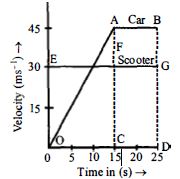 JEE Mains 2018 Hard
- Consider four conducting materials copper, tungsten, mercury and aluminium with resistivity \(\rho_{ C }, \rho_{ T }, \rho_{ M }\) and \(\rho_{ A }\) espectively Then:JEE Mains 2020 Easy