


Questions
5 questionsShowing 1–5 of 5 questions
-
- (A) \(\Delta H\) is negative while \(\Delta S\) is positive
- (B) Both \(\Delta H\) and are \(\Delta S\) negative
- (C) \(\Delta H\) is positive while \(\Delta S\) is negative
- (D) Both \(\Delta H\) and \(\Delta S\) are positive
Show answer and solution
Correct Answer: (D)
\(\Delta G\, = \,\Delta H - T\Delta S\)For a spontaneous reaction \(\Delta G = -ve\) which is possible when both \(\Delta H\) and \(\Delta S\) are positive at high temperature and hence the reaction becomes spontaneous.
-
- (A) \(1.0 \times 10^{-10}\)
- (B) \(10\)
- (C) \(1\)
- (D) \(1.0 \times 10^{10}\)
Show answer and solution
Correct Answer: (C)
Given \(\Delta {H^o} = - 29.8\,kJ\,mo{l^{ - 1}}\)\(\Delta {S^o} = - 1.00\,kJ\,{K^{ - 1}}\)
From the equation
\(\Delta G = \Delta {H^o} - T\Delta {S^o} = - 29.8 - (298 \times - 0.100)\)
\( = - 29.8 + 29.8 = 0\)
Now, \(\Delta {G^o} = - 2.303\,RT\,\log \,{K_{eq}}\)
\(0 = - 2.303\,RT\,\log \,{K_{eq}}\)
\(\therefore {K_{eq}} = 1\)
-
- (A) \(124.50\)
- (B) \(249\)
- (C) \(498\)
- (D) \(62.25\)
Show answer and solution
Correct Answer: (A)
\(2{H_2}{O_2}(l) \leftrightarrow 2{H_2}O(l) + {O_2}(g)\)\(W = - {P_{ext}}(\Delta V) = - ({n_{{O_2}}})RT\)
\(\because \,100\) mole \({H_2}{O_2}\) on decomposition give \(50\) mol \({O_2}\)
\(\therefore \,W = - (50)(8.3)(300) = - 124500\,J\)
\( = - 124.5\,kJ\)
-
- (A) \(-676.5\)
- (B) \(-110\)
- (C) \(110.5\)
- (D) \(676.5\)
Show answer and solution
Correct Answer: (B)
Many enthalpy changes are difficult to measure directly under standard conditions. Hess law states that the total enthalpy change of a reaction is independent of the route taken. To find\(H _{ f }, C _{( s )}+\frac{1}{2} O _{2}( g ) \rightarrow CO ( g )\)
Given:- combustion of carbon
\(C + O _{2} \rightarrow CO _{2}: \Delta H _{1}=-393.5 KJmol\)
combination of carbon monoxide
\(CO +\frac{1}{2} O _{2} \rightarrow CO _{2}: \Delta H _{2}=-283.5 kJ mol ^{-1}\)
Formation of carbon monoxide:
\(\triangle H =\triangle H _{1}-\Delta H _{2}=-393.5-(-283.5)\)
\(=39.3 .5+283.5=-110 kJ / mol\)
-
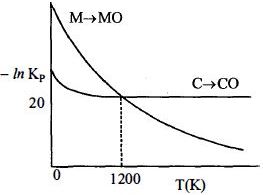
- (A) At \(T < 1200\,K,\) oxidation of carbon is unfavourable
- (B) Oxidation of carbon is favourable at all temperatures.
- (C) At \(T< 1200\,K,\) the reaction \(MO(s) +C(s) \to M(s) + CO(g)\) is spontaneous.
- (D) At \(T > 1200\,K,\) carbon will reduce \(MO(s)\) to \(M(s)\)
Show answer and solution
Correct Answer: (C)
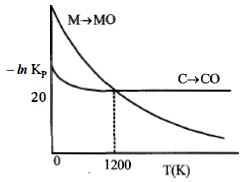
At \(< 1200\,K\), carbon will reduce \(MO(s)\) to \(M(s)\) hence, chemical reaction\(MO(s) + C(s) \to M(s) + CO(g)\) is spontaneous
No questions on this page match these filters.