


2015 में पूछे गए अध्याय
19 अध्याय- 3प्रश्न STD 12 जैव-अणु
- 1प्रश्न STD 12 ऐमीन
- 2प्रश्न STD 12 Carboxylic acids and their derivative
- 1प्रश्न STD 12 हैलोऐल्केन तथा हैलोऐरीन
- 3प्रश्न STD 12 उपसहसंयोजन यौगिक
- 4प्रश्न STD 12 D- एवं f-ब्लॉक के तत्व सबसे ज़्यादा पूछा गया
- 7प्रश्न STD 12 P-ब्लॉक के तत्व - 2 सबसे ज़्यादा पूछा गया
- 4प्रश्न STD 12 रासायनिक बलगतिकी सबसे ज़्यादा पूछा गया
- 3प्रश्न STD 12 वैद्युत रसायन
- 2प्रश्न STD 12 Solution and colligative properties
- 2प्रश्न STD 11 रसायन विज्ञान की कुछ मूल अवधारणाएँ
- 3प्रश्न STD 11 कार्बनिक रसायन शुद्धि और लक्षण वर्णन
- 2प्रश्न STD 12 ऐल्डिहाइड एवं कीटोन
- 3प्रश्न STD 11 Organic chemistry isomerism
- 3प्रश्न STD 11 रासायनिक आबंधन तथा आण्विक संरचना
- 2प्रश्न STD 11 तत्त्वों का वर्गीकरण एवं गुणधर्मों में आवर्तिता
- 3प्रश्न STD 11 साम्यावस्था - 1
- 3प्रश्न STD 11 ऊष्मागतिकी
- 3प्रश्न STD 11 परमाणु की संरचना
JEE Mains 2015 Chemistry के सभी प्रश्न
19 अध्याय54 में से 1–50 प्रश्न
-
- (A) विटामिन \(E\)
- (B) विटामिन \(K\)
- (C) विटामिन \(C\)
- (D) विटामिन \(D\)
उत्तर और हल देखें
सही उत्तर: (C)
Vitamin \(B\) and \(C\) are water soluble while vitamin \(\mathrm{A}, \mathrm{D}, \mathrm{E}\) and \(\mathrm{K}\) are fat soluble or water insoluble. -
- (A) ग्लैकोजन
- (B) ग्लूकोज़
- (C) पैरूविक अम्ल
- (D) \(L-\) लैक्टिक अम्ल
उत्तर और हल देखें
सही उत्तर: (D)
\(\underset{\begin{smallmatrix}
stored\,\,in \\
the\,\,form\,\,of\,\,\downarrow
\\
Glycogen
\end{smallmatrix}}{\mathop{Glu\cos e}}\,\,\xrightarrow[\begin{smallmatrix}
(does\,\,not\,\,need\,\,oxygen; \\
enzymes\,\,are\,\,need\,\,only)
\end{smallmatrix}]{1}\)\(\underset{\underset{Lactic\,\,acid}{\mathop{\downarrow }}\,}{\mathop{Pyruvic\,\,acid}}\,\xrightarrow{{{O}_{2}}}C{{O}_{2}}\,+\,{{H}_{2}}O\)
During vigorous exercise suffcient oxygen is not available to meet the energy demand so, energy is derived through conversion of pyruvic acid to lactic acid.
-
- (A) केवल ग्लूकोस
- (B) गैलेक्टोस और फ्रुक्टोस की सममोल मात्रा
- (C) ग्लूकोस और गैलेक्टोस की सममोल मात्रा
- (D) गैलेक्टोस और फ्रुक्टोस की सममोल मात्रा
उत्तर और हल देखें
सही उत्तर: (A)
Starch is a mixture of amylose and amylopectin polysaccharides and monomer is glucose. Thus on complete hydrolysis it gives only glucose. -
- (A) \(< CH_3NH_2 \)

- (B) \(< CH_3NH_2 \)

- (C) \(< CH_3NH_2\)

- (D) \(< CH_3NH_2 \)

उत्तर और हल देखें
सही उत्तर: (C)
Aliphatic amines are more basic than aromatic amines thus methylamine is most basic. Electron donating groups increase the basicity whereas electron withdrawing groups decrease the basicity of the aromatic amines. Thus \(p-\) methoxyaniline is more basic than aniline which is further more basic than \(p-\) nitroaniline.
- (A) \(< CH_3NH_2 \)
- 5. ऐसिटिक अम्ल का मोलर द्रव्यमान बेंजीन में हिमांक अवनमन से निकाले जाने पर जिससे प्रभावित होता है वह है। 2015 कठिन
- (A) आंशिक आयनीकरण
- (B) वियोजन
- (C) संकुल विरचन
- (D) संगुणन
उत्तर और हल देखें
सही उत्तर: (D)
Acetic acid contain carboxylic group \(-\,COOH\) which can form \(H\,-\) bonding so acetic acid dimerises.
-
- (A) वोल्फ-किश्नर अभिक्रिया
- (B) रोजेनमुंड अभिक्रिया
- (C) ईटार्ड अभिक्रिया
- (D) हेल-फोलार्ड-जेलिस्की अभिक्रिया
उत्तर और हल देखें
सही उत्तर: (D)
Hell - Volhard - Zelinsky Reaction :It is \(\alpha \) - subtitution when a carboxylic acid having \(\alpha \) - hydrogens is treated with chlorine or bromine in presence of small amount of red phosphorous.
\(R-C{{H}_{2}}COOH\,+\,{{X}_{2}}\,\xrightarrow{P}\) \(\begin{matrix}
X\,\,\,\,\,\,\,\,\,\,\,\,\,\,\,\,\,\,\,\,\,\,\,\,\,\,\,\,\,\,\,\,\,\,\,\,\,\, \\
|\,\,\,\,\,\,\,\,\,\,\,\,\,\,\,\,\,\,\,\,\,\,\,\,\,\,\,\,\,\,\,\,\,\,\,\,\,\,\,\,\, \\
RCH-COOH+HX \\
\end{matrix}\) \((X\,=\,Cl,\,Br)\) -
- (A) फिंकलस्टाइन अभ्भिक्रिया
- (B) स्वार्टस अभिक्रिया
- (C) मुक्त मूलक फ्लोरिनेशन
- (D) सैन्डमायर अभभिक्रिया
उत्तर और हल देखें
सही उत्तर: (B)
Alkyl fluorides can be prepared by action of mercurous fluoride or antimony trifluorides (inorganic fluorides) on corresponding alkyl halide. This reaction is known as Swarts reaction.\(C H_{3} B r+A g F \rightarrow \underset{\text { Methyl fluoride}}{C H_3F}+A g B r\)
But, when aciton of Nallacetone takes place on alkyl chloride of bromide alkyl lodide forms. This reaction is called Finkelstein reaction
\(C_{2} H_{2} C I \stackrel{N a t}{\longrightarrow} C_{2} H_{5} I+N a C I\)
Free redical fluorination is highly explosive reaction, so not preferred for the preparation of fluoride.
-
- (A) \({\left[ {CoC{l_4}} \right]^{2 - }}\)
- (B) \({\left[ {CoC{l_6}} \right]^{3 - }}\)
- (C) \({\left[ {CoC{l_6}} \right]^{4 - }}\)
- (D) \({\left[ {Co{{\left( {{H_2}O} \right)}_6}} \right]^{2 + }}\)
उत्तर और हल देखें
सही उत्तर: (A)
Aqueous of solution of \(CoCl_2\) contains \([Co(H_2O)_6]^{2+}\) which is pinkish in colour so option \((d)\) is incorrect. Reduction potential of \(C{o^{3 \oplus }} \to C{o^{2 \oplus }}\) is high so option \((b)\) is incorrect. \(Co^{2+}\) does not oxidises easily to \(Co^{3+}\). It is general case that symmetrical substituted octahedral complexes are less deeper in colour than tetrahedral complexes. So \([CoCl_4]^{-2}\) is deep blue in colour. -
- (A) \(CH_4\)
- (B) \(CO\)
- (C) \(CN^-\)
- (D) \(Br^-\)
उत्तर और हल देखें
सही उत्तर: (A)
The donor atoms, molecules or anions which donate a pair of electrons to the metal atom or ion and form a coordinate bond with it are called ligands. In methane there is no electrons for donation to central metal atom/ ion it is stable with complete octet configuration. -
- (A) \(4\)
- (B) \(6\)
- (C) \(2\)
- (D) \(3\)
उत्तर और हल देखें
सही उत्तर: (D)
\(\left[\mathrm{Pt}(\mathrm{Cl})(\mathrm{py})\left(\mathrm{NH}_{3}\right)\left(\mathrm{NH}_{2} \mathrm{OH}\right)\right]^{+}\) is square planar complex.The structures are formed by fixing a group and then arranging all the groups. Hence, this complex shows three geometrical isomers.

-
- (A) \((NH_4)_3 [As (Mo_3O_{10})_4]\)
- (B) \(BaCrO_4\)
- (C) \(Zn_2[Fe(CN)_6]\)
- (D) \(K_3[Co(NO_2)_6]\)
उत्तर और हल देखें
सही उत्तर: (C)
\(Z n_{2}\left[F e(C N)_{6}\right], K_{3}\left[C o\left(N O_{2}\right)_{6}\right] \) and \(\left(N H_{4}\right)_{3} A s\left[M o_{3} O_{l 0}\right]_{4}\) show color due to d-d transition while \(B a C r O_{4}\) is coloured due to charge transfer phenomenon.Further according to spectrochemical series the strong ligand possessing complex has higher energy and hence lower wavelength. Therefore, complexes containing \(N O_{2}, N H_{4}^{+}, O^{2-}\) etc., ligands show yellow colour while \(\mathrm{CN}^{-}\) forces the complex to impart white colour.
Spectrochemical series \(I^{-} < B r^{-} < S^{2-} < S C N^{-} < C I^{-} < N O_{3}^{-} < N_{3}^{-} < F^{-} < O H^{-}\)
\( < C_{2} O_{4}^{2-}=H_{2} O < N C S^{-} < C H_{3} C N < p y < N H_{3} < e n\)
\( < b i p y < phen < N o_{2}^{-} < p p h_{3} < C N^{-}=C O\)
- 12. एक गुलाबी लवण, गरम करने पर नीला हो जाता है। लवण में किस धनायन के होने की सर्वाधिक संभावना है ? 2015 मध्यम
- (A) \(Co^{2+}\)
- (B) \(Cu^{2+}\)
- (C) \(Zn^{2+}\)
- (D) \(Fe^{2+}\)
उत्तर और हल देखें
सही उत्तर: (A)
\(Zn^{2+}\) salts are white. Usually \(Fe^{2+}\) salts are rarely pink. \(Cu^{2+}\) salts are usually blue in hydrated form. \(Co^{2+}\) is pink in aqueous solution -
- (A) \(L \rightarrow M\) आवेश स्थानांतरण संक्रमण
- (B) \(\sigma-\sigma^{*}\) संक्रमण
- (C) \(M \rightarrow L\) आवेश स्थानांतरण संक्रमण
- (D) \(d - d\) संक्रमण
उत्तर और हल देखें
सही उत्तर: (A)
\(K M n O_{4} \rightarrow K^{+}+M n O_{4}^{-}\)\(\therefore \ln M n O_{4}^{-},\) Mn has \(+7\) oxidation state having no electron in d-orbitals. It ts considered that higher the oxidation state of metal, greater is the tendency to occur \(L \rightarrow M\) charge transfer,
because ligand is able to donate the electron into the vacant ( - orbital of metal.
since, charge transfer is laporate as well as spin allowed, therefore, it shows colour
-
- (A) \(Na _{2} Cr _{2} O _{7}\) की विलयता \(K _{2} Cr _{2} O _{7}\) से कम है।
- (B) आयतनी विश्लेषण में \(Na _{2} Cr _{2} O _{7}\) एक प्राथमिक मानक है।
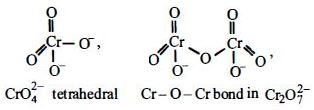
- (C) \(CrO _{4}^{2-}\) चतुष्फलकीय आकार का है।
- (D) \(Cr _{2} O _{7}^{2-}\) में एक \(Cr - O - Cr\) आबंध है।
उत्तर और हल देखें
सही उत्तर: (A)
\(Na_2Cr_2O_7\) is used as primary standard in volumetryHydration energy of \(Na^+\) is greater then \(K^+\). Because of smaller size of \(Na^+\) , \(Na_2Cr_2O_7\) is more soluble than \(K_2Cr_2O_7\).
-
- (A) अभिकथन गलत है परन्तु तर्क सही है।
- (B) अभिकथन व तर्क दोनों गलत हैं।
- (C) अभिकथन और तर्क दोनों सही हैं और तर्क अभिकथन का सही स्पष्टीकरण है।
- (D) अभिकथन और तक दोनों सही हैं परन्तु तक अभिकथन का सही स्पष्टीकरण नहीं है।
उत्तर और हल देखें
सही उत्तर: (C)
Nitrogen and oxygen in air do not react to form oxides of nitrogen in atmosphere because the reaction between nitrogen and oxygen requires high temperature. -
- (A) \(H_4P_2O_5\)
- (B) \((HPO_3)_3\)
- (C) \(H_4P_2O_6\)
- (D) \(H_4P_2O_7\)
उत्तर और हल देखें
सही उत्तर: (C)
\(H_4P_2O_6\) has \(P-P\) linkage\(\begin{array}{*{20}{c}}
{\begin{array}{*{20}{c}}
{\,\,O\,\,\,\,\,\,\,\,O\,} \\
{\,||\,\,\,\,\,\,\,\,\,||}
\end{array}} \\
{HO - P - P - OH} \\
{|\,\,\,\,\,\,\,\,\,|\,} \\
{\,\,\,\,OH\,\,\,OH}
\end{array}\) -
- (A) इसे प्लास्टिक या मोमअटे कांच बोतलों में अंधेरे में संग्रहित किया जाता है
- (B) प्रकाश में इसका अपघटन होता है
- (C) यह केवल ऑक्सीकारक है
- (D) इसे धूल से दूर रखना चाहिए
उत्तर और हल देखें
सही उत्तर: (C)
(A) It has to be stored in plastic or wax, lined glass bottles in dark to prevent its decomposition. Thus, the option (A) is correct.(B) It has to be kept away from dust as it decomposes in presence of dust. Thus, the option (B) is correct.
(C) Hydrogen peroxide can act as oxidizing as well as reducing agent. For example, in acidic medium, it oxidizes ferrous ions to ferric ions. \(2 \mathrm{Fe}^{2+}+\mathrm{H}_{2} \mathrm{O}_{2}+2 \mathrm{H}^{+} \rightarrow 2 \mathrm{Fe}^{3+}+2 \mathrm{H}_{2} \mathrm{O}\)
In acidic medium, hydrogen peroxide reduces HOCI to chloride ion. \(\mathrm{HOCl}+\mathrm{H}_{2} \mathrm{O}_{2} \rightarrow \mathrm{H}^{+}+\mathrm{Cl}^{-}+\mathrm{H}_{2} \mathrm{O}+\mathrm{O}_{2}\)
Thus, the option \(C\) is incorrect.
(D) It decomposes on exposure to light to form water and oxygen. \(2 \mathrm{H}_{2} \mathrm{O}_{2} \rightleftharpoons 2 \mathrm{H}_{2} \mathrm{O}+\mathrm{O}_{2}\)
Thus, the option (D) is correct.
-
- (A) केवल \(HCl\)
- (B) \(HCl\) और \(HClO_2\)
- (C) \(HCl\) और \(HOCl\)
- (D) \(HOCl\) और \(HOCl_2\)
उत्तर और हल देखें
सही उत्तर: (C)
Chlorinated water is yellow in colour on standing reaction occurs \(Cl_2 + H_2O \to HCl + HOCl\) -
- (A) \(Kr\)
- (B) \(Xe\)
- (C) \(He\)
- (D) \(Ne\)
उत्तर और हल देखें
सही उत्तर: (B)
As we move down the group, the melting and boiling points show a regular increase due to corresponding increase in the magnitude of their van der waal forces of attraction as the size of the atom increases. -
- (A) क्लोरीन
- (B) नाइट्रोजन
- (C) फ्लुओरीन
- (D) सल्फर
उत्तर और हल देखें
सही उत्तर: (C)
Flourine is the most electronegative element and has least tendency to form double bonds. -
- (A) \(X_2O_3\)
- (B) \(X_2Cl_3\)
- (C) \(X_2(SO_4)_3\)
- (D) \(XPO_4\)
उत्तर और हल देखें
सही उत्तर: (B)
\(X_2O_3\Rightarrow X^{3+}O^{2-}\)\(X_2Cl_3\Rightarrow X^{3+}Cl^{2-}\)
\(X_2(SO_4)_3\Rightarrow X^{3+}SO_4^{2-}\)
\(XPO_4\Rightarrow X^{3+}PO_4^{3-}\)
Because \(Cl^{2-}\) does not exist. So, \(X_2Cl_3\) is incorrect. The correct formula should be \(XCl_3\).
-
- (A) आधा रह जाएगा
- (B) समान रहेगा
- (C) दुगुना हो जाएगा
- (D) चार गुना हो जाएगा
उत्तर और हल देखें
सही उत्तर: (C)
Rate \(= K[A][B]=R\)\(R'\, = \,K\left[ A \right]\left[ {2B} \right]\)
\(\frac{R}{{R'}}\, = \,\frac{{k[A][B]}}{{k[A][2B]}}\, = \,\frac{{k[A][B]}}{{2k[A][B]}}\)
\( \Rightarrow \,2R\, = \,R'\) i.e., rate become doubles.
-
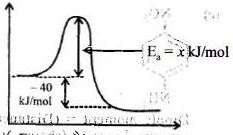
- (A) \(E_f\, = 80\, k\,J/mol ; E_b\, = 120\, k\,J/mol\)
- (B) \(E_f\, = 60\, k\,J/mol ; E_b\, = 100\, k\,J/mol\)
- (C) \(E_f\, = 30\, k\,J/mol ; E_b\, = 70\, k\,J/mol\)
- (D) \(E_f\, = 70\, k\,J/mol ; E_b\, = 30\, k\,J/mol\)
उत्तर और हल देखें
सही उत्तर: (A)
\(\left( {\frac{{{E_{\mathop {forwad}\limits_{(A \to B)} }}}}{{{E_{\mathop {backward}\limits_{(B \to A)} }}}}} \right) = \frac{2}{3} = \frac{x}{{ - 40 + x}}\)\( \Rightarrow - 80 + 2x = 3x\)
\( \Rightarrow x = - 80\,kJ/mol\) for forward
For backward \( = - 40 + ( - 80 = - 120\,kJ/mol)\)
Because activation energy cannot be negative
so, for forwad reaction \(E_a=80\,kJ/mol\)
for forwad reaction \(E_a=120\,kJ/mol\)
-
- (A) \(106.25\)
- (B) \(150\)
- (C) \(125\)
- (D) \(116.25\)
उत्तर और हल देखें
सही उत्तर: (A)
\((a)\) Rate law forr first order reaction \(=\,k[N_2O_5]\)\(2{{N}_{2}}{{O}_{5}}\,(g)\,\to \,4N{{O}_{2}}\,(g)\,+\,{{O}_{2}}(g)\)
\(\mathop {t = 0\,\,\min }\limits_{(\Pr essure\,\,\,in\,\,\,mm\,\,\,Hg)} \) \(50\) \(0\) \(0\)
\(\mathop {t =30\,\,\min }\limits_{(\Pr essure\,\,\,in\,\,\,mm\,\,\,Hg)} \) \(50-2p\) \(4p\) \(p\)
Total pressure \(50-2p+4p+p=50+3p=87.5\,mm\,Hg\)
\(\therefore \,\,P\, = \,12.5\,mm\,Hg\)
\(\therefore \,\,{P_0}\, = 50\) and \(P\) \((t=30\,min)\)
\(=\,25\) for \(N_2O_5\) reactant
\(\therefore \,\,k\, = \,\frac{{2.303}}{{30\,\,\min }}\, \times \,\log \,\left( {\frac{{50}}{{25}}} \right)\,\) \( = \,\frac{{2.303}}{{60\,\,\min }}\, \times \,\log \,\left( {\frac{{50}}{x}} \right)\)
On solving \(x=12.5\,\,mm\,Hg\,=\,50-2p\)
\(\therefore P=18.75\,\,mm\,Hg\)
\(\therefore \) Total pressure \(=50+3P=106.25\,\,mm\,Hg\)
-
- (A) अधिक अणुओं के शामिल होने से एंट्रापी और संक्रियण ऊर्जा में वृद्धि होती है।
- (B) टकराव से सक्रिय स्पीशीज़ का क्षय होता है।
- (C) प्रतिक्रिया में सभी प्रजातियों के एक साथ टक्कर की संभावना कम होती है।
- (D) लोचदार टकराव के कारण अभिकारकों की दिशा में साम्य का स्थानांतरण होता है।
उत्तर और हल देखें
सही उत्तर: (C)
Reactions of higher order \((>3 )\) are very rate due to very less chances of many molecules to undergo effective collisions. -
- (A) दोनों स्थिति में एनोड से कैथोड
- (B) कैथोड से एनोड तथा एनोड से कैथोड
- (C) एनोड से कैथोड तथा कैथोड से एनोड
- (D) दोनों स्थिति में कैथोड से एनोड
उत्तर और हल देखें
सही उत्तर: (C)
\(EMF\) of galvanic cell \(= 1 .1\,volt\)
If \(E_{ext} < EMF\) then electron flows steadily from anode to cathode while If \(E_{ext} > EMF\) there electron flows from cathode to anode as polarity is changed. -
- (A) \(Cl^-, Br^-\) और \(I^-\)
- (B) \(Br^-\) और \(I^-\)
- (C) \(Cl^-\) और \(Br^-\)
- (D) \(I^-\) मात्र
उत्तर और हल देखें
सही उत्तर: (B)
\(MnO_4^ - \, + \,8{H^ + }\, + \,5{e^ - }\, \to \,M{n^{2 + }}\, + \,4{H_2}O\)\(E\, = \,1.51 - \,\frac{{0.059}}{5}\log \frac{{[M{n^{2 + }}]}}{{[MnO_4^ - ]\,\,{{[{H^ + }]}^8}}}\)
Taking \(Mn^{2+}\) and \(MnO_4^-\) in standard state i.e.\(1\,M,\)
\(E\, = \,1.51 - \,\frac{{0.059}}{5}\, \times \,\,8\,\,\log \frac{1}{{\,[{H^ + }]}}\)\(\, = \,1.51 - \,\frac{{0.059}}{5}\, \times \,\,8\, \times \,3 = 1.2268\,\,V\)
Hence at this \(pH,\) \(MnO_4^-\) will oxidise only \(Br^-\) and \(I^-\) as \(SRP\) of \(Cl_2/Cl^-\) is \(1.36\,V\) which is greater than that for \(MnO_4^-\) \(/Mn^{2+}\).
-
- (A) \(2\)
- (B) \(127\)
- (C) \(0 \)
- (D) \(63.5\)
उत्तर और हल देखें
सही उत्तर: (D)
\(C u^{2+}+2 e^{-} \longrightarrow C u\)\(2 F\) i.e. \(2 \times 96500 C\) deposit \(C u=1 \mathrm{mol}=63.5 \mathrm{g}\)
-
- (A) \(128\)
- (B) \(488\)
- (C) \(32\)
- (D) \(64\)
उत्तर और हल देखें
सही उत्तर: (D)
\(\frac{P^{o}-P_{x}}{P_{x}}=\frac{w_{2} M_{1}}{w_{1} M_{2}}\)where \(w_{1}, \,M_{1}=\) mass in \(g\)
and mol. mass of solvent
\(w_{2}, M_{2}=\) mass in \(g\)
and mol. mass of solute
Let \(M_{2}=x\)
\(P^{o}=185\,torr\) ; \(P_{s}=183\,torr\)
\(\frac{185-183}{183}=\frac{1.2 \times 58}{100 x}\)
(Mol. mass of acetone \(=58\) )
\(x=64\)
Molar mass of substance \(=64\)
-
- (A) \(35.8\,torr\) और \(0.280\)
- (B) \(38.0\,torr\) और \(0.589\)
- (C) \(30.5\,torr\) और \(0.389\)
- (D) \(30.5\,torr\) और \(0.480\)
उत्तर और हल देखें
सही उत्तर: (B)
Total \(V.P.\) of solution \(=\,P^o_Ax_A\,+\,P^o_Bx_B\)Given, \(P^o_A\,=\,74.7\,torr\), \(P^o_B\,=\,22.3\,torr\)
\(n_{benzene}\,=\,1.5\,mol\), \(n_{toluene}\,=\,3.5\,mol\)
\(n_{solution}\,=\,1.5+3.5=5\,mol\)
\(X_A\,=\,\frac {n_{benzene}}{n_{solution}}\,=\,\frac {1.5}{5}\)
Total \(V.P.\) of solution
\( = \left( {\frac{{1.5}}{5}\, \times \,74.7\, + \,\frac{{3.5}}{5}\, \times \,22.3} \right)\,torr\)
\(=\,(15.6+22.4)\,torr\,\,=\,38\,torr\)
Mole fraction of benzene in vapour form
\(=\,\frac {22.4}{38}\,=\,0.589\)
-
- (A) \(BaC{l_2}.4{H_2}O\)
- (B) \(BaC{l_2}.3{H_2}O\)
- (C) \(BaC{l_2}.{H_2}O\)
- (D) \(BaC{l_2}.2{H_2}O\)
उत्तर और हल देखें
सही उत्तर: (D)
Weight of hydrated \(BaCl_2 = 61\,g\)Weight of anhydrous \(BaCl_2 = 52\,g\)
Loss in mass \(= 9\,g\)
Assuming \(BaCl_2.xH_2O\) as hydrate mass of \(H_2O = 9\,g\)
Moles of \({{H}_{2}}O=\frac{9}{18}=0.5\)
Grass molecular let of \(BaCl_2 = 208\)
\(\%\) of \(H_2O\) in this hydrated \(BaC{{l}_{2}}=\frac{9}{61}\times 100\)
\(=14.75\%\)
\(=\frac{18x}{208+18x}\times 100\) on solving \(x = 2\)
This percentage is present in \(BaCl_2.2H_2O\)
-
- (A) \(50\)
- (B) \(60\)
- (C) \(70\)
- (D) \(40\)
उत्तर और हल देखें
सही उत्तर: (A)
\(A+3B+3C\rightleftharpoons A{{B}_{2}}{{C}_{3}}.....(1)\)No. of moles of \(A=\frac{6.0\,g}{60\,g/mol}=0.1\,mol\)
No. of moles of \(B=\frac{6.00\times {{10}^{23}}}{6.000\times {{10}^{23}}}=1\,mol\)
No. of moles of \(C = 0.036\)
\(AB_2C_3\) formed accordingly to \(C\) which is a limiting reagent.
Since \(3\) moles of \(C\) are used in \((1)\)
So it gives \(1\) mole of \(AB_2C_3\)
\(n_{A{{B}_{2}}{{C}_{3}}}=\frac{0.036}{3}=0.012\)
\(=\frac{Given\,mass\,(4.8)}{Molecular\,mass\,(M.M)}\)
Mol.mass \(=\frac{4.8}{0.012}=400\)
\(\Rightarrow 400=60+(2\times x)+(80\times 3)\)
\(\Rightarrow x=50\)
-
- (A) \(10\)
- (B) \(3\)
- (C) \(24\)
- (D) \(5\)
उत्तर और हल देखें
सही उत्तर: (A)
Mili equivalents of \(H_2SO_4\)\( = 60 \times \frac{{M \times 2}}{{10}} = 12\)
Mili equivalents of \(NaOH = 20 \times \frac{M}{{10}} = 2\)
Mili equivalents of \(N{H_3} = 12 - 2 = 10\)
\(\% \,\) of nitrogen \( = \frac{{1.4 \times (N \times V)N{H_3}}}{{(Wt.\,of\,organic\,compound)}}\)
\(\frac{{1.4 \times 10}}{{1.4}} = 10\)
-
- (A) \(48\)
- (B) \(60\)
- (C) \(24\)
- (D) \(36\)
उत्तर और हल देखें
सही उत्तर: (C)
Mass of substance \(=250 \mathrm{mg}=0.250 \mathrm{g}\)Mass of \(A g B r=141 \mathrm{mg}=0.141 \mathrm{g}\)
\(1\; mole\) of \(A g B r=1\; g\) atom of \(B r\)
\(188 g\) of \(A g B r=80 g\) of \(B r\)
\(188 g\) of \(A g B r\) contain bromine \(=80 g\)
\(0.141 g\) of \(A g B r\) contain bromine \(=\frac{80}{188} \times 0.141\)
This much amount of bromine present in \(0.250 \mathrm{g}\) of organic compound
\(\because \%\) of bromine \(=\frac{80}{188} \times \frac{0.414}{0.250} \times 100=24 \%\)
-
- (A) \(A - (ii); B - (iii) ; C - (i)\)
- (B) \(A - (iii); B - (i) ; C - (ii)\)
- (C) \(A - (iii); B - (ii) ; C - (i)\)
- (D) \(A - (ii); B - (i) ; C - (iii)\)
उत्तर और हल देखें
सही उत्तर: (C)
\((c)\) In Lassaigne's test, fusion with sodium take place and following species formed respectively.\((a)\) Aniline \(\to \) \(CN^-\)
\((b)\) Benzene sulfonic acid \(\to \) (figure)
\((c)\) Thiourea \(\to \) \(S^{2-}\)
Reaction of \(CN^-\) with hot and acidic solution of \(FeSO_4\) lead to formation of \(Fe_4[Fe(CN)_6]_3\) which is blue in colour. It contains iron in both \(II\) and \(III\) oxidation state.
Reaction of \(S^{2-}\) with sodium nitroprusside
\(N{a_2}S + N{a_2}[Fe{(CN)_5}NO] \to \mathop {N{a_4}[Fe{{(CN)}_5}NOS]}\limits_{(violet\,in\,colour)} \)
Phenoxide ion on reacting with \(FeCl_3\) give red colour with \(FeCl_3\).

-
- (A) \(C_6H_5CH_2OH\)
- (B) \(C_6H_5CHO\)
- (C) \(C_6H_5COOH\)
- (D) \(C_6H_5CH_3\)
उत्तर और हल देखें
सही उत्तर: (B)
Toluene undergoes oxidation with \(K M n O_{4},\) fonns benzoic acid. In this conversion, alkyl part of toluene converts into carboxylic group. Further, benzoic acid reacts with thionyl chloride \(\left(S O C l_{2}\right)\) to give benzoyl chloride which upon reduction with \(H_{2} / P d\) or \(B a S O_{4}\) forms benzaldehyde (Rosenmund reduction)
-
- (A) \(C_6H_5 - CH_2 - CH_2 - CH_2 - CH_2 - Cl\)
- (B) \(\begin{array}{*{20}{c}}
{{C_6}{H_5} - C{H_2} - C{H_2} - CH - C{H_3}}\\
{\,\,\,\,\,\,\,\,\,\,\,\,\,\,\,\,\,\,\,\,\,\,\,\,\,\,\,\,\,\,\,\,\,\,\,\,\,\,\,\,\,\,\,\,\,\,|\,\,\,\,\,\,\,\,\,\,}\\
{\,\,\,\,\,\,\,\,\,\,\,\,\,\,\,\,\,\,\,\,\,\,\,\,\,\,\,\,\,\,\,\,\,\,\,\,\,\,\,\,\,\,\,\,Cl}\,\,\,\,\,\,
\end{array}\) - (C) \(C_6H_5 -CH_2\) \( - \begin{array}{*{20}{c}}
{} \\
{} \\
C \\
| \\
{Cl}
\end{array} < \begin{array}{*{20}{c}}
{C{H_3}} \\
{C{H_3}}
\end{array}\)
उत्तर और हल देखें
सही उत्तर: (C)
Compound \(A\) reacts with alc. \(KOH\) to give compound \(B\) which on further ozonolysis gives \(C\) (does not contains \(\alpha -H\) atom) and \(D\) (contains \(\alpha -H\) atom). This reaction sequence can be achieved by compound in option \((a)\) and \((c)\). Since compound \(A\) gives white ppt. with \(AgNO_3\) preferable option will be \((c)\) as tert alkyl reacts with \(AgNO_3\) more quickly.
-
- (A) \(2 -\) क्लोरोप्रोपेनल
- (B) \(2 -\) क्लोरोब्यूटेन
- (C) \(2 -\) क्लोरोपेन्टेन
- (D) \(2 -\) क्लोरो \(- 2-\) मेथिलब्यूटेन
उत्तर और हल देखें
सही उत्तर: (D)
The optically inactive compound must containst achiral carbon atoms \((s)\). Option \((d)\) contains achiral carbon atom\(\underset{2-chloropropanol}{\mathop{\begin{matrix}
\,Cl\, \\
|\,\, \\
C{{H}_{3}}-C-CHO \\
|\,\, \\
H\, \\
\end{matrix}}}\,\) \(\underset{2-chlorobu\tan e\,(chiral)}{\mathop{\begin{matrix}
\,\,\,\,\,\,\,\,\,\,\,\,\,\,\,\,Cl \\
\,\,\,\,\,\,\,\,\,\,\,\,\,\,\,\,\,\,\,\,\,|\,\,\,\,\,\, \\
C{{H}_{3}}-C{{H}_{2}}-C-C{{H}_{3}} \\
\,\,\,\,\,\,\,\,\,\,\,\,\,\,\,| \\
\,\,\,\,\,\,\,\,\,\,\,\,\,\,\,\,H \\
\end{matrix}}}\,\)\(\underset{(chiral)}{\mathop{\underset{2-chloropen\tan e}{\mathop{\begin{matrix}
\,\,\,\,\,\,\,\,\,\,\,\,\,\,\,\,\,\,\,\,\,\,\,\,\,\,\,\,\,\,\,\,\,\,\,\,Cl \\
\,\,\,\,\,\,\,\,\,\,\,\,\,\,\,\,\,\,\,\,\,\,\,\,\,\,\,\,\,\,\,\,\,\,\,| \\
C{{H}_{3}}-C{{H}_{2}}-C{{H}_{2}}-C-C{{H}_{3}} \\
\,\,\,\,\,\,\,\,\,\,\,\,\,\,\,\,\,\,\,\,\,\,\,\,\,\,\,\,\,\,\,\,\,\,| \\
\,\,\,\,\,\,\,\,\,\,\,\,\,\,\,\,\,\,\,\,\,\,\,\,\,\,\,\,\,\,\,\,H \\
\end{matrix}}}\,}}\,\) \(\underset{(achiral)}{\mathop{\underset{2-chloro-2-methylbu\tan e}{\mathop{\begin{matrix}
C{{H}_{3}} \\
| \\
C{{H}_{2}}-C-C{{H}_{3}} \\
| \\
Cl \\
\end{matrix}}}\,}}\,\) -
- (A) \(2 -\) केनिल \(-1 -\) ब्युटीन
- (B) \(1, 1 -\) डाईफेनिल \(- 1 -\) केनिल
- (C) \(1 -\) केनिल \(- 2 -\) ब्युटीन
- (D) \(3 -\) केनिल \(-1 -\) ब्युटीन
उत्तर और हल देखें
सही उत्तर: (C)
\(1 -\) Phenyl- \(2 -\)butene the two groups around each of the doubly bonded carbon Because, all are different. This compound can show \(c i s -\) and \(t r a n s -\) isomerism -
- (A) \(\begin{array}{*{20}{c}}
{C{H_3} - C{H_2} - C{H_2} - C - C{H_3}} \\
{\,\,\,\,\,\,\,\,\,\,\,\,\,\,\,\,\,\,\,\,\,\,\,\,\,\,\,\,\,\,\,\,\,\,\,\,\,||\,} \\
{\,\,\,\,\,\,\,\,\,\,\,\,\,\,\,\,\,\,\,\,\,\,\,\,\,\,\,\,\,\,\,\,\,\,\,\,O}
\end{array}\) और \(\begin{array}{*{20}{c}}
{C{H_3} - C{H_2} - C - C{H_2} - C{H_3}} \\
{\,\,\,\,\,\,\,\,\,\,\,\,\,\,\,\,\,\,\,\,\,\,\,\,\,\,\,\,\,\,\,\,\,\,\,\,\,||\,\,\,\,\,\,\,\,\,\,\,\,\,\,\,\,\,\,\,\,\,\,\,\,\,\,\,\,\,\,\,\,\,\,\,\,} \\
{\,\,\,\,\,\,\,\,\,\,\,\,\,\,\,\,\,\,\,\,\,\,\,\,\,\,\,\,\,\,\,\,\,\,\,\,O\,\,\,\,\,\,\,\,\,\,\,\,\,\,\,\,\,\,\,\,\,\,\,\,\,\,\,\,\,\,\,\,\,\,\,}
\end{array}\) - (B) \(C{H_3} - C{H_2} - C{H_2} - C{H_2} - CHO\) और \(\begin{array}{*{20}{c}}
{\,\,\,\,\,\,\,\,\,\,\,\,\,\,\,\,\,\,\,\,\,\,\,\,\,\,\,\,\,\,\,\,\,\,\,\,\,O} \\
{\,\,\,\,\,\,\,\,\,\,\,\,\,\,\,\,\,\,\,\,\,\,\,\,\,\,\,\,\,\,\,\,\,\,\,\,||} \\
{C{H_3} - C{H_2} - C{H_2} - C - C{H_3}}
\end{array}\) - (C) \(\begin{array}{*{20}{c}}
{C{H_3} - C{H_2} - C{H_2} - C - C{H_3}} \\
{\,\,\,\,\,\,\,\,\,\,\,\,\,\,\,\,\,\,\,\,\,\,\,\,\,\,\,\,\,\,\,\,\,\,\,\,||} \\
{\,\,\,\,\,\,\,\,\,\,\,\,\,\,\,\,\,\,\,\,\,\,\,\,\,\,\,\,\,\,\,\,\,\,\,\,\,O}
\end{array}\) और \(\begin{array}{*{20}{c}}
{C{H_3} - CH - C{H_2} - CHO} \\
{|\,\,\,\,\,\,\,\,\,\,\,\,\,\,\,\,\,\,\,\,\,\,\,\,} \\
{C{H_3}\,\,\,\,\,\,\,\,\,\,\,\,\,\,\,\,\,\,\,}
\end{array}\) - (D) \(\begin{array}{*{20}{c}}
{C{H_3} - C{H_2} - C - C{H_2} - C{H_3}} \\
{\,\,\,\,\,\,\,\,\,\,\,\,\,\,\,\,\,\,\,\,\,\,\,\,\,\,\,\,\,\,\,\,\,\,\,\,||\,\,\,\,\,\,\,\,\,\,\,\,\,\,\,\,\,\,\,\,\,\,\,\,\,\,\,\,\,\,\,\,\,\,\,\,} \\
{\,\,\,\,\,\,\,\,\,\,\,\,\,\,\,\,\,\,\,\,\,\,\,\,\,\,\,\,\,\,\,\,\,\,\,\,\,O\,\,\,\,\,\,\,\,\,\,\,\,\,\,\,\,\,\,\,\,\,\,\,\,\,\,\,\,\,\,\,\,\,\,\,\,\,}
\end{array}\) और \(\begin{array}{*{20}{c}}
{C{H_3}} \\
{C{H_3}}
\end{array} > CH\) \(-CH_2-CHO\)
उत्तर और हल देखें
सही उत्तर: (A)
Pentan \(-2-\) one and pentan \(-3-\) one are position isomers \((b) , (c) , (d)\) contain different compounds aldehyde and ketones. - (A) \(\begin{array}{*{20}{c}}
-
- (A) अभिकथन गलत है और तर्क सही है।
- (B) अभिकथन सही है मगर तर्क गलत है।
- (C) अभिकथन व तर्क दोनों सही हैं और तर्क अभिकथन का सही स्पष्टीकरण है।
- (D) अभिकथन व तर्क दोनों सही हैं मगर तर्क अभिकथन का सही स्पष्टीकरण नहीं है।
उत्तर और हल देखें
सही उत्तर: (B)
Assertion is correct but reason is incorrect. Bonding \(MO\) shows constructive interference of the combining electron oxide waves. -
- (A) \(0.5\)
- (B) \(0.05\)
- (C) \(0\)
- (D) \(1.0\)
उत्तर और हल देखें
सही उत्तर: (B)
\(1\,e = 1.602 \times {10^{ - 19}}\,C\)\(1\,esu = 3.33 \times {10^{ - 10}}\,C\)
\(\frac{{1\,e}}{{1\,esu}} = \frac{{1.602 \times {{10}^{ - 19}}\,C}}{{3.33 \times {{10}^{ - 10}}\,C}}\)
\(1\,e = 4.802 \times {10^{ - 10}}\,esu\,\)
Dipole moment \(= q \times \) distance
\( \Rightarrow \,1\,D \approx {10^{ - 18}}\,esu\,cm\)
\(0.38 \times {10^{ - 18}}\,esu\,cm = q \times (1.61 \times {10^{ - 8}}\,cm)\)
\(q = 2.36 \times {10^{ - 11}}\,esu\)
\(q = \frac{{2.36 \times {{10}^{ - 11}}\,esu}}{{4.802 \times {{10}^{ - 10}}\,esu}}\)
\(q = 0.049\)
\(q \approx 0.05\) fractional charge
-
- (A) पंचकोणीय समतलीय
- (B) अष्टफलकीय
- (C) वर्ग पिरामिडी
- (D) त्रिकोणीय द्विपिरामिडी
उत्तर और हल देखें
सही उत्तर: (C)
In \(XeOF_4\), \(Xe\) is \(sp^3d^2\), hybridised having \(6\) bond pairs and \(1\) lone pair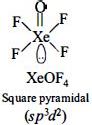
- 44. आवर्त सारणी के दीर्घ स्वरूप में, अगर संयोजी कोश इलेक्ट्रॉन विन्यास \(5 s ^{2} \;5 p ^{4}\) है तब वह तत्व उपस्थित है। 2015 मध्यम
- (A) वर्ग \(16\) और आवर्त \(6\) में
- (B) वर्ग \(17\) और आवर्त \(6\) में
- (C) वर्ग \(16\) और आवर्त \(5\) में
- (D) वर्ग \(17\) और आवर्त \(5\) में
उत्तर और हल देखें
सही उत्तर: (C)
Tellurium \((Te)\) has \(5s^2\,5p^4\) valence shell configuration. It belongs to group \(16\) and present in period \(5\) of the periodic table. - 45. \(N ^{3-}, O ^{2-}\) तथा \(F ^{-}\) की आयनिक त्रिज्यायें (\(\mathop A\limits^o \) में ) क्रमश: हैं 2015 आसान
- (A) \(1.71, 1.40\) तथा \(1.36\)
- (B) \(1.71, 1.36\) तथा \(1.40\)
- (C) \(1.36, 1.40\) तथा \(1.71\)
- (D) \(1.36, 1.71\) तथा \(1.40\)
उत्तर और हल देखें
सही उत्तर: (A)
The ionic radii (in \(\dot{A}\) ) of \(N^{3-}, O^{2-}\) and \(F^{-}\) are respectively 1.71,1.40 and \(1.36 .\)\(N^{3-}, O^{2-}\) and \(F^{-}\) contains ten electrons each. Hence, they are isoelectronic species.
For isoelectronic species, the nuclear charge increases on moving from left to right in a period.
This decreases the ionic radii as the valence electrons are more strongly attracted by the nucleus.
-
- (A) अग्र दिशा में क्योंकि \(Q < K _{C}\)
- (B) विपरीत दिशा में क्योंकि \(Q < K _{ C }\)
- (C) विपरीत दिशा में क्योंकि \(Q > K _{ C }\)
- (D) अग्र दिशा में क्योंकि \(Q > K _{ C }\)
उत्तर और हल देखें
सही उत्तर: (D)
\(\Delta G^{\circ}=2494.2 \,J\)\(2 A \rightleftharpoons B+C\)
\(R=8.314 \,J / K / \mathrm{\,mol}\)
\(e=2.718\)
\([A]=\frac{1}{2},[B]=2\)
\([C]=\frac{1}{2} ; Q=\frac{|B||C|}{|A|^{2}}\)
\(=\frac{2 \times 1 / 2}{\left(\frac{1}{2}\right)^{2}}=4\)
\(\Delta G^{\circ}=-2.303 R T \log K_{c}\)
\(2494.2 \,J=-2.303 \times(8.314 \,J / K /\, m o l) \times(300 K) \log K_{c}\)
\(\Rightarrow \log K_{e}\)
\(=-\frac{2494.2 \,J}{2.303 \times 8.314 \,J / K /\, m o l \times 300 \,K}\)
\(\Rightarrow \log K_{c}=-0.4341 ; K_{c}=0.37 ; Q>K_{c}\)
-
- (A) \(1.56\)
- (B) \(6.22\)
- (C) \(3.11\)
- (D) \(4.56\)
उत्तर और हल देखें
सही उत्तर: (C)
\(\mathop {\mathop {\,\,\,}\limits_{t = 0} }\limits_{t = equilibrium} \mathop {\mathop {{N_2}{O_4}(g)}\limits_1 }\limits_{1 - \alpha } \leftrightarrow \mathop {\mathop {2N{O_2}(g)}\limits_0 }\limits_{2\alpha } \)Where \(\alpha =\) Degree of dissociation.
Mol. wt. of mixture
\( = \frac{{(1 - \alpha ) \times {M_{{N_2}{O_4}}} + 2\alpha \times {M_{N{O_2}}}}}{{(1 + \alpha )}}\)
\( = \frac{{(1 - 0.2)92 + 2 \times 0.2 \times 46}}{{(1 + 0.2)}} = 76.66\)
Now, As per ideal gas equation
\(PV = nRT\)
\(P{M_{mixture}} = dRT\)
\(\therefore d = \frac{{P{M_{mix.}}}}{{RT}} = \frac{{1 \times 76.66}}{{0.0821 \times 300}} = 3.11\,g/L\)
-
- (A) निकाय की ऐन्ट्रॉपी घटती है।
- (B) निकाय की गिब्ज ऊर्जा बढ़ती है।
- (C) साम्यावस्था पर कोई प्रभाव नहीं होता है।
- (D) साम्यावस्था अग्र दिशा में अग्रसर होती है।
उत्तर और हल देखें
सही उत्तर: (D)
Volume of ice is greater than that of water. The direction in which the reaction will proceed can be predicted by applying LeChatelier's principle
\({\text{Pressure }} \propto {\text{ }}\frac{1}{{{\text{Vo1ume}}}}\)
So equilibrium, will shift forward. -
- (A) \(2.48 \times 10^4\,\,nm\)
- (B) \(1.49 \times 10^3\,\,nm\)
- (C) \(2.48 \times 10^3\,\,nm\)
- (D) \(1.49 \times 10^4\,\,nm\)
उत्तर और हल देखें
सही उत्तर: (B)
In \(C{H_4},\,4 \times B{E_{(C - H)}} = 360\,kJ/mol\)\(\therefore \,B{E_{(C - H)}} = 90{\kern 1pt} kJ/mol\)
In \({C_2}{H_6},\,B{E_{(C - C)}} + 6 \times B{E_{(C - H)}} = 620\,kJ/mol\)
\(\therefore \,B{E_{(C - C)}} = 80{\kern 1pt} kJ/mol\)
\(\therefore \,B{E_{(C - C)}} = \frac{{80 \times {{10}^3}}}{{6.023 \times {{10}^{23}}}}\,J/molecule\)
Now, \(E = \frac{{hc}}{\lambda }\)
\(\therefore \,\lambda = \frac{{6.626 \times {{10}^{ - 34}} \times 3 \times {{10}^8} \times 6.023 \times {{10}^{23}}}}{{80 \times {{10}^3}}}\)
\(\therefore \,\lambda = 1.419 \times {10^3}\,nm\)
-
- (A) अधिशोषण की एन्थैल्पी ॠणात्मक है।
- (B) अधिशोषण पर, पृष्ठ ऊर्जा का ह्रास ऊष्मा के रूप में प्रकट होता है।
- (C) अधिशोषण पर, पृष्ठ पर अवशिष्ट बल बढ़ते हैं।
- (D) अधिशोषण की एन्ट्रॉपी ऋणात्मक है।
उत्तर और हल देखें
सही उत्तर: (C)
Adsorption is a phenomena of attracting and retaining the molecules of a substance on the surface of a liquid or a solid resulting into a higher concentration of the molecules on the surface.After adsorption there is a decrease in the residual forces due to bond formation \(\Delta G\), \(\Delta H\) and \(\Delta S\) all are negative in the case of adsorption.
इस पेज पर इन फ़िल्टर से कोई प्रश्न नहीं मिला।
अन्य वर्ष
अक्सर पूछे जाने वाले प्रश्न
ExamBro पर JEE Mains 2015 Chemistry के कितने प्रश्न हैं?
54 प्रश्न, हर एक सही उत्तर और पूरे हल के साथ।
JEE Mains 2015 Chemistry का कौन-सा अध्याय सबसे ज़्यादा पूछा जाता है?
P-ब्लॉक के तत्व - 2, 7 प्रश्नों के साथ; उसके बाद D- एवं f-ब्लॉक के तत्व, 4 प्रश्नों के साथ।
JEE Mains 2015 Chemistry के प्रश्न कितने कठिन होते हैं?
7% आसान, 22% मध्यम और 70% कठिन।