


JEE Mains · Chemistry · STD 12 - Chemical kinetics
- JEE Mains 2015
- Hard
- MCQ
\(A + 2B \to C\), the rate equation for this reaction is given as Rate \(= K[A][B]\) . If the concentration of \(A\) is kept the same but that of \(B\) is doubled what will happen to the rate it self ?
Pick an option to check your answer.
Answer & Solution
Correct Answer
(C) doubled
Step-by-step Solution
Detailed explanation
Rate \(= K[A][B]=R\)
\(R'\, = \,K\left[ A \right]\left[ {2B} \right]\)
\(\frac{R}{{R'}}\, = \,\frac{{k[A][B]}}{{k[A][2B]}}\, = \,\frac{{k[A][B]}}{{2k[A][B]}}\)
\( \Rightarrow \,2R\, = \,R'\) i.e., rate become doubles.
More questions from Chemistry
- The correct stability order of carbocations is _______.JEE Mains 2024 Hard
- Number of compounds from the following with zero dipole moment is _______. \(\mathrm{HF}, \mathrm{H}_2, \mathrm{H}_2 \mathrm{~S}, \mathrm{CO}_2, \mathrm{NH}_3, \mathrm{BF}_3, \mathrm{CH}_4, \mathrm{CHCl}_3, \mathrm{SiF}_4\), \(\mathrm{H}_2 \mathrm{O}, \mathrm{BeF}_2\)JEE Mains 2024 Medium
- Match the LIST-I with LIST-II
List-I
OrbitalList-II
Radial nodes and nodal planeA. \(2s\) I. \(1\) Radial node + two nodal planes B. \(3s\) II. \(1\) Radial node + one nodal plane C. \(3p\) III. \(2\) Radial nodes + No nodal plane D. \(4d\) IV. \(1\) Radial node + No nodal plane
Choose the correct answer from the options given below:JEE Mains 2026 Medium - Methods used for purification of organic compounds are based on _______.JEE Mains 2024 Medium
- Standard electrode potentials for a few half cells are mentioned below :
\(\begin{aligned}
& \mathrm{E}_{\mathrm{Cu}^{2+} / \mathrm{Cu}}^{\circ}=0.34 \mathrm{~V}, \mathrm{E}_{\mathrm{Zn}^{2+} / \mathrm{Zn}}^{\circ}=-0.76 \mathrm{~V} \\
& \mathrm{E}_{\mathrm{Ag}^{+} / \mathrm{Ag}}^{\circ}=0.80 \mathrm{~V}, \mathrm{E}_{\mathrm{Mg}^{2+} / \mathrm{Mg}}^{\circ}=-2.37 \mathrm{~V}
\end{aligned}\)
Which one of the following cells gives the most negative value of \(\Delta \mathrm{G}^{\circ}\) ?JEE Mains 2025 Easy - \(\mathrm{A} \rightarrow \mathrm{~B}\)
The molecule A changes into its isomeric form B by following a first order kinetics at a temperature of 1000 K . If the energy barrier with respect to reactant energy for such isomeric transformation is \(191.48 \mathrm{~kJ} \mathrm{~mol}^{-1}\) and the frequency factor is \(10^{20}\), the time required for \(50 \%\) molecules of A to become \(B\) is _________ picoseconds (nearest integer). \(\left[\mathrm{R}=8.314 \mathrm{~J} \mathrm{~K}^{-1} \mathrm{~mol}^{-1}\right]\)JEE Mains 2025 Hard
More PYQs from JEE Mains
- An object of mass ' \(m\) ' initially at rest on a smooth horizontal plane starts moving under the action of force \(F=2 N\). In the process of its linear motion, the angle \(\theta\) (as shown in figure) between the direction of force and horizontal varies as \(\theta= kx\), where \(k\) is a constant and \(x\) is the distance covered by the object from its initial position. The expression of kinetic energy of the object will be \(E =\frac{ n }{ k } \sin \theta\). The value of \(n\) is \(.....\)
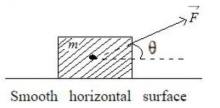 JEE Mains 2023 Hard
- Let \(K_{1}\) and \(K_{2}\) be the maximum kinetic energies of photo-electrons emitted when two monochromatic beams of wavelength \(\lambda_{1}\) and \(\lambda_{2}\), respectively are incident on a metallic surface. If \(\lambda_{1}=3 \lambda_{2}\) thenJEE Mains 2022 Medium
- Which of the following relations is true for two unit vectors \(\hat{ A }\) and \(\hat{ B }\) making an angle \(\theta\) to each other\(?\)JEE Mains 2022 Hard
- Consider the following reactions sequence
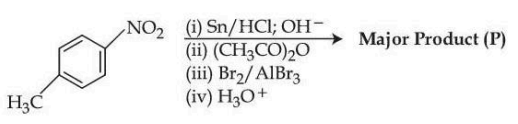
When the product (P) is subjected to Carius analysis using \(AgNO_3\), \(1.0\) g of the product (P) will produce _______ g of the precipitate of AgBr. (Nearest Integer)
(Given: molar mass in g mol\(^{-1}\) C : 12, H : 1, O : 16, N : 14, Br : 80, Ag : 108)JEE Mains 2026 Hard - In a radioactive decay chain, the initial nucleus is \({}_{90}^{232}Th\). At the end there are \(6\,\,\alpha -\) particles and \(4\,\,\beta -\) particles with are emitted. If the end nucleus is \({}_Z^AX\,,\,A\) and \(Z\) are given byJEE Mains 2019 Medium
- When a particle of mass \(m\) is attached to a vertical spring of spring constant \(k\) and released, its motion is described by \(y ( t )= y _{0} \sin ^{2} \omega t ,\) where \('y'\) is measured from the lower end of unstretched spring. Then \(\omega\) isJEE Mains 2020 Hard