


Questions
4 questionsShowing 1–4 of 4 questions
-
- (A) halved
- (B) the same
- (C) doubled
- (D) quadrupled
Show answer and solution
Correct Answer: (C)
Rate \(= K[A][B]=R\)\(R'\, = \,K\left[ A \right]\left[ {2B} \right]\)
\(\frac{R}{{R'}}\, = \,\frac{{k[A][B]}}{{k[A][2B]}}\, = \,\frac{{k[A][B]}}{{2k[A][B]}}\)
\( \Rightarrow \,2R\, = \,R'\) i.e., rate become doubles.
-
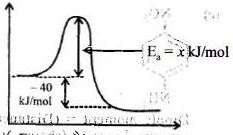
- (A) \(E_f\, = 80\, k\,J/mol ; E_b\, = 120\, k\,J/mol\)
- (B) \(E_f\, = 60\, k\,J/mol ; E_b\, = 100\, k\,J/mol\)
- (C) \(E_f\, = 30\, k\,J/mol ; E_b\, = 70\, k\,J/mol\)
- (D) \(E_f\, = 70\, k\,J/mol ; E_b\, = 30\, k\,J/mol\)
Show answer and solution
Correct Answer: (A)
\(\left( {\frac{{{E_{\mathop {forwad}\limits_{(A \to B)} }}}}{{{E_{\mathop {backward}\limits_{(B \to A)} }}}}} \right) = \frac{2}{3} = \frac{x}{{ - 40 + x}}\)\( \Rightarrow - 80 + 2x = 3x\)
\( \Rightarrow x = - 80\,kJ/mol\) for forward
For backward \( = - 40 + ( - 80 = - 120\,kJ/mol)\)
Because activation energy cannot be negative
so, for forwad reaction \(E_a=80\,kJ/mol\)
for forwad reaction \(E_a=120\,kJ/mol\)
-
- (A) shifting of equilibrium towards reactants due to elastic collisions
- (B) loss of active species on collision
- (C) low probability of simultaneous collision of all the reacting species
- (D) increase in entropy and activation energy as more molecules are involved
Show answer and solution
Correct Answer: (C)
Reactions of higher order \((>3 )\) are very rate due to very less chances of many molecules to undergo effective collisions. -
- (A) \(106.25\)
- (B) \(150\)
- (C) \(125\)
- (D) \(116.25\)
Show answer and solution
Correct Answer: (A)
\((a)\) Rate law forr first order reaction \(=\,k[N_2O_5]\)\(2{{N}_{2}}{{O}_{5}}\,(g)\,\to \,4N{{O}_{2}}\,(g)\,+\,{{O}_{2}}(g)\)
\(\mathop {t = 0\,\,\min }\limits_{(\Pr essure\,\,\,in\,\,\,mm\,\,\,Hg)} \) \(50\) \(0\) \(0\)
\(\mathop {t =30\,\,\min }\limits_{(\Pr essure\,\,\,in\,\,\,mm\,\,\,Hg)} \) \(50-2p\) \(4p\) \(p\)
Total pressure \(50-2p+4p+p=50+3p=87.5\,mm\,Hg\)
\(\therefore \,\,P\, = \,12.5\,mm\,Hg\)
\(\therefore \,\,{P_0}\, = 50\) and \(P\) \((t=30\,min)\)
\(=\,25\) for \(N_2O_5\) reactant
\(\therefore \,\,k\, = \,\frac{{2.303}}{{30\,\,\min }}\, \times \,\log \,\left( {\frac{{50}}{{25}}} \right)\,\) \( = \,\frac{{2.303}}{{60\,\,\min }}\, \times \,\log \,\left( {\frac{{50}}{x}} \right)\)
On solving \(x=12.5\,\,mm\,Hg\,=\,50-2p\)
\(\therefore P=18.75\,\,mm\,Hg\)
\(\therefore \) Total pressure \(=50+3P=106.25\,\,mm\,Hg\)
No questions on this page match these filters.