


JEE Mains · Chemistry · STD 12 - D and f- block elements
- JEE Mains 2015
- Medium
- MCQ
A pink coloured salt turns blue on heating. The presence of which cation is most likely ?
Pick an option to check your answer.
Answer & Solution
Correct Answer
(A) \(Co^{2+}\)
Step-by-step Solution
Detailed explanation
\(Zn^{2+}\) salts are white. Usually \(Fe^{2+}\) salts are rarely pink. \(Cu^{2+}\) salts are usually blue in hydrated form. \(Co^{2+}\) is pink in aqueous solution
More questions from Chemistry
- A student has been given a compound "x" of molecular formula - \(C _6 H _7 N\). 'x' is sparingly soluble in water. However, on addition of dilute mineral acid , 'x' becomes soluble in water. 'x' when treated with \(CHCl _3\) and KOH (alc.) 'y' is produced. 'y' has a specific unpleasant smell. On treatment with benzenesulphonyl chloride, '\(x\)' gives a compound '\(z\)' which is soluble in alkali. The number of different "H" atoms present in '\(z\)' is:-JEE Mains 2026 Medium
- Given below are two statements :
Statement-I: Sublimation is used for the separation and purification of compounds with low melting point.
Statement-II: The Boiling point of a liquid increases as the external pressure is reduced.
In the light of the above statements, choose the correct answer from the options given below :JEE Mains 2026 Medium - The Bohr radius of a hydrogen like species is \(70.53\) pm. The species and the stationary state \((n)\) are respectively (Given : Hydrogen atom Bohr radius is \(52.9\) pm)JEE Mains 2026 Medium
- Match List\(-I\) with List\(-II :\)
Choose the most appropriate answer from the option given below :List\(-I\) List\(-II\) \((a)\) \(\mathrm{NaOH}\) \((i)\) Acidic \((b)\) \(\mathrm{Be}(\mathrm{OH})_{2}\) \((ii)\) Basic \((c)\) \(\mathrm{Ca}(\mathrm{OH})_{2}\) \((iii)\) Amphoteric \((d)\) \(\mathrm{B}(\mathrm{OH})_{3}\) \((e)\) \(\mathrm{Al}(\mathrm{OH})_{3}\) JEE Mains 2021 Hard - The correct order in aqueous medium of basic strength in case of methyl substituted amines is :JEE Mains 2023 Medium
-
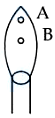
In a borax bead test under hot condition, a metal salt (one from the given) is heated at point B of the flame, resulted in green colour salt bead. The spin-only magnetic moment value of the salt is _______ BM.
(Nearest integer)
[Given atomic number of \(Cu =29, Ni =28, Mn =25, Fe =26\) ]JEE Mains 2024 Medium
More PYQs from JEE Mains
- For a simple harmonic motion in a mass spring system shown, the surface is frictionless. When the mass of the block is \(1\,kg\), the angular frequency is \(\omega_1\). When the mass block is \(2\,kg\) the angular frequency is \(\omega_2\). The ratio \(\omega_2 / \omega_1\) is
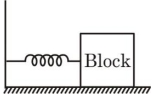 JEE Mains 2023 Easy
- The magnetic moment of a bar magnet is \(0.5 \mathrm{Am}^2\). It is suspended in a uniform magnetic field of \(8 \times 10^{-2} \mathrm{~T}\). The work done in rotating it from its most stable to most unstable position is _______.JEE Mains 2024 Hard
- The mechanism of \(S _{ N } 1\) reaction is given as \(R - X \rightarrow R ^{\oplus} X ^{\ominus} \rightarrow R ^{\oplus} \| X ^{\ominus} \stackrel{ Y^\ominus }{\rightarrow} R - Y + X ^{\ominus}\) Ion pair Solvent separated ion pair A student writes general characteristics based on the given mechanism as: \((a)\) The reaction is favoured by weak nucleophiles \((b)\) \(R^ \oplus\) would be easily formed if the substituents are bulky \((c)\) The reaction is accompained by recemization \((d)\) The reaction is favoured by non-polar solvents. Which observations are correct \(?\)JEE Mains 2020 Medium
- The first and second ionisation enthalpies of a metal are \(496\) and \(4560 \;\mathrm{kJ} \mathrm{mol}^{-1},\) respectively. How many moles of \(\mathrm{HCl}\) and \(\mathrm{H}_{2} \mathrm{SO}_{4}\) respectively, will be needed to react completely with \(1\) mole of the metal hydroxide?JEE Mains 2020 Hard
- \(18\, g\) glucose \((C_6H_{12}O_6)\) is added to \(178.2\, g\) water. The Vapour pressure of pure water at \(100\,{\,^o}C\) (in \(torr\)) for this aqueous solution is :JEE Mains 2016 Hard
- Excited hydrogen atom emits light in the ultraviolet region at \(2.47 \times 10^{15}\,Hz.\) With this frequency, the energy of a single photon is \((h = 6.63 \times 10^{-34}\,Js)\)JEE Mains 2014 Medium