


JEE Mains · Physics · STD 11 - Oscillations
- JEE Mains 2026
- Hard
- MCQ
A uniform disc of radius \(R\) and mass \(M\) is free to oscillate about the axis \(A\) as shown in the figure. For small oscillations the time period is ______.
(\(g\) is acceleration due to gravity)

Pick an option to check your answer.
Answer & Solution
Correct Answer
(A) \(2\pi\sqrt{\dfrac{5R}{4g}}\)
Step-by-step Solution
Detailed explanation
From the given figure, the axis of rotation is a horizontal line passing through the point \(A\) on the edge of the disc. The circular arrow around the axis indicates that the disc oscillates out of its plane, meaning the axis of rotation is a tangent to the disc in its own plane.
The moment of inertia of a uniform disc about its diameter is \(I_{cm} = \dfrac{1}{4}MR^2\).
Using the parallel axis theorem, the moment of inertia of the disc about the given axis of rotation is:
\(I = I_{cm} + MR^2 = \dfrac{1}{4}MR^2 + MR^2 = \dfrac{5}{4}MR^2\)
The distance from the center of mass of the disc to the axis of rotation is \(d = R\).
The time period of a physical pendulum is given by:
\(T = 2\pi\sqrt{\dfrac{I}{Mgd}}\)
Substituting the values of \(I\) and \(d\):
\(T = 2\pi\sqrt{\dfrac{\dfrac{5}{4}MR^2}{MgR}} = 2\pi\sqrt{\dfrac{5R}{4g}}\)
Answer: \(2\pi\sqrt{\dfrac{5R}{4g}}\)
More questions from Physics
- A proton with a kinetic energy of \(2.0\,eV\) moves into a region of uniform magnetic field of magnitude \(\frac{\pi}{2} \times 10^{-3}\,T\). The angle between the direction of magnetic field and velocity of proton is \(60^{\circ}\). The pitch of the helical path taken by the proton is \(..........cm\) (Take, mass of proton \(=1.6 \times 10^{-27}\,kg\) and Charge on proton \(=1.6 \times 10^{-19}\,kg)\)JEE Mains 2023 Medium
- At the centre of a fixed large circular coil of radius \(R\), a much smaller circular coil of radius \(r\) is placed. The two coils are concentric and are in the same plane. The larger coil carries a current \(I\). The smaller coil is set to rotate with a constant angular velocity \(\omega \) about an axis along their common diameter. Calculate the \(emf\) induced in the smaller coil after a time \(t\) of its start of rotationJEE Mains 2018 Hard
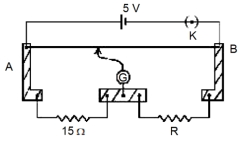
- A meter bridge setup is shown in the figure. It is used to determine an unknown resistance \(R\) using a given resistor of \(15\,\Omega\). The galvanometer \((G)\) shows null deflection when tapping key is at \(43\,cm\) mark from end \(A\). If the end correction for end \(A\) is \(2\,cm\). then the determined value of \(R\) will be__________ \(\Omega\)
 JEE Mains 2022 Hard
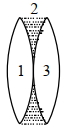
- Two identical thin biconvex lenses of focal length \(15\, cm\) and refractive index \(1.5\) are in contact with each other. The space between the lenses is filled with a liquid of refractive index \(1.25\). The focal length of the combination is \(cm\).
 JEE Mains 2022 Hard
- A battery of \(3.0\, V\) is connected to a resistor dissipating \(0.5\, W\) of power. If the terminal voltage of the battery is \(2.5\, V\) the power dissipated within the internal resistance is\(.......W\)JEE Mains 2020 Hard
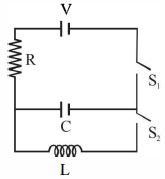
- In an \(LCR \) circuit as shown below both switches are open initially. Now switch \(S_1\) is closed, \(S_2\) kept open. ( \(q\) is charge on the capacitor and \(\tau = RC\) is Capacitive time constant). Which of the following statement is correct?
 JEE Mains 2013 Medium
More PYQs from JEE Mains
- A direct current of \(4\,A\) and an alternating current of peak value \(4\,A\) flow through resistance of \(3\,\Omega\) and \(2\,\Omega\) respectively. The ratio of heat produced in the two resistances in same interval of time will be.JEE Mains 2022 Medium
- In young's double slit experiment performed using a monochromatic light of wavelength \(\lambda\), when a glass plate \((\mu=1.5)\) of thickness \(x \lambda\) is introduced in the path of the one of the interfering beams, the intensity at the position where the central maximum occurred previously remains unchanged. The value of \(x\) will be..........JEE Mains 2022 Medium