


JEE Mains · Physics · STD 11 - 13. oscillations
Match List-I with List-II.
| List-I | List-II |
|---|---|
| A. \(\sin^2 \omega t\) | I. Periodic with time period \(T = \dfrac{\pi}{\omega}\) but not simple harmonic motion (SHM) |
| B. \(\sin^3(2\omega t)\) | II. Periodic with time period \(T = \dfrac{2\pi}{\omega}\) but Not SHM |
| C. \(\sin(\omega t) + \cos(\pi \omega t)\) | III. Periodic with time period \(T = \dfrac{\pi}{\omega}\) and SHM |
| D. \(\cos\omega t + \cos 2\omega t\) | IV. Non-periodic |
Choose the correct answer from the options given below :
- A A-III, B-I, C-IV, D-II
- B A-II, B-I, C-III, D-IV
- C A-III, B-II, C-IV, D-I
- D A-II, B-I, C-IV, D-III
Answer & Solution
Correct Answer
(A) A-III, B-I, C-IV, D-II
Step-by-step Solution
Detailed explanation
For A: \(y = \sin^2 \omega t = \dfrac{1 - \cos 2\omega t}{2} = \dfrac{1}{2} - \dfrac{1}{2} \cos 2\omega t\) This represents simple harmonic motion (SHM) about the mean position \(y = \dfrac{1}{2}\) with an angular frequency of \(2\omega\). The time period is…
See the Complete Solution
Get step-by-step explanations for this and 2.5 Lakh+ more JEE, NEET & CET questions.
- Unlock all solutions
- Practice the full chapter
- Track accuracy across PYQs
4.8 rated on Google Play · 14,000+ reviews
More questions from Physics
- Match the LIST-I with LIST-II.
LIST-I LIST-II (A) \(_0^1n + _{92}^{235}U \rightarrow _{54}^{140}Xe + _{38}^{94}Sr + 2_0^1n\) (I) Chemical reaction (B) \(2H_2 + O_2 \rightarrow 2H_2O\) (II) Fusion with +ve Q value (C) \(_1^2H + _1^2H \rightarrow _2^3He + _0^1n\) (III) Fission (D) \(_1^1H + _1^3H \rightarrow _1^2H + _1^2H\) (IV) Fusion with -ve Q value
Choose the correct answer from the options given below :JEE Mains 2025 Medium - Two sources of light emit X-rays of wavelength \(1\, nm\) and visible light of wavelength \(500\, nm ,\) respectively. Both the sources emit light of the same power \(200\, W\). The ratio of the number density of photons of X-rays to the number densitty of photons of the visible light of the given wavelengths isJEE Mains 2020 Medium
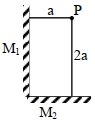
- Two plane mirrors \({M}_{1}\) and \({M}_{2}\) are at right angle to each other shown. A point source \('P'\) is placed at \('a'\) and \('2a'\) meter away from \({M}_{1}\) and \({M}_{2}\) respectively. The longest distance between the images thus formed is : (Take \(\sqrt{5}=2.3\) )
 JEE Mains 2021 Hard
 - A particle is executing simple harmonic motion. Its amplitude is \(A\) and time period is \(5\) sec. The time required by it to move from \(x = A\) to \(x = \dfrac{A}{\sqrt{2}}\) is _______ sec.JEE Mains 2026 Medium
- Consider a n-type semiconductor in which \(\mathrm{n}_{\mathrm{e}}\) and \(\mathrm{n}_{\mathrm{h}}\) are number of electrons and holes, respectively.
(A) Holes are minority carriers
(B) The dopant is a pentavalent atom
(C) \(\mathrm{n}_{\mathrm{e}} \mathrm{n}_{\mathrm{h}} \neq \mathrm{n}_{\mathrm{i}}^2\)
(where \(n_i\) is number of electrons or holes in semiconductor when it is intrinsic form)
(D) \(\mathrm{n}_{\mathrm{e}} \mathrm{n}_{\mathrm{h}} \geq \mathrm{n}_{\mathrm{i}}^2\)
(E) The holes are not generated due to the donors Choose the correct answer from the options given below :JEE Mains 2025 Easy - Two concentric circular coils with radii \(1\,cm\) and \(1000\,cm\), and number of turns \(10\) and \(200\) respectively are placed coaxially with centers coinciding. The mutual inductance of this arrangement will be \(.........\times 10^{-8}\,H\)(Take, \(\pi^2=10\))JEE Mains 2023 Hard
More PYQs from JEE Mains
- If the \(rms\) speed of oxygen molecules at \(0^{\circ} {C}\) is \(160\; {m} / {s}\), find the rms speed of hydrogen molecules at \(0^{\circ} {C}\). (In \({m}/{s}\))JEE Mains 2021 Medium
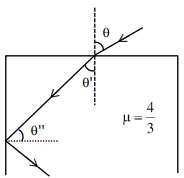
- A ray of light entering from air into a denser medium of refractive index \(\frac{4}{3}\), as shown in figure. The light ray suffers total internal reflection at the adjacent surface as shown. The maximum, value of angle \(\theta\) should be equal to -
 JEE Mains 2021 Hard
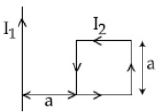
 - A rigid square loop of side \(a\) and carrying current \(I_2\) is laying on a horizontal surface near a long current \(I_1\) wire in the same plane as shown in figure. The net force on the loop due to the wire will be
 JEE Mains 2019 Hard
 - Let \(S=(-1, \infty)\) and \(f: S \rightarrow \mathbb{R}\) be defined as \(f(x)=\int_{-1}^x\left(e^1-1\right)^{11}(2 t-1)^5(t-2)^7(t-3)^{12}(2 t-10)^{61} d t\) Let \(p=\) Sum of square of the values of \(x\), where \(\mathrm{f}(\mathrm{x})\) attains local maxima on \(\mathrm{S}\). and \(\mathrm{q}=\) Sum of the values of \(x\), where \(f(x)\) attains local minima on \(S\). Then, the value of \(p^2+2 q\) isJEE Mains 2024 Hard
- A solid cylinder having radius \(R\) and length \(L\) is slipping on a rough horizontal plane. At time \(t=0\) the cylinder has a translational velocity \(v_0=49\) m/s, perpendicular to its axis and a rotational velocity \(v_0/4R\) about the centre. The time taken by the cylinder to start rolling is ________ seconds. (coefficient of kinetic friction \(\mu_K=0.25\) and \(g=9.8\) m/s\(^2\))JEE Mains 2026 Hard
- The value of \({\cos ^2}\,{10^o}\,\, - \,\cos \,\,{10^o}\,\cos \,\,{50^o}\, + \,{\cos ^2}\,{50^o}\) isJEE Mains 2019 Hard