


JEE Mains · Physics · STD 12 - Electric charges and fields
- JEE Mains 2026
- Hard
- MCQ
A rigid dipole undergoes a simple harmonic motion about its centre in the presence of an electric field \(\vec{E}_1=E_0\hat{x}\). If another electric field \(\vec{E}_2=2E_0(\hat{y}+\hat{z})\) is introduced to the system, what will be the percentage change in the frequency of the oscillation (approximate)?
Pick an option to check your answer.
Answer & Solution
Correct Answer
(A) \(73\%\)
Step-by-step Solution
Detailed explanation
The frequency of oscillation of a rigid dipole in an electric field is given by \(f = \dfrac{1}{2\pi} \sqrt{\dfrac{pE}{I}}\), where \(p\) is the dipole moment, \(E\) is the magnitude of the electric field, and \(I\) is the moment of inertia.
This implies \(f \propto \sqrt{E}\).
The initial electric field is \(\vec{E}_1 = E_0 \hat{x}\), so its magnitude is \(E_1 = E_0\).
The initial frequency is \(f_1 \propto \sqrt{E_0}\).
When the second electric field \(\vec{E}_2 = 2E_0(\hat{y} + \hat{z})\) is introduced, the net electric field becomes \(\vec{E}_{net} = \vec{E}_1 + \vec{E}_2 = E_0 \hat{x} + 2E_0 \hat{y} + 2E_0 \hat{z}\).
The magnitude of the net electric field is \(E_{net} = \sqrt{E_0^2 + (2E_0)^2 + (2E_0)^2} = \sqrt{E_0^2 + 4E_0^2 + 4E_0^2} = 3E_0\).
The new frequency is \(f_2 \propto \sqrt{3E_0}\).
The percentage change in the frequency is given by \(\dfrac{f_2 - f_1}{f_1} \times 100\%\).
Substituting the values, we get \(\left( \dfrac{\sqrt{3E_0}}{\sqrt{E_0}} - 1 \right) \times 100\% = (\sqrt{3} - 1) \times 100\%\).
Using \(\sqrt{3} \approx 1.732\), the percentage change is \((1.732 - 1) \times 100\% = 73.2\%\).
The approximate percentage change is \(73\%\).
Answer: \(73\%\)
More questions from Physics
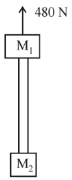
- Two blocks of mass \(M_1 = 20\,kg\) and \(M_2 = 12\,kg\) are connected by a metal rod of mass \(8\,kg.\) The system is pulled vertically up by applying a force of \(480\,N\) as shown. The tension at the mid-point of the rod is ........ \(N\)
 JEE Mains 2013 Hard
- When a certain photosensitive surface is illuminated with monochromatic light of frequency \(v\) , the stopping potential for the photo current is \(-V_0/2.\) When the surface is illuminated by monochromatic light of frequency \(v/2,\) the stopping potential is \(-V_0.\) The threshold frequency for photoelectric emission isJEE Mains 2019 Medium
- A resonance tube is old and has jagged end. It is still used in the laboratory to determine velocity of sound in air. A tuning fork of frequency \(512\,Hz\) produces first resonance when the tube is filled with water to a mark \(11\,cm\) below a reference mark, near the open end of the tube. The experiment is repeated with another fork of frequency \(256\,Hz\) which produces first resonance when water reaches a mark \(27\,cm\) below the reference mark. The velocity of sound in air, obtained in the experiment, is close to .... \(ms^{-1}\)JEE Mains 2019 Medium
- A hoop and a solid cylinder of same mass and radius are made of a permanent magnetic material with their magnetic moment parallel to their respective axes. But the magnetic moment of hoop is twice of solid cylinder. They are placed in a uniform magnetic field in such a manner that their magnetic moments make a small angle with the field. If the oscillation periods of hoop and cylinder are \(T_h\) and \(T_c\) respectively, then the relation between them is....JEE Mains 2019 Medium
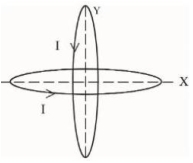
- Two identical circular wires of radius \(20\,cm\) and carrying current \(\sqrt{2}\,A\) are placed in perpendicular planes as shown in figure. The net magnetic field at the centre of the circular wire is \(.............\times 10^{-8}\,T\). (Take \(\pi=3.14\) )
 JEE Mains 2023 Medium
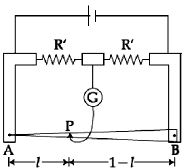
- In a meter bridge, the wire of length \(1\, m\) has a nonuniform cross-section such that, the variation \(\frac{{dR}}{{d\ell }}\) of its resistance \(R\) with length \(\ell \) is \(\frac{{dR}}{{d\ell }} \propto \frac{1}{{\sqrt \ell }}\) Two equal resistances are connected as shown in the figure. The galvanometer has zero deflection when the jockey is at point \(P\). What is the length \(AP\) ? ................ \(m\)
 JEE Mains 2019 Hard
More PYQs from JEE Mains
- A particle executes simple harmonic motion between \(x =- A\) and \(x =+ A\). If time taken by particle to go from \(x=0\) to \(\frac{A}{2}\) is \(2 s\); then time taken by particle in going from \(x =\frac{ A }{2}\) to \(A\) is \(.........\,s\)JEE Mains 2023 Medium
- Given below are two statements: Statement \(I:\) If heat is added to a system, its temperature must increase. Statement \(II:\) If positive work is done by a system in a thermodynamic process, its volume must increase. In the light of the above statements, choose the correct answer from the options given belowJEE Mains 2023 Medium
- A man grows into a giant such that his linear dimensions increase by a factor of \(9\). Assuming that his density remains same, the stress in the leg will change by a factor ofJEE Mains 2017 Hard
- In a single slit experiment, a parallel beam of green light of wavelength \(550 \mathrm{~nm}\) passes through a slit of width \(0.20 \mathrm{~mm}\). The transmitted light is collected on a screen \(100 \mathrm{~cm}\) away. The distance of first order minima from the central maximum will be \(\mathrm{x} \times 10^{-5} \mathrm{~m}\). The value of \(\mathrm{x}\) is _______.JEE Mains 2024 Hard
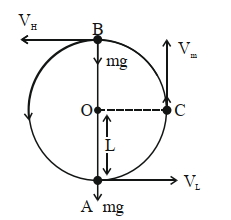
- A bob of mass ' \(m\) ' is suspended by a light string of length ' \(L\) '. It is imparted a minimum horizontal velocity at the lowest point \(A\) such that it just completes half circle reaching the top most position B. The ratio of kinetic energies \(\frac{(\text { K.E. })_A}{(\text { K.E. })_B}\) is _______.
 JEE Mains 2024 Hard
- The length of a light string is 1.4 m when the tension on it is 5 N. If the tension increases to 7 N , the length of the string is 1.56 m. The original length of the string is _____ m.JEE Mains 2025 Easy