


JEE Mains · Physics · STD 11 - Oscillations
- JEE Mains 2026
- Medium
- MCQ
A particle is executing simple harmonic motion. Its amplitude is \(A\) and time period is \(5\) sec. The time required by it to move from \(x = A\) to \(x = \dfrac{A}{\sqrt{2}}\) is _______ sec.
Pick an option to check your answer.
Answer & Solution
Correct Answer
(C) \(5/8\)
Step-by-step Solution
Detailed explanation
The equation of simple harmonic motion for a particle starting from the extreme position \(x = A\) is given by:
\(x = A \cos(\omega t)\)
We need to find the time \(t\) when the particle reaches \(x = \dfrac{A}{\sqrt{2}}\). Substituting this value into the equation:
\(\dfrac{A}{\sqrt{2}} = A \cos(\omega t)\)
\(\cos(\omega t) = \dfrac{1}{\sqrt{2}}\)
\(\omega t = \dfrac{\pi}{4}\)
Since the angular frequency \(\omega = \dfrac{2\pi}{T}\), we have:
\(\dfrac{2\pi}{T} t = \dfrac{\pi}{4}\)
\(t = \dfrac{T}{8}\)
Given the time period \(T = 5\) sec, the required time is:
\(t = \dfrac{5}{8}\) sec
Answer: \(5/8\)
More questions from Physics
- An inductor of \(0.5 \,mH\), a capacitor of \(200 \,\mu F\) and a resistor of \(2 \,\Omega\) are connected in series with a \(220 \,V\) ac source. If the current is in phase with the emf, the frequency of ac source will be ................ \(\times 10^{2} \,Hz\)JEE Mains 2022 Hard
- A wire of resistance \(160\,\Omega\) is melted and drawn in wire of one-fourth of its length. The new resistance of the wire will be \(......\Omega\)JEE Mains 2023 Hard
- A magnetic dipole experiences a torque of \(80 \sqrt{3} \mathrm{~N} \mathrm{~m}\) when placed in uniform magnetic field in such a way that dipole moment makes angle of \(60^{\circ}\) with magnetic field. The potential energy of the dipole is :JEE Mains 2025 Easy
- A compressive force, \(F\) is applied at the two ends of a long thin steel rod. It is heated, simultaneously, such that its temperature increases by \(\Delta T\). The net change in its length is zero. Let \(l\) be the length of the rod, \(A\) its area of cross- section, \(Y\) its Young's modulus, and \(\alpha \) its coefficient of linear expansion. Then, \(F\) is equal toJEE Mains 2017 Medium
- The magnitude of vectors \(\overrightarrow{ OA }, \overrightarrow{ OB }\) and \(\overrightarrow{ OC }\) in the given figure are equal. The direction of \(\overrightarrow{ OA }+\overrightarrow{ OB }-\overrightarrow{ OC }\) with \(x\)-axis will be
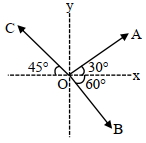 JEE Mains 2021 Hard
- Two inclined planes are placed as shown in figure. A block is projected from the Point \(A\) of inclined plane \(A B\) along its surface with a velocity just sufficient to carry it to the top Point \(B\) at a height \(10 m\). After reaching the Point \(B\) the block slides down on inclined plane \(BC\). Time it takes to reach to the point \(C\) from point \(A\) is \(t (\sqrt{2}+1) s\). The value of \(t\) is........(use \(g =10 m / s ^{2}\) )
 JEE Mains 2022 Hard
More PYQs from JEE Mains
- The ratio for the speed of the electron in the \(3^{ rd }\) orbit of \(He ^{+}\)to the speed of the electron in the \(3^{\text {ad }}\) orbit of hydrogen atom will beJEE Mains 2022 Medium
- An AC voltage \(\mathrm{V}=20 \sin 200 \pi t\) is applied to a series \(LCR\) circuit which drives a current \(I=10 \sin \left(200 \pi t+\frac{\pi}{3}\right)\). The average power dissipated is _______.JEE Mains 2024 Hard
- In young's double slit experiment performed using a monochromatic light of wavelength \(\lambda\), when a glass plate \((\mu=1.5)\) of thickness \(x \lambda\) is introduced in the path of the one of the interfering beams, the intensity at the position where the central maximum occurred previously remains unchanged. The value of \(x\) will be..........JEE Mains 2022 Medium