


JEE Mains · Physics · STD 11 - 13. oscillations
The equation of motion of a particle is given by \(x = a \sin\left(50t + \dfrac{\pi}{3}\right)\) cm. The particle will come to rest at time \(t_1\) and it will have zero acceleration at time \(t_2\). The \(t_1\) and \(t_2\) respectively are _______.
- A \(\dfrac{\pi}{300} \, s, \dfrac{\pi}{75} \, s\)
- B \(\dfrac{\pi}{75} \, s, \dfrac{\pi}{300} \, s\)
- C \(\dfrac{\pi}{300} \, s, \dfrac{\pi}{25} \, s\)
- D \(\dfrac{\pi}{50} \, s, \dfrac{\pi}{100} \, s\)
Answer & Solution
Correct Answer
(A) \(\dfrac{\pi}{300} \, s, \dfrac{\pi}{75} \, s\)
Step-by-step Solution
Detailed explanation
The equation of motion is given by \(x = a \sin\left(50t + \dfrac{\pi}{3}\right)\). Velocity is the rate of change of displacement: \(v = \dfrac{dx}{dt} = 50a \cos\left(50t + \dfrac{\pi}{3}\right)\) The particle comes to rest when \(v = 0\). For the first time it comes to rest:…
See the Complete Solution
Get step-by-step explanations for this and 2.5 Lakh+ more JEE, NEET & CET questions.
- Unlock all solutions
- Practice the full chapter
- Track accuracy across PYQs
4.8 rated on Google Play · 14,000+ reviews
More questions from Physics
- In the circuit diagram shown in figure given below, the current flowing through resistance \(3\, \Omega\) is \(\frac{ x }{3}\,A\). The value of \(x\) is \(...........\)
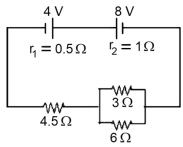 JEE Mains 2023 Hard
 - A river is flowing from west to east direction with speed of \(9 \mathrm{~km} \mathrm{~h}^{-1}\). If a boat capable of moving at a maximum speed of \(27 \mathrm{~km} \mathrm{~h}^{-1}\) in still water, crosses the river in half a minute, while moving with maximum speed at an angle of \(150^{\circ}\) to direction of river flow, then the width of the river is :JEE Mains 2025 Easy
- A coil of area A and N turns is rotating with angular velocity \(\omega\) in a uniform magnetic field \(\vec{B}\) about an axis perpendicular to \(\vec{B}\). Magnetic flux \(\varphi\) and induced \(\operatorname{emf} \varepsilon\) across it, at an instant when \(\vec{B}\) is parallel to the plane of coil, are :JEE Mains 2025 Easy
- When an air bubble of radius \(r\) rises from the bottom to the surface of a lake, its radius becomes \(\frac{{5r}}{4}\).Taking the atmospheric pressure to be equal to \(10\,m\) height of water column, the depth of the lake would approximately be ....... \(m\) (ignore the surface tension and the effect of temperature)JEE Mains 2018 Hard
- Interference fringes are observed on a screen by illuminating two thin slits \(1 \,mm\) apart with a light source \((\lambda=632.8\, nm )\). The distance between the screen and the slits is \(100\, cm\). If a bright fringe is observed on a screen at a distance of \(1.27\, mm\) from the central bright fringe, then the path difference between the waves, which are reaching this point from the slits is close to\(....\mu m\)JEE Mains 2020 Hard
- A flask contains Hydrogen and Argon in the ratio \(2: 1\) by mass. The temperature of the mixture is \(30^{\circ} C\). The ratio of average kinetic energy per molecule of the two gases ( \(K\) argon/ \(K\) hydrogen) is: (Given: Atomic Weight of \(Ar = 39.9\))JEE Mains 2023 Medium
More PYQs from JEE Mains
- If \(\in\), \( E \) and \( t \) represent the free space permittivity, electric field and time respectively, then the unit of \( \frac{eE}{t} \) will be :JEE Mains 2026 Medium
- A closed circular tube of average radius \(15\,cm\), whose inner walls are rough, is kept in vertical plane. A block of mass \(1\,kg\) just fit inside the tube. The speed of block is \(22\,m / s\), when it is introduced at the top of tube. After completing five oscillations, the block stops at the bottom region of tube. The work done by the tube on the block is \(......J\). [Given \(g=10\,m / s ^2\) ]
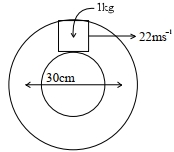 JEE Mains 2023 Hard
 - If \(\sin\left(\dfrac{\pi}{18}\right) \sin\left(\dfrac{5\pi}{18}\right) \sin\left(\dfrac{7\pi}{18}\right) = K\), then the value of \(\sin\left(\dfrac{10K\pi}{3}\right)\) is :JEE Mains 2026 Hard
- In Vander Waals equation \(\left[ P +\frac{ a }{ V ^{2}}\right][ V - b ]= RT\); \(P\) is pressure, \(V\) is volume, \(R\) is universal gas constant and \(T\) is temperature. The ratio of constants \(\frac{a}{b}\) is dimensionally equal to .................JEE Mains 2022 Medium
- The mirror image of the point \((1,2,3)\) in a plane is \(\left(-\frac{7}{3},-\frac{4}{3},-\frac{1}{3}\right) .\) Which of the following points lies on this plane ?JEE Mains 2020 Hard
- If \(\alpha=\lim _{x \rightarrow 0^{+}}\left(\frac{e^{\sqrt{\tan x}}-e^{\sqrt{x}}}{\sqrt{\tan x}-\sqrt{x}}\right)\) and \(\beta=\lim _{x \rightarrow 0}(1+\sin x)^{\frac{1}{2} \cot x}\) are the roots of the quadratic equation \(a x^2+b x-\sqrt{e}=0\), then 12 \(\log _e(a+b)\) is equal to .............JEE Mains 2024 Hard