


JEE Mains · Physics · STD 11 - Kinetic theory of gases
- JEE Mains 2026
- Hard
- MCQ
A mixture of carbon dioxide and oxygen has volume \(8310\) cm\(^3\), temperature \(300\) K, pressure \(100\) kPa and mass \(13.2\) g. The number of moles of carbon dioxide and oxygen gases in the mixture respectively are _______.
(Assume both carbon dioxide and oxygen gases behave like ideal gases) \([R = 8.31\) J/mol.K\(]\)
Pick an option to check your answer.
Answer & Solution
Correct Answer
(C) \(0.21\) and \(0.12\)
Step-by-step Solution
Detailed explanation
Using the ideal gas equation, the total number of moles of the mixture is given by:
\(n = \dfrac{PV}{RT}\)
Substituting the given values:
\(P = 100 \text{ kPa} = 10^5 \text{ Pa}\)
\(V = 8310 \text{ cm}^3 = 8.31 \times 10^{-3} \text{ m}^3\)
\(T = 300 \text{ K}\)
\(R = 8.31 \text{ J/(mol}\cdot\text{K)}\)
\(n = \dfrac{10^5 \times 8.31 \times 10^{-3}}{8.31 \times 300} = \dfrac{100}{300} = \dfrac{1}{3} \text{ mol}\)
Let \(n_1\) and \(n_2\) be the number of moles of \(CO_2\) and \(O_2\) respectively.
\(n_1 + n_2 = \dfrac{1}{3}\)
The total mass of the mixture is \(13.2 \text{ g}\). Using the molar masses of \(CO_2\) (\(44 \text{ g/mol}\)) and \(O_2\) (\(32 \text{ g/mol}\)):
\(44n_1 + 32n_2 = 13.2\)
Substituting \(n_2 = \dfrac{1}{3} - n_1\) into the mass equation:
\(44n_1 + 32\left(\dfrac{1}{3} - n_1\right) = 13.2\)
\(12n_1 + \dfrac{32}{3} = 13.2\)
\(12n_1 = \dfrac{39.6 - 32}{3} = \dfrac{7.6}{3}\)
\(n_1 = \dfrac{7.6}{36} = \dfrac{19}{90} \approx 0.21 \text{ mol}\)
The number of moles of \(O_2\) is:
\(n_2 = \dfrac{1}{3} - \dfrac{19}{90} = \dfrac{11}{90} \approx 0.12 \text{ mol}\)
The number of moles of \(CO_2\) and \(O_2\) are \(0.21\) and \(0.12\) respectively.
Answer: \(0.21\) and \(0.12\)
More questions from Physics
- An unknown metal of mass \(192\, g\) heated to a temperature of \(100\,^oC\) was immersed into a brass calorimeter of mass \(128\, g\) containing \(240\, g\) of water at a temperature of \(8.4\,^oC\). Calculate the specific heat of the unknown metal if water temperature stabilizes at \(21.5\,^oC\). (Specific heat of brass is \(394\, J\, kg^{-1}\, K^{-1}\)) ......... \(J\, kg^{-1}\, K^{-1}\)JEE Mains 2019 Medium
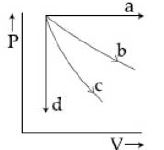
- The given diagram shows four processes i.e., isochoric, isobaric, isothermal and adiabatic. The correct assignment of the processes, in the same order is given by
 JEE Mains 2019 Medium
- Figure shows a part of an electric circuit. The potentials at points \(a , b\) and \(c\) are \(30\,V , 12\,V\) and \(2\,V\) respectively. The current through the \(20 \Omega\) resistor will be \(........\,A\)
 JEE Mains 2023 Hard
- Match List \(I\) with List \(II\)
Choose the correct answer from the options given belowLIST\(-I\) LIST\(-II\) \((A)\) Torque \((I)\) \(ML ^{-2} T ^{-2}\) \((B)\) Stress \((II)\) \(ML ^2 T ^{-2}\) \((C)\) Pressure of gradient \((III)\) \(ML ^{-1} T ^{-1}\) \((D)\) Coefficient of viscosity \((IV)\) \(ML ^{-1} T ^{-2}\) JEE Mains 2023 Medium - If the collision frequency of hydrogen molecules in a closed chamber at \(27^{\circ} \mathrm{C}\) is \(\mathrm{Z}\), then the collision frequency of the same system at \(127^{\circ} \mathrm{C}\) is _______.JEE Mains 2024 Hard
- Two planets \(A\) and \(B\) of equal mass are having their period of revolutions \(T_{A}\) and \(T_{B}\) such that \(T_{A}=2 T_{B}\). These planets are revolving in the circular orbits of radii \(I_{A}\) and \(I_{B}\) respectively. Which out of the following would be the correct relationship of their orbits?JEE Mains 2022 Medium
More PYQs from JEE Mains
- In a Young's double slit experiment set up, the two slits are kept 0.4 mm apart and screen is placed at 1 m from slits. If a thin transparent sheet of thickness \(20 \mu m\) is introduced in front of one of the slits then centre bring fringe shifts by 20 mm on the screen. The refractive index of transparent sheet is given by \(\frac{\alpha}{10}\), where \(\alpha\) is _________ .JEE Mains 2026 Hard
- For the plane electromagnetic wave given by \(\mathrm{E}=\mathrm{E}_0 \sin (\omega \mathrm{t}-\mathrm{kx})\) and \(\mathrm{B}=\mathrm{B}_0 \sin (\omega \mathrm{t}-\mathrm{kx})\), the ratio of average electric energy density to average magnetic energy density isJEE Mains 2023 Medium