


JEE Mains · Physics · STD 11 - Oscillations
- JEE Mains 2026
- Medium
- Numerical
The velocity of a particle executing simple harmonic motion along \(x\)-axis is described as \(v^2 = 50 - x^2\), where \(x\) represents displacement. If the time period of motion is \(\dfrac{x}{7}\) s, the value of \(x\) is _____.
Pick an option to check your answer.
Answer & Solution
Correct Answer
(B) 44
Step-by-step Solution
Detailed explanation
The given equation is \(v^2 = 50 - x^2\)
Differentiating with respect to \(x\):
\(2v \dfrac{dv}{dx} = -2x\)
\(v \dfrac{dv}{dx} = -x\)
Since acceleration \(a = v \dfrac{dv}{dx}\), we get:
\(a = -x\)
Comparing this with the standard equation of SHM \(a = -\omega^2 x\), we get:
\(\omega^2 = 1 \Rightarrow \omega = 1\) rad/s
The time period of the motion is given by:
\(T = \dfrac{2\pi}{\omega} = 2\pi\)
Taking \(\pi = \dfrac{22}{7}\), we get:
\(T = 2 \times \dfrac{22}{7} = \dfrac{44}{7}\) s
Given that the time period is \(\dfrac{x}{7}\) s, comparing the two gives:
\(x = 44\)
Answer: \(44\)
More questions from Physics
- A sample of radioactive material \(A\), that has an activity of \(10\, mCi\, (1\, Ci = 3.7 \times 10^{10}\, decays/s)\), has twice the number of nuclei as another sample of different radioactive material \(B\) which has an activity of \(20\, mCi\). The correct choices for half-lives of \(A\) and \(B\) would then be respectivelyJEE Mains 2019 Hard
- In a meter bridge experiment the balance point in obtained if the gaps are closed by \(2\,\Omega\) and \(3\,\Omega\). A shunt of \(x\,\Omega\) is added to \(3\,\Omega\) resistor to shift the balancing point by \(22.5\,cm\). The value of \(X\) is \(................\)JEE Mains 2023 Medium
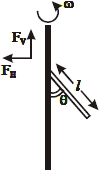
- A uniform rod of length \('l'\) is pivoted at one of its ends on a vertical shaft of negligible radius When the shaft rotates at angular speed \(\omega\) the rod makes an angle \(\theta\) with it (see figure). To find \(\theta\) equate the rate of change of angular momentum (direction going into the paper ) \(\frac{ m \ell^{2}}{12} \omega^{2} \sin \theta \cos \theta\) about the centre of mass \((CM)\) to the torque provided by the horizontal and vertical forces \(F_{H}\) and \(F_{V}\) about the CM. The value of \(\theta\) is then such that:
 JEE Mains 2020 Hard
- An alternating voltage source \(V =260 \sin (628\,t )\) is connected across a pure inductor of \(5\,mH\). Inductive reactance in the circuit is \(......... \Omega\)JEE Mains 2023 Easy
- Two blocks (\(P\) and \(Q\)) with respectively masses \(2\) kg and \(1.5\) kg are joined by a massless thread. These blocks are mounted on a frictionless pulley which is fixed on the edge of a cube (\(S\)), as shown in the figure below. Block \(P\) is positioned on the top surface which has no friction and block \(Q\) is in contact with side-surface, having coefficient friction \(\mu\). The cube (\(S\)) moves towards the right with acceleration of \(\dfrac{g}{2}\), where \(g\) is gravitational acceleration. During this movement the block \(P\) and \(Q\) remain stationary. The value of \(\mu\) is _______. (take \(g = 10\) m/s\(^2\))
 JEE Mains 2026 Hard
- Statement \(I :\) When a Si sample is doped with Boron, it becomes \(P\) type and when doped by Arsenic it becomes \(N-\)type semi conductor such that \(P-\)type has excess holes and N-type has excess electrons. Statement \(II\) : When such \(P-\)type and \(N-\)type semi-conductors, are fused to make a junction, a current will automatically flow which can be detected with an externally connected ammeter. In the light of above statements, choose the most appropriate answer from the options given below.JEE Mains 2023 Medium
More PYQs from JEE Mains
- Given below are two statements: Statement \(I :\) \(PN\) junction diodes can be used to function as transistor, simply by connecting two diodes, back to back, which acts as the base terminal. Statement \(II :\) In the study of transistor, the amplification factor \(\beta\) indicates ratio of the collector current to the base current. In the light of the above statements, choose the correct answer from the options given below :JEE Mains 2021 Medium
- When \(100\,g\) of a liquid \(A\) at \(100\,^oC\) is added to \(50\,g\) of a liquid \(B\) at temperature \(75\,^oC\), the temperature of the mixture becomes \(90\,^oC\). The temperature of the mixture, if \(100\,g\) of liquid \(A\) at \(100\,^oC\) is added to \(50\,g\) of liquid \(B\) at \(50\,^oC\), will be ........\(^oC\)JEE Mains 2019 Hard
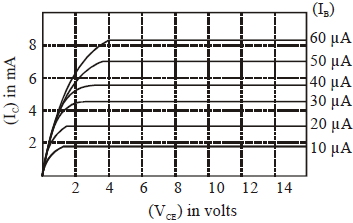
- The output characteristics of a transistor is shown in the figure. When \(V_{C E}\) is \(10\, V\) and \(I_{ C }=4.0\, mA ,\) then value of \(\beta_{ ac }\) is
 JEE Mains 2020 Medium
- A meter bridge with two resistances \( R_{1} \) and \( R_{2} \) as shown in figure was balanced (null point) at 40 cm from the point P. The null point changed to 50 cm from the point P, when 16 \( \Omega \) resistance is connected in parallel to \( R_{2} \). The values of resistances \( R_{1} \) and \( R_{2} \) are __________ .
 JEE Mains 2026 Hard