


JEE Mains · Physics · STD 12 - Electric charges and fields
- JEE Mains 2026
- Medium
- MCQ
Two point charges \(q_1=3\,\mu C\) and \(q_2=-4\,\mu C\) are placed at points \((2\hat{i}+3\hat{j}+3\hat{k})\) and \((\hat{i}+\hat{j}+\hat{k})\) respectively. Force on charge \(q_2\) is ________ N. \(\left(\text{Take } \dfrac{1}{4\pi\epsilon_0} = 9\times 10^9 \text{ SI Units}\right)\)
Pick an option to check your answer.
Answer & Solution
Correct Answer
(B) \((4\hat{i}+8\hat{j}+8\hat{k})\times 10^{-3}\)
Step-by-step Solution
Detailed explanation
Position vector of \(q_1\), \(\vec{r}_1 = 2\hat{i} + 3\hat{j} + 3\hat{k}\)
Position vector of \(q_2\), \(\vec{r}_2 = \hat{i} + \hat{j} + \hat{k}\)
Vector from \(q_1\) to \(q_2\) is \(\vec{r}_{21} = \vec{r}_2 - \vec{r}_1 = (\hat{i} + \hat{j} + \hat{k}) - (2\hat{i} + 3\hat{j} + 3\hat{k}) = -\hat{i} - 2\hat{j} - 2\hat{k}\)
Magnitude \(|\vec{r}_{21}| = \sqrt{(-1)^2 + (-2)^2 + (-2)^2} = \sqrt{9} = 3\)
Force on \(q_2\) due to \(q_1\) is given by Coulomb's law in vector form:
\(\vec{F}_{21} = \dfrac{1}{4\pi\epsilon_0} \dfrac{q_1 q_2}{|\vec{r}_{21}|^3} \vec{r}_{21}\)
Substituting the given values:
\(\vec{F}_{21} = \dfrac{9 \times 10^9 \times (3 \times 10^{-6}) \times (-4 \times 10^{-6})}{3^3} (-\hat{i} - 2\hat{j} - 2\hat{k})\)
\(\vec{F}_{21} = \dfrac{-108 \times 10^{-3}}{27} (-\hat{i} - 2\hat{j} - 2\hat{k})\)
\(\vec{F}_{21} = -4 \times 10^{-3} (-\hat{i} - 2\hat{j} - 2\hat{k})\)
\(\vec{F}_{21} = (4\hat{i} + 8\hat{j} + 8\hat{k}) \times 10^{-3} \text{ N}\)
Answer: \((4\hat{i}+8\hat{j}+8\hat{k})\times 10^{-3}\)
More questions from Physics
- Three point particles of masses \(1.0\; \mathrm{kg} .1 .5 \;\mathrm{kg}\) and \(2.5\; kg\) are placed at three comers of a right angle triangle of sides \(4.0\; \mathrm{cm}, 3.0 \;\mathrm{cm}\) and \(5.0\; \mathrm{cm}\) as shown in the figure. The center of mass of the system is at a point
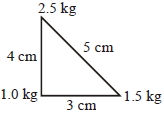 JEE Mains 2020 Medium
- The following bodies are made to roll up (without slipping) the same inclined plane from a horizontal place: \((i)\) a ring of radius \(R,\,(ii)\) a solid cylinder of radius \(\frac {R}{2}\) nd \((iii)\) a solid sphere of radius \(\frac {R}{4}.\) If, in each case, the speed of the center of mass at bottom of the incline is same, the ratio of the maximum heights they climb isJEE Mains 2019 Hard
- In a double -slit experiment, green light \(\left( {5303\,\mathop A\limits^o } \right)\) falls on a double slit having a separation of \(19.44\,\mu m\) and a width of \(4.05\,\mu m\). The number of bright fringes between the first and the second diffraction minima isJEE Mains 2019 Hard
- Two identical spherical balls of mass \(M\) and radius \(R\) each are stuck on two ends of a rod of length \(2R\) and mass \(M\) (see figure). The moment of inertia of the system about the axis passing perpendicularly through the centre of the rod is
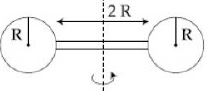 JEE Mains 2019 Hard
- The current \(I\) in the given circuit will be \(......A\)
 JEE Mains 2022 Medium
- A body having specific charge \(8\,\mu {C} / {g}\) is resting on a frictionless plane at a distance \(10\, {cm}\) from the wall (as shown in the figure). It starts moving towards the wall when a uniform electric field of \(100 \,{V} / {m}\) is applied horizontally toward the wall. If the collision of the body with the wall is perfectly elastic, then the time period of the motion will be \(....\, S.\)
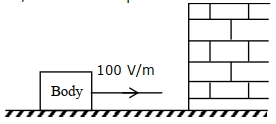 JEE Mains 2021 Hard
More PYQs from JEE Mains
- For the given circuit, comment on the type of transformer used:
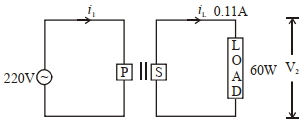 JEE Mains 2021 Medium
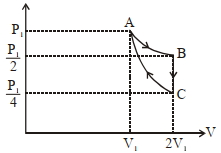
- If one mole of an ideal gas at \(\left( P _{1}, V _{1}\right)\) is allowed to expand reversibly and isothermally (\(A\) to \(B\) ) its pressure is reduced to one-half of the original pressure (see \(figure\)). This is followed by a constant volume cooling till its pressure is reduced to one-fourth of the initial value \(( B \rightarrow C ) .\) Then it is restored to its initial state by a reversible adiabatic compression (\(C\) to \(A\)). The net workdone by the gas is equal to ...... .
 JEE Mains 2021 Hard
- A uniform disc of radius \(R\) and mass \(M\) is free to oscillate about the axis \(A\) as shown in the figure. For small oscillations the time period is ______.
(\(g\) is acceleration due to gravity) JEE Mains 2026 Hard