


JEE Mains · Physics · STD 12 -Alternating current
- JEE Mains 2024
- Hard
- MCQ
An alternating voltage \(\mathrm{V}(\mathrm{t})=220 \sin 100 \ \pi \mathrm{t}\) volt is applied to a purely resistive load of \(50\ \Omega\). The time taken for the current to rise from half of the peak value to the peak value is _______.
Pick an option to check your answer.
Answer & Solution
Correct Answer
(B) \(3.3 \mathrm{~ms}\)
Step-by-step Solution
Detailed explanation
Given equation of alternating voltage:
\( V(t) = 220 \sin(100 \pi t) \)
Comparing this with the standard alternating voltage equation \( V(t) = V_0 \sin(\omega t) \), we get:
Peak voltage, \( V_0 = 220\text{ V} \)
Angular frequency, \( \omega = 100 \pi\text{ rad/s} \)
For a purely resistive load, the current \( I(t) \) is in phase with the voltage and is given by:
\( I(t) = I_0 \sin(\omega t) \) (where \( I_0 \) is the peak current value)
Step 1: Find the time \( t_1 \) when the current reaches half of its peak value \( \left(\frac{I_0}{2}\right) \):
\( I(t_1) = \frac{I_0}{2} \)
\( I_0 \sin(\omega t_1) = \frac{I_0}{2} \)
\( \sin(\omega t_1) = \frac{1}{2} \)
\( \omega t_1 = \frac{\pi}{6} \implies t_1 = \frac{\pi}{6\omega} \)
Step 2: Find the time \( t_2 \) when the current reaches its full peak value \( (I_0) \):
\( I(t_2) = I_0 \)
\( I_0 \sin(\omega t_2) = I_0 \)
\( \sin(\omega t_2) = 1 \)
\( \omega t_2 = \frac{\pi}{2} \implies t_2 = \frac{\pi}{2\omega} \)
Step 3: Calculate the time taken \( t \) to rise from half of the peak value to the peak value:
\( t = t_2 - t_1 = \frac{\pi}{2\omega} - \frac{\pi}{6\omega} \)
\( t = \frac{3\pi - \pi}{6\omega} = \frac{2\pi}{6\omega} = \frac{\pi}{3\omega} \)
Explanation of your doubt (\( \frac{\pi}{3\omega} = \frac{\pi}{300\pi} \)):
Since we found \( \omega = 100\pi \) from the given voltage equation, substituting this value into the denominator gives:
\( 3\omega = 3 \times 100\pi = 300\pi \)
Now, substitute \( \omega = 100\pi \) into the time equation:
\( t = \frac{\pi}{3 \times 100\pi} = \frac{\pi}{300\pi} \)
\( t = \frac{1}{300}\text{ seconds} \)
Converting seconds into milliseconds (\( 1\text{ s} = 1000\text{ ms} \)):
\( t = \frac{1}{300} \times 1000\text{ ms} = \frac{10}{3}\text{ ms} \approx 3.33\text{ ms} \)
Therefore, the correct option is B.
More questions from Physics
- An ideal gas goes from an initial state to final state. During the process, the pressure of gas increases linearly with temperature.
A. The work done by gas during the process is zero.
B. The heat added to gas is different from change in its internal energy.
C. The volume of the gas is increased.
D. The internal energy of the gas is increased.
E. The process is isochoric (constant volume process)
Choose the correct answer from the options given below:JEE Mains 2025 Easy - The correct match between the entries in column \(I\) and column \(II\) are \(I\) \((II)\) Radiation Wavelength \((a)\) Microwave \((i)\) \(100 m\) \((b)\) Gamma rays \((ii)\) \(10^{-15} m\) \((c)\) \(A.M.\) radio waves \((iii)\) \(10^{-10} m\) \((d)\) \(X-\)rays \((iv)\) \(10^{-3} m\)JEE Mains 2020 Medium
- A container is divided into two chambers by a partition. The volume of first chamber is \(4.5\) litre and second chamber is \(5.5\) litre. The first chamber contain \(3.0\) moles of gas at pressure \(2.0\, atm\) and second chamber contain \(4.0\) moles of gas at pressure \(3.0\, atm\) .After the partition is removed and the mixture attains equilibrium, then, the common equilibrium pressure existing in the mixture is \(x \times 10^{-1} atm\). Value of \(x\) is.........JEE Mains 2021 Hard
- In a uniform magnetic field, the magnetic needle has a magnetic moment \(9.85 \times 10^{-2} \,{A} / {m}^{2}\) and moment of inertia \(5 \times 10^{-6} \,{kgm}^{2}\). If it performs \(10\) complete oscillations in \(5\, seconds\) then the magnitude of the magnetic field is \(....\,mT.\) [ Take \(\pi^{2}\) as \(9.85\) ]JEE Mains 2021 Medium
- Given below are two statements: Statement \(I\) : Electromagnetic waves are not deflected by electric and magnetic field. Statement \(II\) : The amplitude of electric field and the magnetic field in electromagnetic waves are related to each other as \(E _0=\sqrt{\frac{\mu_0}{\varepsilon_0}} B_0\) In the light of the above statements, choose the correct answer from the options given below:JEE Mains 2023 Medium
-
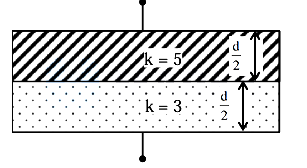
Space between the plates of a parallel plate capacitor of plate area \(4 \mathrm{~cm}^2\) and separation of (d) 1.77 mm, is filled with uniform dielectric materials with dielectric constants (3 and 5) as shown in figure. Another capacitor of capacitance 7.5 pF is connected in parallel with it. The effective capacitance of this combination is ________ pF. \(\left(\right.\) Given \(\left.\varepsilon_0=8.85 \times 10^{-12} \mathrm{~F} / \mathrm{m}\right)\)JEE Mains 2025 Hard
More PYQs from JEE Mains
- A magnet of total magnetic moment \({10\,^{ - 2}}\hat i\,A - {m^2}\) is placed in a time varying magnetic field, \(B\,\hat i\,\left( {\cos \,\omega t} \right)\) where \(B = 1\, Tesla\) and \(\omega = 0.125\, rad/s\). The work done for reversing the direction of the magnetic moment at \(t = 1\, second\), isJEE Mains 2019 Medium
- A uniform cable of mass \(‘M’\) and length \(‘L’\) is placed on a horizontal surface such that its \({\left( {\frac{1}{n}} \right)^{th}}\) part is hanging below the edge of the surface. To lift the hanging part of the cable upto the surface, the work done should beJEE Mains 2019 Hard
- An engine operating between the boiling and freezing points of water will have \(1.\) efficiency more than \(27 \%\) \(2.\) efficiency less than the efficiency a Carnot engine operating between the same two temperatures. \(3.\) efficiency equal to \(27 \%\) \(4.\) efficiency less than \(27 \%\)JEE Mains 2023 Medium