


JEE Mains · Physics · STD 11 - 11. thermodynamics
Given below are two statement Statement \(-I\) : What \(\mu\) amount of an ideal gas undergoes adiabatic change from state \(\left( P _{1}, V _{1}, T _{1}\right)\) to state \(\left( P _{2}, V _{2}, T _{2}\right)\), the work done is \(W =\frac{1 R \left( T _{2}- T _{1}\right)}{1-\gamma}\), where \(\gamma=\frac{ C _{ P }}{ C _{ V }}\) and \(R =\) universal gas constant, Statement \(-II\) : In the above case. when work is done on the gas. the temperature of the gas would rise. Choose the correct answer from the options given below
- A Both statement \(-I\) and statement \(-II\) are true.
- B Both statement \(-I\) and statement \(-II\) are false.
- C Statement \(-I\) is true but statement \(-II\) is false.
- D Statement \(-I\) is false but statement \(-II\) is true.
Answer & Solution
Correct Answer
(A) Both statement \(-I\) and statement \(-II\) are true.
Step-by-step Solution
Detailed explanation
\(W _{\text {adiabatic }}=\frac{ NR \left( T _{f}- T _{ i }\right)}{1-\gamma} \rightarrow\) statment \(1\) \(Q=W+\Delta U\) \(0= W +\Delta U\) \(\Delta U =- W\) If work is done on the gas, i.e. work is negative \(\therefore \Delta U\) is positive. \(\therefore\) Temperature will…
See the Complete Solution
Get step-by-step explanations for this and 2.5 Lakh+ more JEE, NEET & CET questions.
- Unlock all solutions
- Practice the full chapter
- Track accuracy across PYQs
4.8 rated on Google Play · 14,000+ reviews
More questions from Physics
- The electric field in a plane electromagnetic wave is given by \(\overrightarrow{{E}}=200 \cos \left[\left(\frac{0.5 \times 10^{3}}{{m}}\right) {x}-\left(1.5 \times 10^{11} \frac{{rad}}{{s}} \times {t}\right)\right] \frac{{V}}{{m}} \hat{{j}}\) If this wave falls normally on a perfectly reflecting surface having an area of \(100 \;{cm}^{2}\). If the radiation pressure exerted by the \(E.M.\) wave on the surface during a \(10\, minute\) exposure is \(\frac{{x}}{10^{9}} \frac{{N}}{{m}^{2}}\). Find the value of \({x}\).JEE Mains 2021 Hard
- A radio-active material is reduced to \(1 / 8\) of its original amount in \(3\) days. If \(8 \times 10^{-3}\,kg\) of the material is left after \(5\) days. The initial amount of the material is \(.......\,g\)JEE Mains 2023 Medium
- A small point of mass \(m\) is placed at a distance \(2 R\) from the centre ' \(O^{\prime}\) of a big uniform solid sphere of mass M and radius R . The gravitational force on ' m ' due to M is \(\mathrm{F}_1\). A spherical part of radius \(\mathrm{R} / 3\) is removed from the big sphere as shown in the figure and the gravitational force on m due to remaining part of M is found to be \(\mathrm{F}_2\). The value of ratio \(\mathrm{F}_1: \mathrm{F}_2\) is _______.
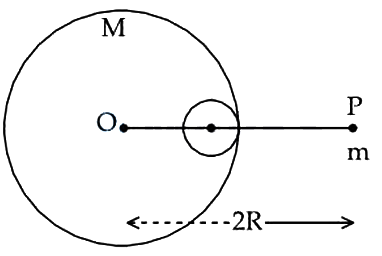 JEE Mains 2025 Hard
 - The total length of potentiometer wire AB is 50 cm in the arrangement as shown in figure. If P is the point where the galvanometer shows zero reading then the length AP is _________ cm .
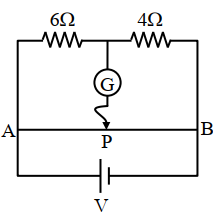 JEE Mains 2026 Hard
 - Light is incident from a medium into air at two possible angles of incidence \((A)\, 20^o\) and \((B)\, 40^o\) . In the medium light travels \(3.0\, cm\) in \(0.2\, ns\). The ray willJEE Mains 2013 Hard
- Two travelling waves produces a standing wave represented by equation, \({y}=1.0\, {mm} \cos \left(1.57 \,{cm}^{-1}\right) {x} \sin \left(78.5\, {s}^{-1}\right) {t}\) The node closest to the origin in the region \({x}>0\) will be at \({x}=\ldots \ldots \ldots\, {cm}\)JEE Mains 2021 Medium
More PYQs from JEE Mains
- Let \(A=\{1,2,3, \ldots, 10\}\) and \(B=\left\{\frac{m}{n}: m, n \in A, m \lt n\right.\) and \(\left.\operatorname{gcd}(m, n)=1\right\}\). Then \(n(B)\) is equal to :JEE Mains 2025 Medium
- If average depth of an ocean is \(4000 \mathrm{~m}\) and the bulk modulus of water is \(2 \times 10^9 \mathrm{Nm}^{-2}\), then fractional compression \(\frac{\Delta V}{V}\) of water at the bottom of ocean is \(\alpha \times 10^{-2}\). The value of \(\alpha\) is ___________(Given, \(\mathrm{g}=10 \mathrm{~ms}^{-2}, \rho=1000 \mathrm{~kg} \mathrm{~m}^{-3}\) )JEE Mains 2024 Hard
- Let a set \(A=A_{1} \cup A_{2} \cup \ldots \cup A_{k,} \quad\) where \(A_{ i } \cap A _{ j }=\phi\) for \(i \neq j 1 \leq i , j \leq k\). Define the relation \(R\) from \(A\) to \(A\) by \(R=\left\{(x, y): y \in A_{i}\right.\) if and only if \(\left.x \in A_{i}, 1 \leq i \leq k\right\}\). Then, \(R\) isJEE Mains 2022 Medium
- Two convex lenses of focal length \(20\,cm\) each are placed coaxially with a separation of \(60\,cm\) between them. The image of the distant object formed by the combination is at \(...........\,cm\) from the first lens.JEE Mains 2023 Medium
- A wedge \(Y\) with mass of \(10\) kg and all frictionless surfaces and the inclined surface making \(37°\) with horizontal. A block \(X\) with mass \(2\) kg is placed at the highest point of the wedge as shown in figure is at rest. At \(t = 0\) wedge \((Y)\) is pulled toward right with constant force \((f)\) of \(24\) N. Taking the block \(X\) at rest at \(t = 0\), the time taken by it to slide down \(8.8\) m on the slope, while \(Y\) is on the move, is _____ s.
(take \(\tan(37°) = 3/4\) and \(g = 10\) m/s\(^2\))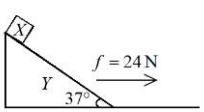 JEE Mains 2026 Hard
 - A wire of length \(L\) and mass per unit length \(6.0\times 10^{-3}\; \mathrm{kgm}^{-1}\) is put under tension of \(540\; \mathrm{N}\). Two consecutive frequencies that it resonates at are : \(420\; \mathrm{Hz}\) and \(490 \;\mathrm{Hz}\). Then \(\mathrm{L}\) in meters isJEE Mains 2020 Easy