


enEnglishhiहिन्दी
JEE Mains · Physics · STD 12 - 11. Dual nature of radiation and matter
An electron and proton are separated by a large distance. The electron starts approaching the proton with energy \(3\, {eV}\). The proton captures the electrons and forms a hydrogen atom in second excited state. The resulting photon is incident on a photosensitive metal of threshold wavelength \(4000\, \mathring {{A}}\). What is the maximum kinetic energy of the emitted photoelectron ? (In \({eV}\))
- A \(1.99\)
- B \(3.3\)
- C \(1.41\)
- D \(7.61\)
Answer & Solution
Correct Answer
(C) \(1.41\)
Step-by-step Solution
Detailed explanation
Initially, energy of electron \(=+3 {eV}\) Finally, in \(2^{\text {nd }}\) excited state, \(E=-\frac{(13.6\, {eV})}{3^{2}}\) \(=-1.51 \,{eV}\) Loss in energy is emitted as photon, So, photon energy \(\frac{{hc}}{\lambda}=4.51\, {eV}\) No, photoelectric effect equation…
See the Complete Solution
Get step-by-step explanations for this and 2.5 Lakh+ more JEE, NEET & CET questions.
- Unlock all solutions
- Practice the full chapter
- Track accuracy across PYQs
4.8 rated on Google Play · 14,000+ reviews
More questions from Physics
- One of the two small circular coils, (none of them having any self- inductance) is suspended with a \(V-\) shaped copper wire, with plane horizontal. The other coil is placed just below the first one with plane horizontal. Both the coils are connected in series with a \(dc\) supply. The coils are found to attract each other with a force. Which one of the following statements is incorrect ?JEE Mains 2013 Hard
- The approximate height from the surface of earth at which the weight of the body becomes \(\frac{1}{3}\) of its weight on the surface of earth is \(..........km\) : [Radius of earth \(R =6400 \,km\) and \(\sqrt{3}=1.732]\)JEE Mains 2022 Medium
- In materials like aluminium and copper, the correct order of magnitude of various elastic modulii isJEE Mains 2014 Medium
- Four particles \(A, B, C\) and \(D\) with masses \(m_A=m, m_B=2m, m_C=3m\) and \(m_D=4m\) are at the corners of a square. They have accelerations of equal magnitude with directions as shown. The acceleration of the centre of mass of the particles is
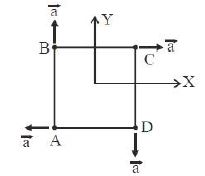 JEE Mains 2019 Hard
 - In finding out refractive index of glass slab the following observations were made through travelling microscope \(50\) vernier scale division \(=\) \(49 \mathrm{MSD} ; 20\) divisions on main scale in each \(\mathrm{cm}\) For mark on paper \(\mathrm{MSR}=8.45 \mathrm{~cm}, \mathrm{VC}=26\) For mark on paper seen through slab \(\mathrm{MSR}=7.12 \mathrm{~cm}, \mathrm{VC}=41\) For powder particle on the top surface of the glass slab \(\mathrm{MSR}=4.05 \mathrm{~cm}, \mathrm{VC}=1\) \((\mathrm{MSR}=\) Main Scale Reading, \(\mathrm{VC}=\) Vernier Coincidence) Refractive index of the glass slab is _______.JEE Mains 2024 Hard
- In an experiment to measure the focal length ( \(f\) ) of a convex lens, the magnitude of object distance \((x)\) and the image distance \((y)\) are measured with reference to the focal point of the lens. The \(y-x\) plot is shown in figure. The focal length of the lens is _______ \(\mathrm{cm}\).
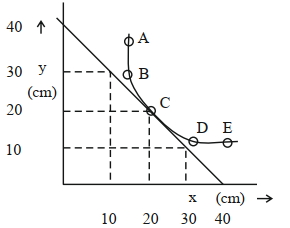 JEE Mains 2024 Hard
More PYQs from JEE Mains
- In the given circuit the current through Zener Diode is close to.......\(mA\)
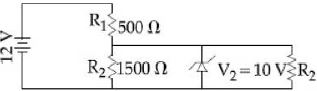 JEE Mains 2019 Medium
 - Consider a block and trolley system as shown in figure. If the coefficient of kinetic friction between the trolley and the surface is \(0.04\) , the acceleration of the system in \(\mathrm{ms}^{-2}\) is _______. (Consider that the string is massless and unstretchable and the pulley is also massless and frictionless)
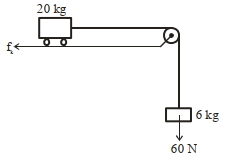 JEE Mains 2024 Hard
 - Let [.] denote the greatest integer function. If \(\int_0^{e^3}\left[\frac{1}{\mathrm{e}^{\mathrm{x}-1}}\right] \mathrm{dx}=\alpha-\log _{\mathrm{e}} 2\), then \(\alpha^3\) is equal to _______ .JEE Mains 2025 Medium
- Given a sequence of \(4\) numbers, first three of which are in \(G.P.\) and the last three are in \(A.P\). with common difference six. If first and last terms in this sequence are equal, then the last term isJEE Mains 2013 Hard
- If \(y (x)\) is the solution of the differential equation \(\frac{{dy}}{{dx}} + \left( {\frac{{2x + 1}}{x}} \right)y = {e^{ - 2x}},x > 0\) where \(y\,\,(1)\, = \,\frac{1}{2}{e^{ - 2}},\) thenJEE Mains 2019 Hard
- Consider two identical metallic spheres of radius \(R\) each having charge \(Q\) and mass \(m\). Their centers have an initial separation of \(4 R\). Both the spheres are given an initial speed of \(u\) towards each other. The minimum value of \(u\), so that they can just touch each other is:
(Take \(k=\frac{1}{4 \pi \epsilon_0}\) and assume \(k Q^2>G m^2\) where G is the Gravitational constant)JEE Mains 2026 Easy