


enEnglishguગુજરાતી
JEE Mains · Physics · STD 12 - 13. Nuclei
If \('f^{\prime}\) denotes the ratio of the number of nuclei decayed \(\left(N_{d}\right)\) to the number of nuclei at \(t=0\) \(\left({N}_{0}\right)\) then for a collection of radioactive nuclei, the rate of change of \('f'\) with respect to time is given as: \([\lambda\) is the radioactive decay constant]
- A \(\lambda\left(1-{e}^{-\lambda t}\right)\)
- B \(-\lambda e^{-\lambda t}\)
- C \(\lambda e^{-\lambda t}\)
- D \(-\lambda\left(1-{e}^{-\lambda . t}\right)\)
Answer & Solution
Correct Answer
(C) \(\lambda e^{-\lambda t}\)
Step-by-step Solution
Detailed explanation
\(N = N _{0} e ^{-\lambda t}\) \(N _{ d }= N _{0}- N\) \(N _{ d }= N _{0}\left(1- e ^{-\lambda t }\right)\) \(\frac{ N _{ d }}{ N _{0}}= f =1- e ^{-\lambda t }\) \(\frac{ df }{ dt }=\lambda e ^{-\lambda t }\)
See the Complete Solution
Get step-by-step explanations for this and 2.5 Lakh+ more JEE, NEET & CET questions.
- Unlock all solutions
- Practice the full chapter
- Track accuracy across PYQs
4.8 rated on Google Play · 14,000+ reviews
More questions from Physics
- In a plane electromagnetic wave, the directions of electric field and magnetic field are represented by \(\hat{ k }\) and \(2 \hat{ i }-2 \hat{ j },\) respectively What is the unit vector along direction of propagation of the wave.JEE Mains 2020 Medium
- Two simple pendulums having lengths \(l_1\) and \(l_2\) with negligible string mass undergo angular displacements \(\theta_1\) and \(\theta_2\), from their mean positions, respectively. If the angular accelerations of both pendulums are same, then which expression is correct?JEE Mains 2025 Medium
- A capacitor of reactance \(4 \sqrt{3} \Omega\) and a resistor of resistance \(4 \Omega\) are connected in series with an ac source of peak value \(8 \sqrt{2} \mathrm{~V}\). The power dissipation in the circuit is _______ \(W\).JEE Mains 2024 Hard
- Light is incident from a medium into air at two possible angles of incidence \((A)\, 20^o\) and \((B)\, 40^o\) . In the medium light travels \(3.0\, cm\) in \(0.2\, ns\). The ray willJEE Mains 2013 Hard
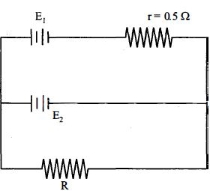
- A \(dc\) source of \(emf \,E_1 = 100\,V\) and internal resistance \(r = 0.5\,\Omega ,\) a storage battery of emf \(E_2 = 90\,V\) and an external resistance \(R\) are connected as shown in figure. For what value of \(R\) no current will pass through the battery ? ................ \(\Omega\)
 JEE Mains 2013 Medium
 - Two vessels \(A\) and \(B\) are of the same size and are at same temperature. A contains \(1 \mathrm{~g}\) of hydrogen and \(B\) contains \(1 \mathrm{~g}\) of oxygen. \(\mathrm{P}_{\mathrm{A}}\) and \(\mathrm{P}_{\mathrm{B}}\) are the pressures of the gases in \(A\) and \(\mathrm{B}\) respectively, then \(\frac{\mathrm{P}_{\mathrm{A}}}{\mathrm{P}_{\mathrm{B}}}\) is _______.JEE Mains 2024 Hard
More PYQs from JEE Mains
- The coefficient of \(x^{18}\) in the product \((1+ x)(1- x)^{10} (1+ x + x^2 )^9\) isJEE Mains 2019 Hard
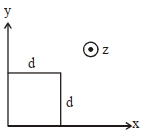
- The magnetic field in a region is given by \(\overrightarrow{ B }= B _{0}\left(\frac{ x }{ a }\right) \,\hat{ k }\). A square loop of side \(d\) is placed with its edges along the \(x\) and \(y\) axes. The loop is moved with a constant velocity \(\overrightarrow{ v }= v _{0} \hat{ i }\). The emf induced in the loop is:
 JEE Mains 2021 Hard
 - Let the point A be the foot of perpendicular drawn from the point \(P(a, b, 0)\) on the line \(\dfrac{x-1}{2} = \dfrac{y-2}{1} = \dfrac{z-\alpha}{3}\). If the midpoint of the line segment PA is \(\left(0, \dfrac{3}{4}, \dfrac{-1}{4}\right)\), then the value of \(a^2 + b^2 + \alpha^2\) is equal to:JEE Mains 2026 Hard
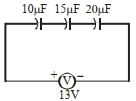
- The charge on capacitor of capacitance \(15 \mu F\) in the figure given below is \(\dots \; \mu c\)
 JEE Mains 2022 Medium
 - The function \(f(x)=x^{3}-6 x^{2}+a x+b\) is such that \(f(2)=f(4)=0\). Consider two statements. \((S_1)\) there exists \(\mathrm{x}_{1}, \mathrm{x}_{2} \in(2,4), \mathrm{x}_{1}<\mathrm{x}_{2}\), such that \(f^{\prime}\left(x_{1}\right)=-1\) and \(f^{\prime}\left(x_{2}\right)=0\) \((S_2)\) there exists \(\mathrm{x}_{3}, \mathrm{x}_{4} \in(2,4), \mathrm{x}_{3}<\mathrm{x}_{4}\), such that \(f\) is decreasing in \(\left(2, x_{4}\right)\), increasing in \(\left(x_{4}, 4\right)\) and \(2 f^{\prime}\left(x_{3}\right)=\sqrt{3} f\left(x_{4}\right)\). ThenJEE Mains 2021 Hard
- The integral \(\int {\frac{{2{x^3} - 1}}{{{x^4} + x}}} \,dx\) is equal to (Here \(C\) is a constant of integration)JEE Mains 2019 Hard