


JEE Mains · Physics · STD 12 - Ray optics and optical instruments
- JEE Mains 2026
- Hard
- MCQ
Light ray incident along a vector \(\vec{AO}\) \((\vec{AO} = 2\hat{i}-3\hat{j})\) emerges out along vector \(\vec{OB}\) \((\vec{OB} = C\hat{i}-4\hat{j})\) as shown in the figure below. The value of \(C\) is ________.

Pick an option to check your answer.
Answer & Solution
Correct Answer
(A) \(1.6\)
Step-by-step Solution
Detailed explanation
From the given figure, the interface is horizontal and the normal is along the y-axis.
The incident ray is along the vector \(\vec{AO} = 2\hat{i} - 3\hat{j}\).
The angle of incidence \(\alpha\) is the angle between the incident ray and the normal.
\(\sin \alpha = \dfrac{2}{\sqrt{2^2 + (-3)^2}} = \dfrac{2}{\sqrt{13}}\)
The refracted ray is along the vector \(\vec{OB} = C\hat{i} - 4\hat{j}\).
The angle of refraction \(\beta\) is the angle between the refracted ray and the normal.
\(\sin \beta = \dfrac{C}{\sqrt{C^2 + (-4)^2}} = \dfrac{C}{\sqrt{C^2 + 16}}\)
Applying Snell's law at the interface:
\(\mu_1 \sin \alpha = \mu_2 \sin \beta\)
\(1 \times \dfrac{2}{\sqrt{13}} = 1.5 \times \dfrac{C}{\sqrt{C^2 + 16}}\)
\(\dfrac{2}{\sqrt{13}} = \dfrac{3}{2} \dfrac{C}{\sqrt{C^2 + 16}}\)
Squaring both sides:
\(\dfrac{4}{13} = \dfrac{9}{4} \left( \dfrac{C^2}{C^2 + 16} \right)\)
\(16(C^2 + 16) = 117 C^2\)
\(16 C^2 + 256 = 117 C^2\)
\(101 C^2 = 256\)
\(C^2 = \dfrac{256}{101}\)
\(C = \dfrac{16}{\sqrt{101}} \approx 1.592\)
Approximating \(\sqrt{101} \approx 10\), we get \(C \approx 1.6\).
Answer: \(1.6\)
More questions from Physics
- A body travels \(102.5 \mathrm{~m}\) in \(\mathrm{n}^{\text {th }}\) second and \(115.0 \mathrm{~m}\) in \((n+2)^{\text {th }}\) second. The acceleration is what?JEE Mains 2024 Hard
- The maximum rated power of the LED is \(2\) mW and it is used in the circuit with input voltage of \(5\) V as shown in the figure below. The current through resistance \(R_S\) is \(0.5\) mA. The minimum value of the resistance of \(R_S\), to ensure that the LED is not damaged is _______ k\(\Omega\).
 JEE Mains 2026 Hard
- The light of two different frequencies whose photons have energies \(3.8 \,eV\) and \(1.4 \,eV\) respectively, illuminate a metallic surface whose work function is \(0.6 \,eV\) successively. The ratio of maximum speeds of emitted electrons for the two frequencies respectivly will beJEE Mains 2022 Medium
- Match List\(-I\) with List\(-II.\)
Choose the most appropriate answer from the option given below :List\(-I\) List\(-II\) \((a)\) Torque \((i)\) \({MLT}^{-1}\) \((b)\) Impulse \((ii)\) \({MT}^{-2}\) \((c)\) Tension \((iii)\) \({ML}^{2} {T}^{-2}\) \((d)\) Surface Tension \((iv)\) \({MI} {T}^{-2}\) JEE Mains 2021 Medium - A light source of wavelength \(\lambda\) illuminates a metal surface and electrons are ejected with maximum kinetic energy of 2 eV . If the same surface is illuminated by a light source of wavelength \(\frac{\lambda}{2}\), then the maximum kinetic energy of ejected electrons will be (The work function of metal is 1 eV )JEE Mains 2025 Easy
- Given below are two statements: One is labelled as Assertion \((A)\) and other is labelled as Reason \((R)\). Assertion \((A)\) : Time period of oscillation of a liquid drop depends on surface tension \((S)\), if density of the liquid is \(p\) and radius of the drop is \(r\), then \(T = k \sqrt{ pr ^{3} / s ^{3 / 2}}\) is dimensionally correct, where \(K\) is dimensionless. Reason \((R)\): Using dimensional analysis we get \(R.H.S.\) having different dimension than that of time period. In the light of above statements, choose the correct answer from the options given below.JEE Mains 2022 Medium
More PYQs from JEE Mains
- Diameter of the objective lens of a telescope is \(250\, cm\). For light of wavelength \(600\, nm\). Coming from a distant object, the limit of resolution of the telescope is close toJEE Mains 2019 Easy
- A parallel plate capacitor of capacitance \(12.5 \mathrm{pF}\) is charged by a battery connected between its plates to potential difference of \(12.0 \mathrm{~V}\). The battery is now disconnected and a dielectric slab \(\left(\epsilon_{\mathrm{r}}=6\right)\) is inserted between the plates. The change in its potential energy after inserting the dielectric slab is _______.\(\times 10^{-12} \mathrm{~J}\).JEE Mains 2024 Hard
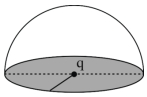
- If a charge \(q\) is placed at the centre of a closed hemispherical non-conducting surface, the total flux passing through the flat surface would be
 JEE Mains 2022 Medium
- A line charge of length \(\frac{\text { ' } a \text { ' }}{2}\) is kept at the center of an edge \(B C\) of a cube \(A B C D E F G H\) having edge length ' \(a\) ' as shown in the figure. If the density of line charge is \(\lambda\) C per unit length, then the total electric flux through all the faces of the cube will be _______. (Take, \(\epsilon_0\) as the free space permittivity)
 JEE Mains 2025 Hard
- A body is in simple harmonic motion with time period half second \((T\, = 0.5\, s)\) and amplitude one \(cm\, (A\,= 1\, cm)\). Find the average velocity in the interval in which it moves form equilibrium position to half of its amplitude .... \(cm/s\)JEE Mains 2014 Medium