


Questions
29 questionsShowing 1–29 of 29 questions
-
- (A) \(15\)
- (B) \(10\)
- (C) \(18\)
- (D) \(12\)
Show answer and solution
Correct Answer: (D)
\(\omega_{1}=0.02 ; \mu_{1}=1.5 ; \quad \omega_{2}=0.03 ; \mu_{2}=1.6\)Achromatic combination
\(\therefore \theta_{\text {net }}=0\)
\(\theta_{1}-\theta_{2}=0\)
\(\theta_{1}=\theta_{2}\)
\(\omega_{1} \delta_{1}=\omega_{2} \delta_{2}\)
\(\&\, \delta_{\text {net }}=\delta_{1}-\delta_{2}=2^{\circ}\)
\(\delta_{1}-\frac{\omega_{1} \delta_{1}}{\omega_{2}}=2^{\circ}\)
\(\delta_{1}\left(1-\frac{\omega_{1}}{\omega_{2}}\right)=2^{\circ}\)
\(\delta_{1}\left(1-\frac{2}{3}\right)=2^{\circ}\)
\(\delta_{1}=6^{\circ}\)
\(\delta_{1}=\left(\mu_{1}-1\right) A_{1}\)
\(6^{\circ}=(1.5-1) A_{1}\)
\(A_{1}=12^{\circ}\)
-
- (A) \(11.7\)
- (B) \(10\)
- (C) \(7.5\)
- (D) \(8.75\)
Show answer and solution
Correct Answer: (B)
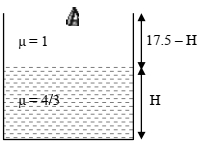
Height of water observed by observer\(=\frac{{H}}{\mu_{{w}}}=\frac{{H}}{(4 / 3)}=\frac{3 {H}}{4}\)
Height of air observed by observer \(=17.5-{H}\) According to question, both height observed by observer is same.
\(\frac{3 {H}}{4}=17.5-{H}\)
\(\Rightarrow {H}=10\, {cm}\)
-
- (A) \(75\)
- (B) \(135\)
- (C) \(150\)
- (D) \(210\)
Show answer and solution
Correct Answer: (C)
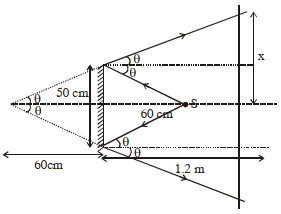
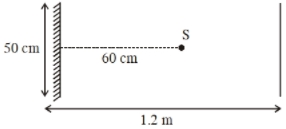
\(\tan \theta=\frac{25}{60}=\frac{ x }{180}\)\(x =75 \,cm\)
so distance between extreme point \(=2 x =2 \times\) \(75=150\, cm\)
-
- (A) \({\sin ^{ - 1}}\left( {\frac{\mu }{2}} \right)\)
- (B) \({\sin ^{ - 1}}\sqrt {\frac{{\mu - 1}}{2}} \)
- (C) \(2{\cos ^{ - 1}}\left( {\frac{\mu }{2}} \right)\)
- (D) \({\cos ^{ - 1}}\left( {\frac{\mu }{2}} \right)\)
Show answer and solution
Correct Answer: (C)
(c) Given \({\delta _m} = A,\) as\(\mu = \frac{{\sin \,\left({\frac{{A + {\delta _m}}}{2}} \right)}}{{\sin \,\left({\frac{A}{2}} \right)}}\)
\( \Rightarrow \)\(\mu = \frac{{\sin \left({\frac{{A + A}}{2}} \right)}}{{\sin \left({\frac{A}{2}} \right)}} = 2\cos \frac{A}{2} \)
\(\Rightarrow A = 2{\cos ^{ - 1}}\left({\frac{\mu }{2}} \right)\)
-
- (A) \(500\)
- (B) \(600\)
- (C) \(700\)
- (D) \(800\)
Show answer and solution
Correct Answer: (B)
For no deviation, \(n_{1}=n_{2}\)\(1.2+\frac{10.8 \times 10^{-14}}{\lambda^{2}} =1.45+\frac{1.8 \times 10^{-14}}{\lambda^{2}}\)
\(0.25 =\frac{9 \times 10^{-14}}{\lambda^{2}}\)
\(\lambda^{2} =\frac{9 \times 10^{-14}}{0.25}\)
\(\lambda =\frac{3}{5} \times 10^{-6}\)
\(\lambda =6 \times 10^{-7} m\)
\(\lambda =600 nm\)
-
- (A) \(\sin ^{-1} \frac{\sqrt{5}}{3}\)
- (B) \(\sin ^{-1} \frac{\sqrt{7}}{3}\)
- (C) \(\sin ^{-1} \frac{\sqrt{7}}{4}\)
- (D) \(\sin ^{-1} \frac{\sqrt{5}}{4}\)
Show answer and solution
Correct Answer: (B)
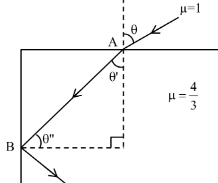
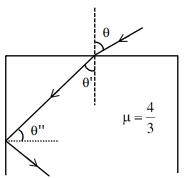
At maximum angle \(\theta\) ray at point \(B\) goes in gazing emergence, at all less values of \(\theta, \operatorname{TIR}\) occurs.At point B
\(\frac{4}{3} \times \sin \theta^{\prime \prime}=1 \times \sin 90^{\circ}\)
\(\theta^{\prime \prime}=\sin ^{-1}\left(\frac{3}{4}\right)\)
\(\theta^{\prime}=\left(\frac{\pi}{2}-\theta^{\prime \prime}\right)\)
At point \(A\)
\(1 \times \sin \theta=\frac{4}{3} \times \sin \theta^{\prime}\)
\(\sin \theta=\frac{4}{3} \times \sin \left(\frac{\pi}{2}-\theta^{\prime \prime}\right)\)
\(\sin \theta=\frac{4}{3} \cos \left[\cos ^{-1} \frac{\sqrt{7}}{4}\right]\)
\(\sin \theta=\frac{4}{3} \times \frac{\sqrt{7}}{4}\)
\(\theta=\sin ^{-1}\left(\frac{\sqrt{7}}{3}\right)\)
-
- (A) \(50\)
- (B) \(80\)
- (C) \(30\)
- (D) \(60\)
Show answer and solution
Correct Answer: (D)
At minimum deviation \(r_{1}=r_{2}=\frac{A}{2}\)Also given \({i}=2 {r}_{1}={A}\)
Now \(1 \sin i =\sqrt{3} \sin r_{1}\)
\(1 \sin A=\sqrt{3} \sin \frac{A}{2}\)
\(2 \sin \frac{A}{2} \cos \frac{A}{2}=\sqrt{3} \sin \frac{A}{2}\)
\(\cos \frac{A}{2}=\frac{\sqrt{3}}{2} \Rightarrow \frac{A}{2}=30^{\circ}\)
\(A=60^{\circ}\)
-
- (A) Image is real, same side of concave mirror.
- (B) Image is virtual, opposite side of concave mirror.
- (C) Image is real, same side of convex mirror.
- (D) Image is virtual, opposite side of convex mirror.
Show answer and solution
Correct Answer: (D)
Since orientation is same image is virtual. Since image is smaller the mirror has to be convex -
- (A) \(350\)
- (B) \(250\)
- (C) \(50\)
- (D) \(150\)
Show answer and solution
Correct Answer: (C)
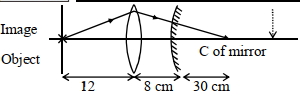
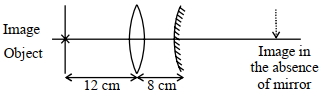
For the object to coincide with image, the light must fall perpendicularly to mirror. Which means that the light will have to converge at \({C}\) of mirror.
Without the mirror also, the light would coverage at \({C}\).So the distance is : \(12+8+30=50 \,{cm}\)
-
- (A) \(1, \infty\)
- (B) Very high, \(\infty\)
- (C) \(\frac{1}{2}, \frac{f}{2}\)
- (D) \(\frac{1}{4}, \frac{f}{4}\)
Show answer and solution
Correct Answer: (C)
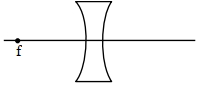
\({U}=-{f}\)\(\frac{1}{{V}}-\frac{1}{{U}}=\frac{1}{-{f}} \Rightarrow \frac{1}{{V}}=-\frac{2}{{f}}\)
\({V}=\frac{-{f}}{2}\)
\({m}=\frac{{V}}{{U}}=\frac{1}{2}\)
distance \(=\frac{{f}}{2}\)
-
- (A) \(\frac{2 {d}_{1} {d}_{2}}{{d}_{1}-{d}_{2}}\)
- (B) \(\frac{2 {d}_{1} {d}_{2}}{{d}_{1}+{d}_{2}}\)
- (C) \(\frac{{d}_{1} {d}_{2}}{{d}_{1}+{d}_{2}}\)
- (D) \(\frac{{d}_{1} {d}_{2}}{{d}_{1}-{d}_{2}}\)
Show answer and solution
Correct Answer: (A)
Using Newton"s formula\(\left({f}+{d}_{1}\right)\left({f}-{d}_{2}\right)={f}^{2}\)
\({f}^{2}+{fd}_{1}-{fd}_{2}-{d}_{1} {d}_{2}={f}^{2}\)
\({f}=\frac{{d}_{1} {d}_{2}}{{d}_{1}-{d}_{2}}\)
\(\therefore {R}=\frac{2 {d}_{1} {d}_{2}}{{d}_{1}-{d}_{2}}\)
-
- (A) \(2.5\)
- (B) \(12\)
- (C) \(60\)
- (D) \(25\)
Show answer and solution
Correct Answer: (D)
For simple microscope,\(m=1+\frac{D}{f_{0}}\)
\(6=1+\frac{D}{f_{0}}\)
\(5=\frac{25}{f_{0}}\)
\(f_{0}=5 {cm}\)
For compound microscope,
\(m=\frac{L . D}{f_{0} \cdot f_{e}}\)
\(12=\frac{60 \times 25}{5 \cdot f_{e}}\)
-
- (A) \(4\)
- (B) \(0.2\)
- (C) \(40\)
- (D) \(0.1\)
Show answer and solution
Correct Answer: (D)
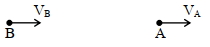
Mirror used is convex mirror (rear-view mirror)\(\therefore \mathrm{V}_{\mathrm{I} / \mathrm{m}}=-\mathrm{m}^{2} \mathrm{~V}_{\mathrm{O} / \mathrm{m}}\)
Given,
\(\mathrm{V}_{\mathrm{O} / \mathrm{m}}=40 \mathrm{~m} / \mathrm{s}\)
\(\mathrm{m}=\frac{\mathrm{f}}{\mathrm{f}-\mathrm{u}}=\frac{10}{10+190}=\frac{10}{200}\)
\(\therefore \mathrm{V}_{\mathrm{L} / \mathrm{m}}=-\frac{1}{400} \times 40=-0.1 \mathrm{~m} / \mathrm{s}\)
\(\therefore\) Car will appear to move with speed \(0.1 \mathrm{~m} / \mathrm{s}\).
-
- (A) \(0.005\)
- (B) \(500\)
- (C) \(5.173\)
- (D) \(5\)
Show answer and solution
Correct Answer: (D)
\({i}={A}=60^{\circ}\)\(={\delta}_{\min }=2 {i}-{A}\)
\(=2 \times 60^{\circ}-60^{\circ}=60^{\circ}\)
\(\mu=\frac{\sin ^{-1}\left(\frac{\delta_{\min }+{A}}{2}\right)}{\sin ^{-1}\left(\frac{{A}}{2}\right)}\)
\(=\sqrt{3}\)
\({V}_{\text { prism }}=\frac{3 \times 10^{8}}{\sqrt{3}}\)
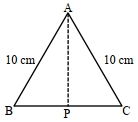
\({AP}=10 \times 10^{-2} \times \frac{\sqrt{3}}{2}\)
\(\text { time }=\frac{5 \times 10^{-2}}{3 \times 10^{8}} \times \sqrt{3} \times \sqrt{3}\)
\(=5 \times 10^{-10}\, {sec}\)
\(\text { Ans }=5\)
-
- (A) \(\frac{1}{\mu_{2}-\mu_{1}}\)
- (B) \(\mu_{1}-\mu_{2}\)
- (C) \(\frac{1}{\mu_{1}-\mu_{2}}\)
- (D) \(\mu_{2}-\mu_{1}\)
Show answer and solution
Correct Answer: (B)
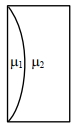
\(\frac{1}{{f}_{1}}=\left(\mu_{1}-1\right)\left(\frac{1}{{R}}\right)\)\(\frac{1}{{f}_{2}}=\left(\mu_{2}-1\right)\left(-\frac{1}{{R}}\right)\)
\(\frac{1}{{f}_{1}}+\frac{1}{{f}_{2}}=\frac{1}{{f}_{{eq}}}=\frac{\left(\mu_{1}-1\right)-\left(\mu_{2}-1\right)}{{R}}\)
\(\frac{1}{f_{e q}}=\frac{\left(\mu_{1}-\mu_{2}\right)}{R}\)
\(\frac{{R}}{{f}_{{eq}}}=\left(\mu_{1}-\mu_{2}\right)\)

-
- (A) \(15 \)
- (B) \(20\)
- (C) \(30\)
- (D) \(10\)
Show answer and solution
Correct Answer: (C)
According to lens formula \(\frac{1}{f} = (\mu - 1)\left[ {\frac{1}{{{R_1}}} - \frac{1}{{{R_2}}}} \right]\)The lens is plano-convex i.e., \({R_1} = R\) and \({R_2} = \infty \)
Hence \(\frac{1}{f} = \frac{{\mu - 1}}{R} \Rightarrow f = \frac{R}{{\mu - 1}}\)
Speed of light in medium of lens \(v = 2 \times {10^8}\) \(m/s\)
==> \(\mu = \frac{c}{v} = \frac{{3 \times {{10}^8}}}{{2 \times {{10}^8}}} = \frac{3}{2} = 1.5\)
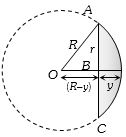
If \(r\) is the radius and \(y\) is the thickness of lens (at the centre), the radius of curvature \(R\) of its curved surface in accordance with the figure is given by
\({R^2} = {r^2} + {(R - y)^2} \Rightarrow {r^2} + {y^2} - 2Ry = 0\)
Neglecting \({y^2};\) we get \(R = \frac{{{r^2}}}{{2y}} = \frac{{{{(6/2)}^2}}}{{2 \times 0.3}} = 15 cm\)
Hence \(f = \frac{{15}}{{1.5 - 1}} = 30 cm\)
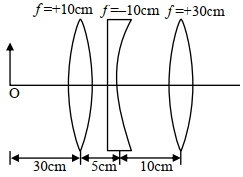
- 17. Find the distance of the image from object \(O\), formed by the combination of lenses in the figure : (in \(cm\))
 2021 Hard
- (A) \(75\)
- (B) \(10\)
- (C) \(20\)
- (D) \(100\)
Show answer and solution
Correct Answer: (A)
\(\frac{1}{{V}_{1}}+\frac{1}{30}=\frac{1}{10}\)\(\frac{1}{{V}_{1}}=\frac{2}{30} \Rightarrow {V}_{1}=15 \,{cm}\)
\(\frac{1}{{V}_{2}}-\frac{1}{10}=-\frac{1}{10}\)
\(\frac{1}{{V}_{2}}=0 \quad {V}_{2}=\infty\, {V}_{3}=30\, {cm}\)
\({OV}_{3}=75\, {cm}\)
-
- (A) \(A\) is true but \(R\) is false
- (B) Both \(A\) and \(R\) are true but \(R\) is \(NOT\) the correct explanation of \(A\).
- (C) Both \(A\) and \(R\) are true and \(R\) is the correct explanation of \(A\)
- (D) \(A\) is false but \(R\) is true
Show answer and solution
Correct Answer: (C)
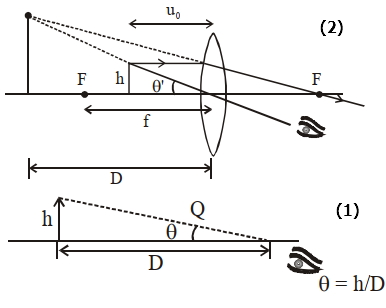
\(\theta^{\prime}=\frac{ h }{ u _{0}} ; \theta^{\prime}\) is same for both object and image\(m =\frac{\theta^{\prime}}{\theta}=\frac{ D }{\mu_{0}}\)
\(u _{0} < D\)
Hence \(m > 1\)
-
- (A) \(55.44\)
- (B) \(9.52\)
- (C) \(37.58\)
- (D) \(18.23\)
Show answer and solution
Correct Answer: (C)
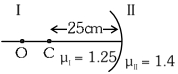
\(\frac{\mu_{2}}{v}-\frac{\mu_{1}}{u}=\frac{\mu_{2}-\mu_{1}}{R}\)\(\frac{1.4}{v}-\frac{1.25}{-40}=\frac{1.4-1.25}{-25}\)
\(\frac{1.4}{v}=-\frac{0.15}{25}-\frac{1.25}{40}\)
\(v=-37.58\, {cm}\)
-
- (A) Statements \(( A ),( B )\) and \(( C )\) are true
- (B) Only statement \((D)\) is true
- (C) Only statements \(( A )\) and \(( B )\) are true
- (D) Statements \((B)\) and \((C)\) are true
Show answer and solution
Correct Answer: (A)
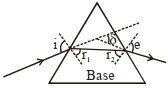
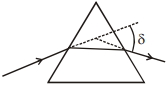
Deviation is minimum in a prism when\(i = e , r _{1}= r _{2}\) and ray \((2)\) is parallel to base of prism.
- 21. The focal length \(f\) is related to the radius of curvature \(R\) of the spherical convex mirror by 2021 Easy
- (A) \(f =+\frac{1}{2} R\)
- (B) \(f =- R\)
- (C) \(f=-\frac{1}{2} R\)
- (D) \(f = R\)
Show answer and solution
Correct Answer: (A)
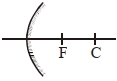
For convex mirror, focus is behind the mirror.\(\Rightarrow f =+\frac{ R }{2}\)
-
- (A) \(30\)
- (B) \(36\)
- (C) \(25\)
- (D) \(40\)
Show answer and solution
Correct Answer: (A)
\(\lambda_{ m }=\frac{\lambda_{ a }}{\mu} \Rightarrow \mu=\frac{3}{2}\)\(\frac{\mu}{ v }-\frac{1}{ u }=\frac{\mu-1}{ R }\)
\(\frac{3}{2 \times 10}+\frac{1}{15}=\frac{\frac{3}{2}-1}{ R }\)
\(R =\frac{30}{13}\)
\(=30\)
-
- (A) \(\overrightarrow{ b }=\overrightarrow{ a }+2 \overrightarrow{ c }\)
- (B) \(\overrightarrow{ b }=2 \overrightarrow{ a }+\overrightarrow{ c }\)
- (C) \(\overrightarrow{ b }=\overrightarrow{ a }-2(\overrightarrow{ a } \cdot \overrightarrow{ c }) \overrightarrow{ c }\)
- (D) \(\overrightarrow{ b }=\overrightarrow{ a }-\overrightarrow{ c }\)
Show answer and solution
Correct Answer: (C)
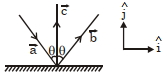
\(\overrightarrow{ a }=\sin \theta \hat{ i }-\cos \hat{ j }\)\(\overrightarrow{ b }=\sin \theta \hat{ i }+\cos \theta \hat{ j }\)
\(\overrightarrow{ c }=\hat{ j }\)
\(\overrightarrow{ a }-2(\overrightarrow{ a } \cdot \overrightarrow{ c }) \overrightarrow{ c }=\sin \theta \hat{ i }+\cos \theta \hat{ j }\)
-
- (A) \(1\)
- (B) Infinite
- (C) \(\frac{ R _{1} R _{2}}{ R _{1}- R _{2}}\)
- (D) Zero
Show answer and solution
Correct Answer: (B)
\(\frac{1}{ F }=\left[\frac{\mu_{ L }}{\mu_{ S }}-1\right]\left[\frac{1}{ R _{1}}-\frac{1}{ R _{2}}\right]\)If \(\mu_{ L }=\mu_{ S } \Rightarrow \frac{1}{ F }=0 \Rightarrow F =\infty\)
-
- (A) \(5.33\)
- (B) \(4.33\)
- (C) \(3.33\)
- (D) \(2.33\)
Show answer and solution
Correct Answer: (C)
\(V=\frac{c}{\sqrt{\mu_{r} \varepsilon_{r}}}\)\(V=3.33 \times 10^{7} \;m / sec\)
-
- (A) \(10\)
- (B) \(15\)
- (C) \(20\)
- (D) \(30\)
Show answer and solution
Correct Answer: (B)
\(m =\frac{ f }{ u + f }\)\(+ m =\frac{ f }{-10+ f } \quad \cdots\)
\(- m =\frac{ f }{-20+ f } \ldots\)
(1) / (2)
\(-1=\frac{ f -20}{ f -10}\)
\(10- f = f -20\)
\(30=2 f\)
\(f =15 cm\)
-
- (A) green
- (B) red
- (C) blue and green
- (D) blue
Show answer and solution
Correct Answer: (B)
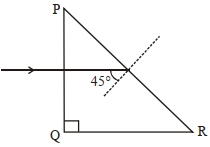
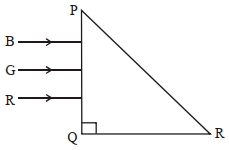
Assuming that the right angled prism is an isoceles prism, so the other angles will be \(45^{\circ}\) each.\(\Rightarrow\) Each incident ray will make an angle of \(45^{\circ}\) with the normal at face \(PR\).
\(\Rightarrow\) The wavelength corresponding to which the incidence angle is less than the critical angle, will pass through \(PR\). \(\Rightarrow \theta_{ C }=\) critical angle
\(\Rightarrow \theta_{c}=\sin ^{-1}\left(\frac{1}{\mu}\right)\)
\(\Rightarrow\) If \(\theta_{ C } \geq 45^{\circ}\)
the light ray will pass
\(\Rightarrow\left(\theta_{ C }\right)_{ Red }=\sin ^{-1}\left(\frac{1}{1.27}\right)=51.94^{\circ}\)
Red will pass.
\(\Rightarrow\left(\theta_{ C }\right)_{ Green }=\sin ^{-1}\left(\frac{1}{1.42}\right)=44.76^{\circ}\)
Green will not pass
\(\Rightarrow\left(\theta_{ C }\right)_{ Blue }=\sin ^{-1}\left(\frac{1}{1.49}\right)=42.15^{\circ}\)
Blue will not pass
\(\Rightarrow\) So only red will pass through \(PR.\)
-
- (A) \(3 {a}\)
- (B) \(4.6 {a}\)
- (C) \(2.3 {a}\)
- (D) \(2 \sqrt{10} {a}\)
Show answer and solution
Correct Answer: (B)
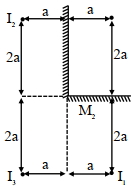
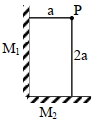
Shortest distance is \(2 {a}\) between \({I}_{1} \& {I}_{3}\)But answer given is for \({I}_{1} \& {I}_{2}\)
\(\sqrt{(4 a)^{2}+(2 a)^{2}}\)
\(a \sqrt{20}\)
\(4.47 {a}\)
-
- (A) Astigmatism
- (B) Myopia with Astigmatism
- (C) Presbyopia with Astigmatism
- (D) Myopia and hypermetropia
Show answer and solution
Correct Answer: (B)
If distant objects are blurry then problem is Myopia.If objects are distorted then problem is Astigmatism
No questions on this page match these filters.