


JEE Mains · Chemistry · STD 12 -Solution and colligative properties
- JEE Mains 2026
- Medium
- MCQ
Solution A is prepared by dissolving \(1\) g of a protein (molar mass \(= 50000\) g mol\(^{-1}\)) in \(0.5\) L of water at \(300\) K. Its osmotic pressure is \(x\) bar. Solution B is made by dissolving \(2\) g of same protein in \(1\) L of water at \(300\) K. Osmotic pressure of solution B is \(y\) bar. Entire solution of A is mixed with entire solution of B at same temperature. The osmotic pressure of resultant solution is \(z\) bar. \(x, y\) and \(z\) respectively are:
\((R = 0.083\) L bar mol\(^{-1}\) K\(^{-1})\)
Pick an option to check your answer.
Answer & Solution
Correct Answer
(A) \(9.96 \times 10^{-4}; 9.96 \times 10^{-4}; 9.96 \times 10^{-4}\)
Step-by-step Solution
Detailed explanation
Osmotic pressure is given by \(\pi = CRT = \dfrac{w}{MV}RT\)
For solution A:
\(x = \dfrac{1}{50000 \times 0.5} \times 0.083 \times 300\)
\(x = \dfrac{1}{25000} \times 24.9 = 9.96 \times 10^{-4}\) bar
For solution B:
\(y = \dfrac{2}{50000 \times 1} \times 0.083 \times 300\)
\(y = \dfrac{2}{50000} \times 24.9 = 9.96 \times 10^{-4}\) bar
For the resultant solution (mixture of A and B):
Total mass of protein \(= 1 + 2 = 3\) g
Total volume of solution \(= 0.5 + 1 = 1.5\) L
\(z = \dfrac{3}{50000 \times 1.5} \times 0.083 \times 300\)
\(z = \dfrac{3}{75000} \times 24.9 = 9.96 \times 10^{-4}\) bar
Therefore, \(x = y = z = 9.96 \times 10^{-4}\) bar.
Answer: \(9.96 \times 10^{-4}; 9.96 \times 10^{-4}; 9.96 \times 10^{-4}\)
More questions from Chemistry
- Arrange the following in increasing order of solubility product :
\(\mathrm{Ca}(\mathrm{OH})_2, \mathrm{AgBr}, \mathrm{PbS}, \mathrm{HgS}\)JEE Mains 2025 Medium - The octahedral complex of a metal ion \(M^{3+}\) with four monodentate ligands \(L_1, L_2, L_3\) and \(L_4\) absorb wave lengths in the region of red, green, yellow and blue, respectively. The increasing order of ligand strength of the four ligands is :JEE Mains 2014 Hard
- Iron (III) catalyses the reaction between iodide and persulphate ions, in which
A. \(Fe ^{3+}\) oxidises the iodide ion
B. \(Fe ^{3+}\) oxidises the persulphate ion
C. \(Fe ^{2+}\) reduces the iodide ion
D. \(Fe ^{2+}\) reduces the persulphate ion
Choose the most appropriate answer from the options given below:JEE Mains 2024 Medium - Phthalimide is made to undergo following sequence of reactions. (Image) Total number of \(\pi\) bonds present in product ' \(P\) ' is _______.
 JEE Mains 2024 Medium
- The candela is the luminous intensity, in a given direction, of a source that emits monochromatic radiation of frequency ' \(\mathrm{A}\) ' \(\times 10^{12}\) hertz and that has a radiant intensity in that direction of \(\frac{1}{{ }^{\prime}}\) watt per steradian. ' \(A\) ' and ' \(B\) ' are respectively _______.JEE Mains 2024 Medium
- The \(pH\) at which \(\mathrm{Mg}(\mathrm{OH})_2\left[\mathrm{~K}_{\mathrm{sp}}=1 \times 10^{-11}\right]\) begins to precipitate from a solution containing \(0.10 \ \mathrm{M}\) \(\mathrm{Mg}^{2+}\) ions is _______.JEE Mains 2024 Hard
More PYQs from JEE Mains
- As shown in the figure a block of mass \(10\,kg\) lying on a horizontal surface is pulled by a force \(F\) acting at an angle \(30^{\circ}\), with horizontal. For \(\mu_{ s }=0.25\), the block will just start to move for the value of \(F..........\,N\) : \(\left[\right.\) Given \(\left.g =10\,ms ^{-2}\right]\)
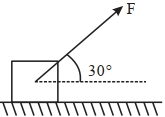 JEE Mains 2023 Medium
- As shown in figure, when a spherical cavity (centred at \(\mathrm{O})\) of radius \(1\) is cut out of a uniform sphere of radius \(\mathrm{R} \text { (centred at } \mathrm{C}),\) the centre of mass of remaining (shaded) part of sphere is at \(G\), i.e, on the surface of the cavity. \(\mathrm{R}\) can be detemined by the equation
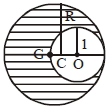 JEE Mains 2020 Hard
- The angular frequency of the damped oscillator is given by, \(\omega = \sqrt {\left( {\frac{k}{m} - \frac{{{r^2}}}{{4{m^2}}}} \right)} \) where \(k\) is the spring constant, \(m\) is the mass of the oscillator and \(r\) is the damping constant. If the ratio \(\frac{{{r^2}}}{{mk}}\) is \(8\%\), the change in time period compared to the undamped oscillator is approximately as followsJEE Mains 2014 Medium
- A light planet is revolving around a massive star in a circular orbit of radius \(R\) with a period of revolution \(T\). If the force of attraction between planet and star is proportional to \(\mathrm{R}^{-3 / 2}\) then choose the correct option.JEE Mains 2024 Hard
- The volume of an ideal gas \((\gamma=1.5)\) is changed adiabatically from \(5\) litres to \(4\) litres. The ratio of initial pressure to final pressure is _______.JEE Mains 2024 Hard
- A spherical liquid drop of radius \(R\) acquires the terminal velocity \(v_1\) when falls through a gas of viscosity \(\eta\). Now the drop is broken into \(64\) identical droplets and each droplet acquires terminal velocity \(v_2\) falling through the same gas. The ratio of terminal velocities \(v_1/v_2\) is ________.JEE Mains 2026 Medium