


JEE Mains · Chemistry · STD 12 -Solution and colligative properties
- JEE Mains 2026
- Hard
- Numerical
A non-volatile, non-electrolyte solid solute when dissolved in \(40\) g of a solvent, the vapour pressure of the solvent decreased from \(760\) mm Hg to \(750\) mm Hg. If the same solution boils at \(320\) K, then the number of moles of the solvent present in the solution is _____. (Nearest integer)
[Given: boiling point of the pure solvent \(= 319.5\) K, \(K_b\) of the solvent \(= 0.3\) K kg mol\(^{-1}\)]
Pick an option to check your answer.
Answer & Solution
Correct Answer
(A) 5
Step-by-step Solution
Detailed explanation
From the relative lowering of vapour pressure, we have:
\(\dfrac{P^0 - P_s}{P_s} = \dfrac{n_B}{n_A}\)
where \(n_B\) is the number of moles of solute and \(n_A\) is the number of moles of solvent.
Substituting the given values:
\(\dfrac{760 - 750}{750} = \dfrac{n_B}{n_A}\)
\(\dfrac{10}{750} = \dfrac{n_B}{n_A} \Rightarrow n_A = 75 n_B\)
The elevation in boiling point is given by:
\(\Delta T_b = T_b - T_b^0 = 320 - 319.5 = 0.5\) K
We also know that \(\Delta T_b = K_b \times m\), where \(m\) is the molality of the solution.
\(m = \dfrac{n_B}{\text{Mass of solvent in kg}} = \dfrac{n_B}{0.04}\)
Substituting the values into the elevation in boiling point equation:
\(0.5 = 0.3 \times \dfrac{n_B}{0.04}\)
\(n_B = \dfrac{0.5 \times 0.04}{0.3} = \dfrac{0.02}{0.3} = \dfrac{1}{15}\) mol
Now, substituting \(n_B\) back to find the number of moles of the solvent \(n_A\):
\(n_A = 75 \times \dfrac{1}{15} = 5\) mol
Answer: \(5\)
More questions from Chemistry
- Among \(Fe^{2+}, Fe^{3+}, Cr^{2+}\) and \(Zn^{2+}\), the ion that shows positive borax bead test and with highest ionisation enthalpy is:JEE Mains 2026 Hard
- Amongst \(LiCl, RbCl, BeCl_2\) and \(MgCl_2\) the compounds with the greatest and the least ionic character, respectively are:JEE Mains 2014 Hard
- The correct \(IUPAC\) name of \(\left[\mathrm{PtBr}_2\left(\mathrm{PMe}_3\right)_2\right]\) is _______.JEE Mains 2024 Medium
- Identify the incorrect statement about tertiary structure of proteins.JEE Mains 2026 Medium
- Which one of the following alkenes when treated with \(HCl\) yields majorly an anti Markovnikov product?JEE Mains 2019 Hard
- In the cell \(Pt(s)| H_2 (g,1\,bar)| HCl(aq)| AgCl(s)| Ag(s)| Pt(s)\) the cell potential is \(0.92\,V\) when a \(10^{-6}\) molal \(HCl\) solution is used. The standard electrode potential of \((AgCl / Ag,Cl^- )\) electrode is ............. \(\mathrm{V}\) \(\left\{ {Given,\frac{{2.303RT}}{F} = 0.06\,V\,at\,298\,K} \right\}\)JEE Mains 2019 Hard
More PYQs from JEE Mains
-
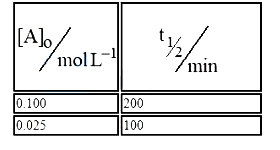
For a given reaction \(\mathrm{R} \rightarrow \mathrm{P}, \mathrm{t}_{1 / 2}\) is related to \([\mathrm{A}]_0\) as given in table.
Given: \(\log 2=0.30\)
Which of the following is true?
A. The order of the reaction is \(1 / 2\).
B. If \([\mathrm{A}]_0\) is 1 M , then \(\mathrm{t}_{1 / 2}\) is \(200 \sqrt{10} \mathrm{~min}\)
C. The order of the reaction changes to 1 if the concentration of reactant changes from 0.100 M to 0.500 M .
D. \(\mathrm{t}_{1 / 2}\) is 800 min for \([\mathrm{A}]_0=1.6 \mathrm{M}\)
Choose the correct answer from the options given below:JEE Mains 2025 Medium - When \(100\,g\) of a liquid \(A\) at \(100\,^oC\) is added to \(50\,g\) of a liquid \(B\) at temperature \(75\,^oC\), the temperature of the mixture becomes \(90\,^oC\). The temperature of the mixture, if \(100\,g\) of liquid \(A\) at \(100\,^oC\) is added to \(50\,g\) of liquid \(B\) at \(50\,^oC\), will be ........\(^oC\)JEE Mains 2019 Hard
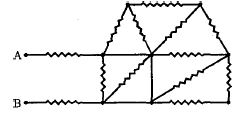
- In the given circuit all resistances are of value \(R\,ohm\) each. The equivalent resistance between \(A\) and \(B\) is
 JEE Mains 2018 Hard
- After understanding the assertion and reason, choose the correct option.
Assertion : In the bonding molecular orbital \((MO)\) of \(H_2,\) electron density is increased between the nuclei.
Reason : The bonding \(MO\) is \({\psi _A}\, + \,\,{\psi _{B,}}\) which shows destructive interference of the combining electron waves.JEE Mains 2015 Hard - A granite rod of \(60\ cm\) length is clamped at its middle point and is set into longitudinal vibrations. The density of granite is \(2.7 \times 10^3 \) \(kg/m^3\) and its Young's modulus is \(9.27 \times 10^{10}\) \(Pa\) What will be the fundamental frequency of the longitudinal vibrations .... \(kHz\) ?JEE Mains 2018 Hard
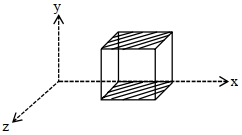
- A cube is placed inside an electric field, \(\overrightarrow{{E}}=150\, {y}^{2}\, \hat{{j}}\). The side of the cube is \(0.5 \,{m}\) and is placed in the field as shown in the given figure. The charge inside the cube is \(.....\times 10^{-11} {C}\)
 JEE Mains 2021 Hard