


JEE Mains · Chemistry · STD 12 -Solution and colligative properties
- JEE Mains 2026
- Medium
- MCQ
Given below are two statements :
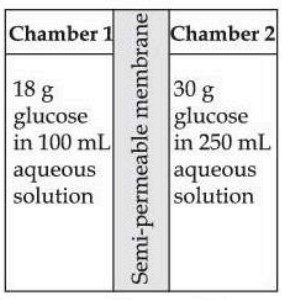
Statement I : H\(_2\)O molecules move from the chamber \(1\) to chamber \(2\).
Statement II : The osmotic pressure of a solution prepared by dissolving \(50\) mg of potassium sulphate (molar mass \(= 174\) g/mol) in \(2\) L of water (at \(27°\)C) is \(0.0107\) bar. (Given : R \(= 0.083\) dm\(^3\) bar K\(^{-1}\) mol\(^{-1}\) and assume complete dissociation of electrolyte)
In the light of the above statements, choose the correct answer from the options given below :
Pick an option to check your answer.
Answer & Solution
Correct Answer
(D) Statement I is false but Statement II is true
Step-by-step Solution
Detailed explanation
For Statement I:
Molarity of the solution in Chamber 1 (\(M_1\)) = \(\dfrac{18 / 180}{100 / 1000} = 1\) M
Molarity of the solution in Chamber 2 (\(M_2\)) = \(\dfrac{30 / 180}{250 / 1000} = \dfrac{1/6}{1/4} = 0.667\) M
Since \(M_1 > M_2\), the solution in Chamber 1 has a higher solute concentration. During osmosis, the solvent (water) moves from the region of lower solute concentration to the region of higher solute concentration across a semi-permeable membrane. Thus, water will move from Chamber 2 to Chamber 1. Statement I is false.
For Statement II:
The osmotic pressure is given by \(\pi = iCRT\)
For \(K_2SO_4\), assuming complete dissociation (\(K_2SO_4 \rightarrow 2K^+ + SO_4^{2-}\)), the van't Hoff factor \(i = 3\).
Concentration \(C = \dfrac{50 \times 10^{-3}}{174 \times 2}\) mol/L
\(\pi = 3 \times \left( \dfrac{50 \times 10^{-3}}{174 \times 2} \right) \times 0.083 \times 300\)
\(\pi = \dfrac{3 \times 0.05 \times 24.9}{348} = \dfrac{3.735}{348} \approx 0.0107\) bar
Statement II is true.
Therefore, Statement I is false but Statement II is true.
Answer: Statement I is false but Statement II is true
More questions from Chemistry
- Heat treatment of muscular pain involves radiation of wavelength of about \(900\,nm.\) Which spectral line of \(H -\) atom is suitable for this purpose? \([{R_H} = 1 \times {10^5}\,c{m^{ - 1}},\,h\, = 6.6\, \times {10^{ - 34}}\,Js\,\,c = 3\,\) \(\times \,{10^8}\,m{s^{ - 1}}]\)JEE Mains 2019 Medium
- Given
Based on data provided, the value of electron gain enthalpy of fluorine would be.....\(kJ\,mol^{-1}\)Reaction Energy Change (in \(kJ\) ) \(Li(s) \to Li(g)\) \(161\) \(Li(g) \to Li^+(g)\) \(520\) \(\frac {1}{2}F_2(g)\,\to F(g)\) \(77\) \(F(g) + e^- \to F^-(g)\) (Electron gain enthalpy) \(Li^+ (g) + F^-(g) \to LiF(s)\) \(-1047\) \(Li (s) + \frac {1}{2}F_2(g)\to LiF(s)\) \(-617\) JEE Mains 2013 Hard - In the following the correct bond order sequence is :JEE Mains 2021 Medium
- Given below are two statements: one is labelled as Assertion \((A)\) and the other is labelled as Reason \((R)\).
Assertion \((A)\) : Both rhombic and monoclinic sulphur exist as \(S_5\) while oxygen exists as \(O_2\). Reason \((R)\) : Oxygen forms \(\mathrm{p} \pi-\mathrm{p} \pi\) multiple bonds with itself and other elements having small size and high electronegativity like \(\mathrm{C}, \mathrm{N}\), which is not possible for sulphur. In the light of the above statements, choose the most appropriate answer from the options given below :JEE Mains 2024 Medium - Given below are two statements :
Statement (I) : An element in the extreme left of the periodic table forms acidic oxides.
Statement (II) : Acid is formed during the reaction between water and oxide of a reactive element present in the extreme right of the periodic table.
In the light of the above statements, choose the correct answer from the options given below :JEE Mains 2025 Easy - Values of dissociation constant, \(K_a\) are given as follows
Correct order of increasing base strength of the base \(CN^-,F^-\) and \(NO_2^-\) will beAcid \(K_a\) \(HCN\) \(6.2\times 10^{-10}\) \(HF\) \(7.2\times 10^{-4}\) \(HNO_2\) \(4.0\times 10^{-4}\) JEE Mains 2013 Hard
More PYQs from JEE Mains
- Two short bar magnets oflength \(1\ cm\) each have magnetic moments \(1.20\ Am^2\) and \(1.00\ Am^2\) respectively. They are placed on a horizontal table parallel to each other with their \(N\) poles pointing towards the South. They have a common magnetic equator and are separated by a distance of \(20.0\ cm\). The value of the resultand horizontal magnetic induction at the mid-point \(O\) of the line joining their centres is close to (Horizontal component of earth.s magnetic induction is \(3.6 \times 10^{-5}\) \(Wbm^{-2}\) )JEE Mains 2013 Hard
- A proton moving with one tenth of velocity of light has a certain de Broglie wavelength of \(\lambda\). An alpha particle having certain kinetic energy has the same de-Brogle wavelength \(\lambda\). The ratio of kinetic energy of proton and that of alpha particle is:JEE Mains 2023 Medium
- Given below are two statements: one is labelled as Assertion \((A)\) and the other is labelled as Reason \((R)\). Assertion \((A)\) : \(\mathrm{NH}_3\) and \(\mathrm{NF}_3\) molecule have pyramidal shape with a lone pair of electrons on nitrogen atom. The resultant dipole moment of \(\mathrm{NH}_3\) is greater than that of \(\mathrm{NF}_3\). Reason \((R)\) : In \(\mathrm{NH}_3\), the orbital dipole due to lone pair is in the same direction as the resultant dipole moment of the \(\mathrm{N}-\mathrm{H}\) bonds. \(\mathrm{F}\) is the most electronegative element. In the light of the above statements, choose the correct answer from the options given below:JEE Mains 2024 Medium
- The distance between object and its two times magnified real image as produced by a convex lens is \(45 \mathrm{~cm}\). The focal length of the lens used is _______ \(\mathrm{cm}\).JEE Mains 2024 Hard
- Let \(\vec A\, = \,(\hat i\, + \,\hat j)\,\) and \(\vec B\, = \,(2\hat i\, - \,\hat j)\,.\) The magnitude of a coplanar vector \(\vec C\) such that \(\vec A\cdot \vec C\, = \,\vec B\cdot \vec C\, = \vec A\cdot \vec B\) is given byJEE Mains 2018 Hard
- Lanthanoid ions with \(4 f^7\) configuration are :
(A) \(\mathrm{Eu}^{2+}\)
(B) \(\mathrm{Gd}^{3+}\)
(C) \(\mathrm{Eu}^{3+}\)
(D) \(\mathrm{Tb}^{3+}\)
(E) \(\mathrm{Sm}^{2+}\)
Choose the correct answer from the options given below :JEE Mains 2025 Hard