


JEE Mains · Chemistry · STD 12 - Electrochemistry
- JEE Mains 2026
- Hard
- MCQ
For a general redox reaction
Anode : \(\text{Red}_1 \rightarrow \text{Ox}_1^{n_1^+} + n_1 e^-\)
Cathode : \(\text{Ox}_2 + n_2 e^- \rightarrow \text{Red}_2^{n_2^-}\)
Which of the following statement is incorrect ?
Pick an option to check your answer.
Answer & Solution
Correct Answer
(D) If the reaction is carried out reversibly, the electrical work done is equal to the ratio of charge and potential difference through which charge is moved.
Step-by-step Solution
Detailed explanation
For the given redox reaction, the half-cell reactions are:
Anode: \(\text{Red}_1 \rightarrow \text{Ox}_1^{n_1^+} + n_1 e^-\)
Cathode: \(\text{Ox}_2 + n_2 e^- \rightarrow \text{Red}_2^{n_2^-}\)
To obtain the overall balanced chemical equation, we multiply the anode reaction by \(n_2\) and the cathode reaction by \(n_1\) so that the number of electrons lost equals the number of electrons gained:
\(n_2\text{Red}_1 \rightarrow n_2\text{Ox}_1^{n_1^+} + n_1 n_2 e^-\)
\(n_1\text{Ox}_2 + n_1 n_2 e^- \rightarrow n_1\text{Red}_2^{n_2^-}\)
Adding these gives the overall reaction:
\(n_2\text{Red}_1 + n_1\text{Ox}_2 \rightleftharpoons n_2\text{Ox}_1^{n_1^+} + n_1\text{Red}_2^{n_2^-}\)
Thus, statement (A) is correct.
In the overall reaction, electrons do not appear because the electrons produced at the anode are exactly consumed at the cathode. Thus, statement (B) is correct.
From the Nernst equation:
\(E = E^\circ - \dfrac{RT}{nF} \ln Q = E^\circ - \dfrac{2.303 RT}{nF} \log_{10} Q\)
\(\dfrac{E - E^\circ}{RT/F} = -\dfrac{2.303}{n} \log_{10} Q\)
The graph of \(\dfrac{E - E^\circ}{RT/F}\) versus \(\log_{10} Q\) is a straight line with a slope of \(-\dfrac{2.303}{n}\), where \(n\) is the number of electrons transferred in the balanced redox reaction. Thus, statement (C) is correct.
The electrical work done by a galvanic cell is given by the product of the total charge transferred and the cell potential (potential difference), not their ratio.
\(W_{\text{electrical}} = \text{Charge} \times \text{Potential difference} = nF E_{\text{cell}}\)
Thus, statement (D) is incorrect.
Answer: If the reaction is carried out reversibly, the electrical work done is equal to the ratio of charge and potential difference through which charge is moved.
More questions from Chemistry
- Given below are two statements:
Statement I: Phenol on treatment with \(CHCl_{3}/aq.\ KOH\) under refluxing condition, followed by acidification produces p-hydroxy benzladehyde as the major product and o-hydroxy benzaldehyde as the minor product.
Statement II: The mixture of \(p-hydroxybenzaldehyde\) and \(o-hydroxybenzaldehyde\) can be easily separated through steam distillation.
In the light of the above statements, choose the correct answer from the options given below :JEE Mains 2026 Easy - '\(x\)' is the product which is obtained by the hydrolysis of prop-1-yne in the presence of mercuric sulphate under dilute acidic medium at \(333\) K. '\(y\)' is the product which is obtained by the reaction of ethane nitrile with methyl magnesium bromide in dry ether followed by hydrolysis. IUPAC name of product obtained from '\(x\)' and '\(y\)' in the presence of barium hydroxide followed by heating is :JEE Mains 2026 Hard
- The pairs among \(A = [\text{SO}_3^{2-}, \text{CO}_3^{2-}]\), \(B = [\text{O}_2^{2-}, \text{F}_2]\), \(C = [\text{CN}^-, \text{CO}]\), \(D = [\text{NH}_3, \text{H}_3\text{O}^+]\) and \(E = [\text{MnO}_4^{2-}, \text{CrO}_4^{2-}]\) that do not have similar Lewis dot structure areJEE Mains 2026 Medium
- The values of pressure equilibrium constant recorded at different temperatures for the following equilibrium reaction have been given below
\(A(g) \rightleftharpoons B(g) + C(g)\)\(\dfrac{1}{T}(\text{K}^{-1})\) \(\log_{10} K_p\) \(0.05\) \(3.5\) \(0.06\) \(2.5\) \(0.07\) \(1.5\)
The magnitude of \(\dfrac{\Delta H°}{R}\) calculated from the above data is _____. (Nearest integer)JEE Mains 2026 Medium -
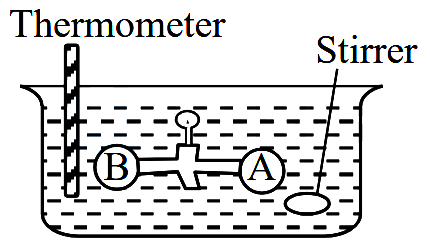
Two vessels A and B are connected via stopcock. The vessel A is filled with a gas at a certain pressure. The entire assembly is immersed in water and is allowed to come to thermal equilibrium with water. After opening the stopcock the gas from vessel A expands into vessel B and no change in temperature is observed in the thermometer. Which of the following statement is true?JEE Mains 2025 Medium - From the magnetic behaviour of \(\left[\mathrm{NiCl}_4\right]^{2-}\) (paramagnetic) and \(\left[\mathrm{Ni}(\mathrm{CO})_4\right]\) (diamagnetic), choose the correct geometry and oxidation state.JEE Mains 2025 Medium
More PYQs from JEE Mains
- An electric dipole of moment \(\overrightarrow{\mathrm{p}}=(-\hat{\mathrm{i}}-3 \hat{\mathrm{j}}+2 \hat{\mathrm{k}}) \times 10^{-29}\; \mathrm{C} \cdot \mathrm{m}\) is at the origin \((0,0,0) .\) The electric field due to this dipole at \(\overrightarrow{\mathrm{r}}=+\hat{\mathrm{i}}+3 \hat{\mathrm{j}}+5 \hat{\mathrm{k}}\) (note that \(\overrightarrow{\mathrm{r}} \cdot \overrightarrow{\mathrm{p}}=0)\) is parallel toJEE Mains 2020 Medium
- A body is projected at \(t = 0\) with a velocity \(10\,ms^{-1}\) at an angle of \(60^o\) with the horizontal. The radius of curvature of its trajectory at \(t=1\,s\) is \(R.\) Neglecting air resistance and taking acceleration due to gravity \(g = 10\,ms^{-2},\) the radius of \(R\) is ........ \(m\)JEE Mains 2019 Hard
- In the following skew conformation of ethane, \(H'-C-C-H"\) dihedral angle is......\(^o\)
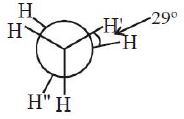 JEE Mains 2019 Hard
- Three bodies \(A, B\) and \(C\) have equal kinetic energies and their masses are \(400 \mathrm{~g}, 1.2 \mathrm{~kg}\) and \(1.6 \mathrm{~kg}\) respectively. The ratio of their linear momenta is _______.JEE Mains 2024 Hard
- The work functions of Aluminium and Gold are \(4.1\,eV\) and \(5.1\,eV\) respectively. The ratio of the slope of the stopping potential versus frequency plot for Gold to that of Aluminium is \(.......\)JEE Mains 2023 Medium
- Half lives of two radioactive nuclei \(A\) and \(B\) are \(10\, minutes\) and \(20\, minutes\), respectively. If, initially a sample has equal number of nuclei, then after \(60\) \(minutes\) , the ratio of decayed numbers of nuclei \(A\) and \(B\) will beJEE Mains 2019 Hard