


JEE Mains · Chemistry · STD 11 - Some basic concept of chemistry
- JEE Mains 2026
- Easy
- MCQ
For the given reaction:
\(CaCO_{3} + 2HCl \to CaCl_{2} + H_{2}O + CO_{2}\)
If 90 g \(CaCO_{3}\) is added to 300 mL of HCl which contains 38.55% HCl by mass and has density \(1.13 g mL^{-1}\) then which of the following option is correct?
[Given molar mass of H, Cl, Ca and O are 1, 35.5, 40 and \(16 g mol^{-1}\) respectively]
Pick an option to check your answer.
Answer & Solution
Correct Answer
(A) 64.97 g of HCl remains unreacted
Step-by-step Solution
Detailed explanation
Density of HCl solution \(( d )=1.13 g / ml\)
\(V =300 ml\)
Wt. of HCl solution \(=339 g\)
Wt. of \(HCl =339 \times \frac{38.55}{100}=130.68 g\)
(LR)
\(CaCO_3+2 HCl \rightarrow CaCl_2+H_2 O+CO_2\)
\(\frac{90}{100} \quad \frac{130.68}{36.5}\)
\(=0.90 mole \quad=3.58 mole\)
Moles of HCl remained \(=1.78\) mole.
Mass of HCl remained \(=64.97 g\).
More questions from Chemistry
- The reaction of \(NO\) with \(N _{2} O _{4}\) at \(250\, K\) gives :JEE Mains 2020 Medium
- When \(9.45\, g\) of \(ClCH _{2} COOH\) is added to \(500\) \(mL\) of water, its freezing point drops by \(0.5^{\circ} C\). The dissociation constant of \(ClCH _{2} COOH\) is \(x \times 10^{-3}\). The value of \(x\) is ............... (Rounded off to the nearest integer) \(\left[ K _{ f \left( H _{2} O \right)}=1.86 \,K\, kg mol ^{-1}\right]\)JEE Mains 2021 Medium
- n-Butane on monochlorination under photochemical condition gives an optically active compound "P". "P" on further chlorination gives dichloro compounds. The number of dichloro compounds obtained (ignore stereoisomers) is:JEE Mains 2026 Hard
- Xg of benzoic acid on reaction with aq \(\mathrm{NaHCO}_3\) released \(\mathrm{CO}_2\) that occupied 11.2 L volume at STP.
X is _____ g.JEE Mains 2025 Easy - Identify the essential amino acids from below :
(A) Valine
(B) Proline
(C) Lysine
(D) Threonine
(E) Tyrosine
Choose the correct answer from the options given below :JEE Mains 2025 Medium - In basic medium \(CrO _{4}^{2-}\) oxidises \(S _{2} O _{3}^{2-}\) to form \(SO _{4}^{2-}\) and itself changes into \(Cr ( OH )_{4}^{-}\). The volume of \(0.154\, M CrO _{4}^{2-}\) required to react with \(40\, mL\) of \(0.25\, M S _{2} O _{3}^{2-}\) is ........... \(mL\) (Rounded-off to the nearest integer)JEE Mains 2021 Easy
More PYQs from JEE Mains
- Three bodies \(A, B\) and \(C\) have equal kinetic energies and their masses are \(400 \mathrm{~g}, 1.2 \mathrm{~kg}\) and \(1.6 \mathrm{~kg}\) respectively. The ratio of their linear momenta is _______.JEE Mains 2024 Hard
- A current of \(10.0\, A\) flows for \(2 .00\, h\) through an electrolytic cell containing a molten salt of metal \(X\). This results in the decomposition of \(0 .250\, mol\) of metal \(X\) at the cathode. The oxidation state of \(X\) in the molten salt is \((F = 96,500\, C\))JEE Mains 2014 Hard
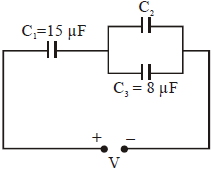
- In the circuit shown in the figure, the total charge in \(750\, \mu C\) and the voltage across capacitor \(C _{2}\) is \(20\, V\). Then the charge on capacitor \(C _{2}\) is\(....\mu C\)
 JEE Mains 2020 Medium
- An object viewed from a near point distance of \(25\, {cm}\), using a microscopic lens with magnification \('6',\) gives an unresolved image. A resolved image is observed at infinite distance with a total magnification double the earlier using an eyepiece along with the given lens and a tube of length \(0.6\, {m}\), if the focal length of the eyepiece is euqal to \(.... \,{cm} .\)JEE Mains 2021 Hard
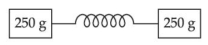
- As per the given figure, two blocks each of mass \(250\,g\) are connected to a spring of spring constant \(2\,Nm ^{-1}\). If both are given velocity \(V\) in opposite directions, then maximum elongation of the spring is:
 JEE Mains 2022 Hard
- The structure of which of the following chloro species can be explained on the basis of \(dsp^2\) hybridization ?JEE Mains 2013 Hard