


JEE Mains · Chemistry · STD 12 - Electrochemistry
- JEE Mains 2026
- Hard
- MCQ
Consider the following data.
| Electrolyte | \(\Lambda^{\circ}_m\) (S cm\(^2\) mol\(^{-1}\)) |
|---|---|
| \(\text{BaCl}_2\) | \(x_1\) |
| \(\text{H}_2\text{SO}_4\) | \(x_2\) |
| HCl | \(x_3\) |
\(\text{BaSO}_4\) is sparingly soluble in water. If the conductivity of the saturated \(\text{BaSO}_4\) solution is \(x\) S cm\(^{-1}\) then the solubility product of \(\text{BaSO}_4\) can be given as (Here \(\Lambda_m = \Lambda^{\circ}_m\))
Pick an option to check your answer.
Answer & Solution
Correct Answer
(A) \(\dfrac{10^6 x^2}{\alpha^2(x_1 + x_2 - 2x_3)^2}\)
Step-by-step Solution
Detailed explanation
Using Kohlrausch's law of independent migration of ions, the limiting molar conductivity of \(\text{BaSO}_4\) is given by:
\(\Lambda^{\circ}_m(\text{BaSO}_4) = \Lambda^{\circ}_m(\text{BaCl}_2) + \Lambda^{\circ}_m(\text{H}_2\text{SO}_4) - 2\Lambda^{\circ}_m(\text{HCl})\)
Substituting the given values:
\(\Lambda^{\circ}_m(\text{BaSO}_4) = x_1 + x_2 - 2x_3\)
For a sparingly soluble salt, the solubility \(S\) (in mol L\(^{-1}\)) is related to its conductivity \(\kappa\) (in S cm\(^{-1}\)) and molar conductivity \(\Lambda_m\) (in S cm\(^2\) mol\(^{-1}\)) by the relation:
\(\Lambda_m = \dfrac{\kappa \times 1000}{S}\)
Given that \(\kappa = x\) and \(\Lambda_m = \Lambda^{\circ}_m\) (which implies complete dissociation, meaning the degree of dissociation \(\alpha = 1\)), we get:
\(S = \dfrac{1000 x}{x_1 + x_2 - 2x_3}\)
The solubility product \(K_{sp}\) for \(\text{BaSO}_4\) (which dissociates into \(\text{Ba}^{2+}\) and \(\text{SO}_4^{2-}\)) is:
\(K_{sp} = S^2 = \left( \dfrac{1000 x}{x_1 + x_2 - 2x_3} \right)^2 = \dfrac{10^6 x^2}{(x_1 + x_2 - 2x_3)^2}\)
Since \(\alpha = 1\), this expression is equivalent to \(\dfrac{10^6 x^2}{\alpha^2(x_1 + x_2 - 2x_3)^2}\).
Answer: \(\dfrac{10^6 x^2}{\alpha^2(x_1 + x_2 - 2x_3)^2}\)
More questions from Chemistry
- Match List\(-I\) with List\(-II\) :
Choose the most appropriate answer from the options given below :List\(-I\) (Metal Ion) List\(-II\) (Group in Qualitative analysis) \((a)\) \({Mn}^{2+}\) \((i)\) Group \(- III\) \((b)\) \({A} {s}^{3+}\) \((ii)\) Group \(- IIA\) \((c)\) \({Cu}^{2+}\) \((iii)\) Group \(- IV\) \((d)\) \({Al}^{3+}\) \((iv)\) Group \(- IIB\) JEE Mains 2021 Medium - The number of \(f\) electrons in the ground state electronic configuration of \(\mathrm{Np}(\mathrm{Z}=93)\) is ....... .JEE Mains 2021 Easy
- \(A, B\) and \(C\) are three biomolecules. The results of the tests performed on them are given below \(\begin{array}{|c|c|c|c|}\hline {} &\text { Molisch's Test} & {\text { Barfoed Test}} & {\text { Biuret Test}} \\ \hline \text { A} & { Positive } & {\text { Negative }} & {\text { Negative }} \\ \hline \text { B } & {\text { Positive }} & {\text { Positive }} & {\text { Negative }} \\ \hline \text { C } & {\text { Negative }} & {\text { Negative }} & {\text { Positive }} \\ \hline\end{array}\) \(A, B\) and \(C\) are respectivelyJEE Mains 2020 Hard
- \(XeO_4\) molecule is tetrahedral havingJEE Mains 2013 Hard
- \(4 \mathrm{~g}\) equimolar mixture of \(\mathrm{NaOH}\) and \(\mathrm{Na}_{2} \mathrm{CO}_{3}\) contains \(\mathrm{x} \mathrm{g}\) of \(\mathrm{NaOH}\) and \(\mathrm{y} \mathrm{g}\) of \(\mathrm{Na}_{2} \mathrm{CO}_{3}\). The value of \(x\) is \(.....g.\) (Nearest integer)JEE Mains 2021 Hard
- Match List - I with List - II.
List - I
Chromium (III) Complexes
(en = ethylene diamine)List - II
\(\Delta_0\) (cm\(^{-1}\))A. \([Cr(CN)_6]^{3-}\) I. \(15,060\) B. \([CrF_6]^{3-}\) II. \(17,400\) C. \([Cr(H_2O)_6]^{3+}\) III. \(22,300\) D. \([Cr(en)_3]^{3+}\) IV. \(26,600\)
Choose the correct answer from the options given below :JEE Mains 2026 Medium
More PYQs from JEE Mains
- Muon \((\mu ^{-1})\) is negatively charged \(\left( {\left| q \right| = \left| e \right|} \right)\) with a mass \(m_{\mu}\, = 200\,m_e\), where \(m_e\) is the mass of the electron and \(e\) is the electronic charge. If \(\mu ^{-1}\) is bound to a proton to form a hydrogen like atom, identify the correct statements \((A)\) Radius of the muonic orbit is \(200\) times smaller than that of the electron \((B)\) the speed of the \(\mu ^{-1}\) in the \(n^{th}\) orbit is \(\frac{1}{{200}}\) times that of the election in the \(n^{th}\) orbit \((C)\) The Ionization energy of muonic atom is \(200\) times more than that of an hydrogen atom \((D)\) The momentum of the muon in the \(n^{th}\) orbit is \(200\) times more than that of the electronJEE Mains 2018 Hard
- The CORRECT order of first ionisation enthalpy is:JEE Mains 2021 Medium
- Identify the colour of compound \('X'\) in the sequence of the reaction.
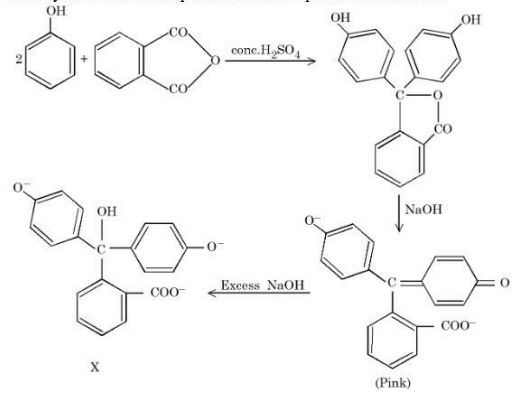 JEE Mains 2026 Medium
- A small bob of mass 100 mg and charge \(+10 \mu \mathrm{C}\) is connected to an insulating string of length 1 m. It is brought near to an infinitely long nonconducting sheet of charge density ' \(\sigma\) ' as shown in figure. If string subtends an angle of \(45^{\circ}\) with the sheet at equilibrium the charge density of sheet will be :
(Given, \(\varepsilon_0=8.85 \times 10^{-12} \frac{\mathrm{~F}}{\mathrm{~m}}\) and acceleration due to gravity, \(g=10 \mathrm{~m} / \mathrm{s}^2\))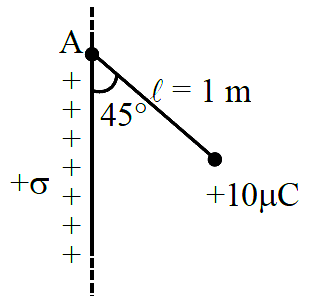 JEE Mains 2025 Medium