


JEE Mains · Chemistry · STD 12 - Electrochemistry
- JEE Mains 2026
- Easy
- Numerical
A volume of \(x mL\) of \(5 M NaHCO _3\) solution was mixed with 10 mL of \(2 M H _2 CO _3\) solution to make an electrolytic buffer. If the same buffer was used in the following electrochemical cell to record a cell potential of 235.3 mV , then the value of \(x =\)__________ mL (nearest integer).
\(Sn ( s )\left| Sn ( OH )_6^{2-}(0.5 M )\right| HSnO _2^{-}(0.05 M ) \mid OH ^{-} \left| Bi _2 O _3(s)\right| Bi ( s )\)
Consider upto one place of decimal for intermediate calculations
\(\left[\begin{array}{ll}\text { Given : } & E _{ HSnO _2^{-} \mid Sn ( OH )_6^{2-}}^{ o }=-0.9 V \\ & E _{ Bi _2 O _3 \mid Bi }^{ o }=-0.44 V \\ & pKa _{\left( H _2 CO _3\right)}=6.11 \\ & \frac{2.303 RT }{ F }=0.059 V \\ &\operatorname{Antilog}(1.29)=19.5\end{array}\right]\)
Pick an option to check your answer.
Answer & Solution
Correct Answer
(C) 78
Step-by-step Solution
Detailed explanation
We have considered
\(E _{\left[ Sn ( OH )_6\right]^{2-} / HSnO _2^{-}}^{ o }=-0.9 V\)
\(Pt \left| HSnO _2^{-}(aq ),\left[ Sn ( OH )_6\right]^{2-}( aq ), OH ^{-}( aq )\right| Bi _2 O _3(s) \\ | Bi ( s )|\)
\(\quad \quad\quad0.5 M \quad\quad\quad 0.05 M\)
\(E _{\text {cell }}^{\circ}=+0.9-0.44=0.46 V\)
Oxidation Half :
\(HSnO _2^{-}+ H _2 O +3 OH ^{-} \rightarrow\left[ Sn ( OH )_6\right]^{2-}+2 e ^{-}\)
Reduction Half :
\(\frac{ Bi _2 O _3+3 H _2 O +6 e ^{-} \rightarrow 2 Bi +6 OH ^{-}}{3 HSnO _2^{-}( aq )+ Bi _2 O _3(s)+6 H _2 O +3 OH ^{-}( aq )}\)
\(\rightarrow 3\left[ Sn ( OH )_6\right]^{-}( aq )+2 Bi ( s )\)
\(E _{\text {cell }}= E _{\text {cell }}^{ o }-\frac{0.059}{6} \log \frac{(0.5)^3}{(0.05)^3 \times\left[ OH ^{-}\right]^3}\)
\(0.2353=0.46-\frac{0.059}{6} \times 3 \log \left[\frac{10}{\left[ OH ^{-}\right]}\right]\)
\(\log \left[\frac{10}{ OH ^{-}}\right]=\frac{2 \times 0.2247}{0.059}=7.6\)
\(I + pOH =7.6\)
\(pOH =6.6\)
\(pH =14-6.6=7.4\)
\(pH = pK _{ a _1}+\log \frac{\left[ HCO _3^{-}\right]}{\left[ H _2 CO _3\right]}\)
\(7.4=6.11+\log \frac{5 x}{20}\)
\(1.29=\log \frac{x}{4}\)
\(\frac{x}{4}=19.5\)
\(x=78\)
More questions from Chemistry
- In the following reactions, the total number of oxygen atoms in \(X\) and \(Y\) is \(........\). \(Na _2 O + H _2 O \rightarrow 2 X\) \(Cl _2 O _7+ H _2 O \rightarrow 2 Y\)JEE Mains 2023 Hard
- For the thermal decomposition of reaction AB(g), the following is constructed.
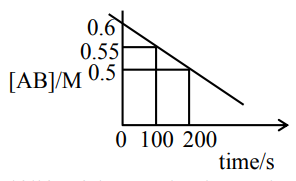
The half life of the reaction is 'x' min.
x =_________ min.(Nearest integer)JEE Mains 2026 Hard - The size of the iso-electronic species \(Cl^-\) , \(Ar\) and \(Ca^{2+}\) is affected byJEE Mains 2019 Easy
- The rate constant of a zero order reaction is \(2.0\times10^{-2}\, mol\, L^{-1}\, s^{-1}\) . If the concentration of the reactant after \(25\, seconds\) is \(0.5\, M\). ......... \(M\) is the initial concentration.JEE Mains 2013 Medium
- Given below are two statements : Statement \(I :\) The limiting molar conductivity of \(\mathrm{KCl}\) (strong electrolyte) is higher compared to that of \(\mathrm{CH}_{3} \mathrm{COOH}\) (weak electrolyte). Statement \(II :\) Molar conductivity decreases with decrease in concentration of electrolyte. In the light of the above statements, choose the most appropriate answer from the options given below:JEE Mains 2021 Hard
- The total number of σ and π bonds in \(2\) -oxohex-\(4\)-ynoic acid is _______.JEE Mains 2024 Medium
More PYQs from JEE Mains
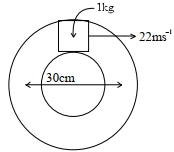
- A closed circular tube of average radius \(15\,cm\), whose inner walls are rough, is kept in vertical plane. A block of mass \(1\,kg\) just fit inside the tube. The speed of block is \(22\,m / s\), when it is introduced at the top of tube. After completing five oscillations, the block stops at the bottom region of tube. The work done by the tube on the block is \(......J\). [Given \(g=10\,m / s ^2\) ]
 JEE Mains 2023 Hard
- An ac circuit has an inductor and a resistor of resistance \({R}\) in series, such that \({X}_{{L}}=3 {R}\). Now, a capacitor is added in series such that \({X}_{{C}}=2 {R}\). The ratio of new power factor with the old power factor of the circuit is \(\sqrt{5}: {x}\). The value of \({x}\) is ...... .JEE Mains 2021 Medium
- A plano-convex lens (focal length \(f_2,\) refractive index \(\mu _2,\) radius of curvature \(R\) ) fits exactly into a plano-concave lens (focal length \(f_1,\) refractive index \(\mu _1,\) radius of curvature \(R\) ). Their plane surfaces are parallel to each other. Then, the focal length of the combination will beJEE Mains 2019 Medium
- A parallel beam of light travelling in air (refractive index 1.0) is incident on a convex spherical glass surface of radius of curvature 50 cm . Refractive index of glass is 1.5 . The rays converge to a point at a distance x cm from the centre of the curvature of the spherical surface. The value of x is __________ cm.JEE Mains 2026 Medium
- A certain gas is isothermally compressed to \(\left(\dfrac{1}{3}\right)^{rd}\) of its initial volume (\(V_o = 3\) litre) by applying required pressure. If the bulk modulus of the gas is \(3 \times 10^5\) N/m\(^2\), the magnitude of work done on the gas is _______ J.JEE Mains 2026 Hard
- The displacement of a particle executing SHM is given by \(x=10 \sin \left(\omega t+\frac{\pi}{3}\right) \mathrm{m}\). The time period of motion is \(3.14 \mathrm{~s}\). The velocity of the particle at \(\mathrm{t}=0\) is_________ \(\mathrm{m} / \mathrm{s}\).JEE Mains 2024 Hard