


JEE Mains · Chemistry · STD 12 - Electrochemistry
- JEE Mains 2026
- Medium
- MCQ
An electrochemical cell is constructed using half cells in the direction of spontaneous change
\(Fe(OH)_2(s) + 2e^- \rightarrow Fe(s) + 2OH^-(aq) \quad E^\theta = -0.88\) V
and \(AgBr(s) + e^- \rightarrow Ag(s) + Br^-(aq) \quad E^\theta = +0.07\) V
Which of the following option is correct?
Pick an option to check your answer.
Answer & Solution
Correct Answer
(A) Overall reaction \(Fe(s) + 2OH^-(aq) + 2AgBr(s) \rightleftharpoons Fe(OH)_2(s) + 2Ag(s) + 2Br^-(aq)\)
Step-by-step Solution
Detailed explanation
For a spontaneous reaction, the cell potential \(E^{\theta}_{cell}\) must be positive. The half-cell with the higher standard reduction potential acts as the cathode (reduction), and the one with the lower standard reduction potential acts as the anode (oxidation).
Given standard reduction potentials:
\(E^{\theta}_{AgBr/Ag} = +0.07\) V
\(E^{\theta}_{Fe(OH)_2/Fe} = -0.88\) V
Since \(+0.07\) V \(> -0.88\) V, \(AgBr\) undergoes reduction at the cathode and \(Fe\) undergoes oxidation at the anode.
Cathode reaction: \(2AgBr(s) + 2e^{-} \rightarrow 2Ag(s) + 2Br^{-}(aq)\)
Anode reaction: \(Fe(s) + 2OH^{-}(aq) \rightarrow Fe(OH)_2(s) + 2e^{-}\)
Overall cell reaction:
\(Fe(s) + 2OH^{-}(aq) + 2AgBr(s) \rightleftharpoons Fe(OH)_2(s) + 2Ag(s) + 2Br^{-}(aq)\)
Standard cell potential:
\(E^{\theta}_{cell} = E^{\theta}_{cathode} - E^{\theta}_{anode} = 0.07 - (-0.88) = +0.95\) V
\(E^{\theta}_{cell}\) is an intensive property, and \(Fe\) is oxidized in the cell. Thus, only the overall reaction given in the first option is correct.
Answer: Overall reaction \(Fe(s) + 2OH^-(aq) + 2AgBr(s) \rightleftharpoons Fe(OH)_2(s) + 2Ag(s) + 2Br^-(aq)\)
More questions from Chemistry
- Among the following species the one which causes the highest \(CFSE,\,\,\Delta _0\) as a ligand isJEE Mains 2014 Hard
- Identify the reaction which does not liberate hydrogenJEE Mains 2016 Medium
- The sum of sigma \((\sigma)\) and pi \((\pi)\) bonds in Hex-1,3-dien-5-yne is _______.JEE Mains 2025 Medium
- \(\mathrm{PCl}_{5}(g) \rightarrow \mathrm{PCl}_{3}(\mathrm{~g})+\mathrm{Cl}_{2}(\mathrm{~g})\) In the above first order reaction the concentration of \(\mathrm{PCl}_{5}\) reduces from initial concentration \(50\, mol\,\mathrm{L}^{-1}\) to \(10\, \mathrm{~mol} \,\mathrm{~L}^{-1}\) in \(120\, minutes\) at \(300\, \mathrm{~K}\). The rate constant for the reaction at \(300\, \mathrm{~K}\) is \(\mathrm{X}\) \(\times 10^{-2} \mathrm{~min}^{-1}\). The value of \(x\) is \(......\) \([\) Given \(\log 5=0.6989]\)JEE Mains 2021 Hard
- Consider the following redox reaction : \(\mathrm{MnO}_4^{-}+\mathrm{H}^{+}+\mathrm{H}_2 \mathrm{C}_2 \mathrm{O}_4 \rightleftharpoons \mathrm{Mn}^{2+}+\mathrm{H}_2 \mathrm{O}+\mathrm{CO}_2\) The standard reduction potentials are given as below \(\left(\mathrm{E}_{\mathrm{red}}^{\circ}\right)\) \(\mathrm{E}_{\mathrm{MmO}_4^{-} / \mathrm{Mm}^{2+}}^{\circ}=+1.51 \mathrm{~V}\) \(\mathrm{E}_{\mathrm{CO}_2 / \mathrm{H}_2 \mathrm{C}_2 \mathrm{O}_4}^{\circ}=-0.49 \mathrm{~V}\) If the equilibrium constant of the above reaction is given as \(K_{\text {eq }}=10^x\), then the value of \(x=\)_______. (nearest integer)JEE Mains 2024 Hard
- A gas undergoes change from state \(A\) to state \(B\). In this process, the heat absorbed and work done by the gas is \(5\, J\) and \(8\, J\), respectively. Now gas is brought back to \(A\) by another process during which \(3\, J\) of heat is evolved. In this reverse process of \(B\) to \(A\)JEE Mains 2017 Hard
More PYQs from JEE Mains
- Consider a uniform rod of mass \(\mathrm{M}=4 \mathrm{m}\) and length \(\ell\) pivoted about its centre. A mass \(m\) moving with velocity \(v\) making angle \(\theta=\frac{\pi}{4}\) to the rod's long axis collides with one end of the rod and sticks to it. The angular speed of the rod-mass system just after the collision isJEE Mains 2020 Hard
- If \(50\) Vernier divisions are equal to \(49\) main scale divisions of a travelling microscope and one smallest reading of main scale is \(0.5 \mathrm{~mm}\), the Vernier constant of travelling microscope is _______.JEE Mains 2024 Hard
- Two identical bodies, projected with the same speed at two different angles cover the same horizontal range \(R\). If the time of flight of these bodies are \(5\) s and \(10\) s, respectively, then the value of \(R\) is ________ m. (Take \(g=10\) m/s\(^2\))JEE Mains 2026 Medium
- A resistor dissipates \(192\, {J}\) of energy in \(1\, {s}\) when a current of \(4\, {A}\) is passed through it. Now, when the current is doubled, the amount of thermal energy dissipated in \(5 \,{s}\) in \(.....\,J.\)JEE Mains 2021 Medium
- A capacitor of \(50 \,\mu {F}\) is connected in a circuit as shown in figure. The charge on the upper plate of the capacitor is \(......\,\mu {C} .\)
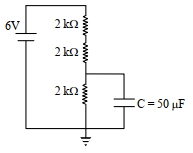 JEE Mains 2021 Medium
- In a plane electromagnetic wave, the directions of electric field and magnetic field are represented by \(\hat{ k }\) and \(2 \hat{ i }-2 \hat{ j },\) respectively What is the unit vector along direction of propagation of the wave.JEE Mains 2020 Medium