


JEE Mains · Chemistry · STD 12 -Solution and colligative properties
- JEE Mains 2026
- Hard
- MCQ
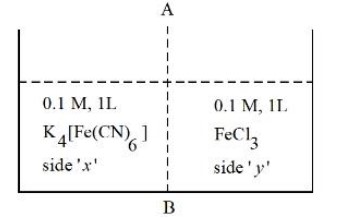
At \(27°\)C, \(0.1\) M, \(1\) L \(K_4[Fe(CN)_6]\) aqueous solution and \(0.1\) M, \(1\) L \(FeCl_3\) aqueous solution are placed in a container separated by a semi permeable membrane AB. Assume complete dissociation of both the solutes. Which of the following statement is correct?
Pick an option to check your answer.
Answer & Solution
Correct Answer
(C) Solution on side '\(y\)' is hypotonic.
Step-by-step Solution
Detailed explanation
For complete dissociation, the van 't Hoff factor \(i\) is equal to the number of ions produced per formula unit.
For side 'x' containing \(K_4[Fe(CN)_6]\):
\(K_4[Fe(CN)_6] \rightarrow 4K^+ + [Fe(CN)_6]^{4-}\)
Number of ions, \(i_x = 5\)
Effective concentration (osmolarity) \(= i_x \times C = 5 \times 0.1 = 0.5\) M
For side 'y' containing \(FeCl_3\):
\(FeCl_3 \rightarrow Fe^{3+} + 3Cl^-\)
Number of ions, \(i_y = 4\)
Effective concentration (osmolarity) \(= i_y \times C = 4 \times 0.1 = 0.4\) M
Since the effective concentration of side 'y' (\(0.4\) M) is less than that of side 'x' (\(0.5\) M), the solution on side 'y' has a lower osmotic pressure and is therefore hypotonic with respect to side 'x'.
Evaluating the other options:
A semi-permeable membrane (SPM) only allows solvent molecules to pass, not solute ions. Thus, \(Fe^{3+}\) and \([Fe(CN)_6]^{4-}\) cannot mix, and no blue color is formed.
To cause reverse osmosis, the external pressure applied to the hypertonic side (side 'x') must be strictly greater than the osmotic pressure difference (\(\Delta \pi = \pi_x - \pi_y\)), not just any value.
Answer: Solution on side '\(y\)' is hypotonic.
More questions from Chemistry
- Ferrous sulphate heptahydrate is used to fortify foods with iron. The amount (in \(grams\)) of the salt required to achieve \(10 \;ppm\) of iron in \(100 \;\mathrm{kg}\) of wheat is Atomic weight : \(Fe =55.85 ; \mathrm{S}=32.0\) \(\mathrm{O}=16.00\)JEE Mains 2020 Hard
- \(2 \mathrm{MnO}_4^{-}+\mathrm{bI}^{-}+\mathrm{cH}_2 \mathrm{O} \rightarrow \mathrm{xI}_2+\mathrm{yMnO}_2+\mathrm{zOH}^{-}\) If the above equation is balanced with integer coefficients, the value of \(z\) is _______.JEE Mains 2024 Hard
- Molality of an aqueous solution of urea is \(4.44 \mathrm{~m}\). Mole fraction of urea in solution is \(x \times 10^{-3}\). Value of \(x\) is _______. (integer answer)JEE Mains 2024 Medium
- A reagent which gives brilliant red precipitate with Nickel ions in basic medium is _______.JEE Mains 2024 Medium
- Chiral complex from the following is : Here en \(=\) ethylene diamineJEE Mains 2023 Medium
- Which of the following tests cannot be used for identifying amino acids?JEE Mains 2019 Medium
More PYQs from JEE Mains
- The total number of lone pairs of electrons on oxygen atoms of ozone is \(...........\).JEE Mains 2023 Medium
- According to molecular orbital theory, the number of unpaired electron(s) in \(\mathrm{O}_{2}^{2-}\) is :JEE Mains 2021 Medium
- Given below are two statements: One is labelled as Assertion \(A\) and the other is labelled as Reason \(R\). Assertion \(A:\) Butan\(-1-\)ol has higher boiling point than ethoxyethane. Reason \(R:\) Extensive hydrogen bonding leads to stronger association of molecules. In the light of the above statements, choose the correct answer from the options given below:JEE Mains 2023 Medium
- \(A \rightarrow B\) (first reaction)
\(C \rightarrow D\) (second reaction)
Consider the above two first-order reactions. The rate constant for first reaction at 500 K is double of the same at 300 K . At \(500 K, 50 \%\) of the reaction becomes complete in 2 hour. The activation energy of the second reaction is half of that of first reaction. If the rate constant at 500 K of the second reaction becomes double of the rate constant of first reaction at the same temperature; then rate constant for the second reaction at 300 K is __________ \(\times 10^{-1}\) hour \(^{-1}\) (nearest integer).JEE Mains 2026 Medium - Which of the following acts as a strong reducing agent? (Atomic number : \(\mathrm{Ce}=58, \mathrm{Eu}=63\), \(\mathrm{Gd}=64, \mathrm{Lu}=71)\)JEE Mains 2024 Hard
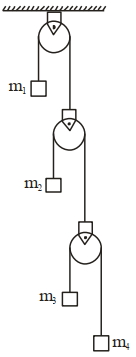
- In the arrangement shown in figure \(a _{1}, a _{2}, a _{3}\) and \(a _{4}\) are the accelerations of masses \(m _{1}, m _{2}, m _{3}\) and \(m _{4}\) respectively. Which of the following relation is true for this arrangement?
 JEE Mains 2022 Hard